






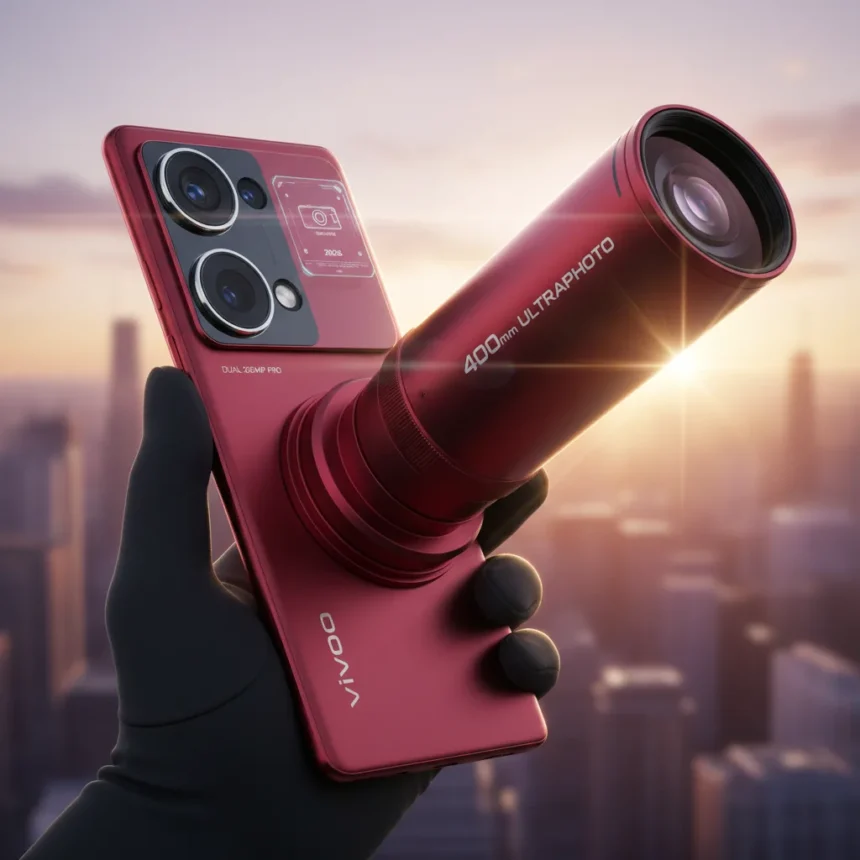
The Vivo X300 Ultra is a flagship smartphone launched in China with a modular camera system that challenges how we think about mobile imaging, featuring dual 200MP sensors, a 400mm telephoto attachment, and professional-grade video capabilities. This is not just another flagship with impressive specs—it is a deliberate attempt to blur the line between smartphone and dedicated camera.
Key Takeaways
- Vivo X300 Ultra pairs a 200MP main sensor with a 200MP periscope telephoto and detachable 400mm lens attachment.
- Snapdragon 8 Elite Gen 5 processor powers the device with 12GB RAM and 256GB storage.
- Full-chain 4K 120fps 10-bit Log video recording enables professional post-production workflows.
- 6.82-inch 2K AMOLED display with 120Hz/144Hz refresh rate and Dolby Vision support.
- Expected India launch at ₹80,999–₹85,999 with premium Green Edition design.
Vivo X300 Ultra Camera System: The 400mm significant shift
The Vivo X300 Ultra’s imaging setup is where this phone earns its flagship status. The main sensor is a 200MP Sony LYTIA-901 with a 1/1.12-inch sensor size—significantly larger than competitors—delivering a 30% increase in single-pixel light-sensitive area and 32% improved full-well capacity. This translates to better low-light performance and more color information per pixel, a measurable advantage over typical flagship sensors.
The periscope telephoto camera matches the main sensor at 200MP, incorporating a 3-degree micro-gimbal OIS system that increases light intake by 300% and improves telephoto video stability by 24%. But the real headline is the detachable 400mm telephoto lens attachment. This accessory extends the phone’s zoom range into territory typically reserved for dedicated cameras, making it genuinely useful for wildlife, sports, and distant subjects where digital zoom alone fails.
The ultra-wide camera rounds out the trio with a 50MP sensor (1/1.28-inch) and CIPA 6.0 stabilization for steady video and handheld shooting. For selfies, a 50MP front camera handles 4K@60fps recording. This is a complete imaging ecosystem, not a gimmick—the telephoto attachment fills a real gap in mobile photography where optical zoom maxes out at 10x on most flagships.



Video Capabilities That Challenge Dedicated Cameras
The Vivo X300 Ultra supports 8K@30fps recording and full-focal-length 4K 120fps 10-bit Log recording with 10-bit 422 APV encoding. For context, Log recording is a flat color profile used in professional filmmaking to preserve maximum dynamic range during post-production grading. Most smartphones capture 8-bit video—this phone’s 10-bit pipeline is rare in mobile devices and signals serious intent toward creators who edit on desktop.
Quad microphones enhance audio capture across different recording scenarios, while an Imaging + AI dual-core engine with a 30-billion-parameter framework powers the AI Creative Camera suite. These AI features handle computational photography tasks like scene recognition, automatic white balance, and detail enhancement—features that increasingly matter for users who want professional output without professional editing skills.



Performance and Design: Built for Demanding Workflows
The Snapdragon 8 Elite Gen 5 processor with Adreno 840 GPU handles the computational load of processing 200MP images and 4K 120fps video without dropping frames. Paired with 12GB LPDDR5X RAM and 256GB UFS 4.1 storage, the Vivo X300 Ultra has the memory bandwidth and speed needed for real-time processing and fast file transfers.
The display is a 6.82-inch 2K AMOLED panel with 120Hz or 144Hz refresh rate options, LTPO technology for dynamic refresh scaling, and Dolby Vision support. For photographers and videographers, accurate color reproduction and high refresh rates matter—this screen delivers both. The device supports NFC and includes a 7000mAh or 6600mAh battery (specs vary by source) with 100W wired charging and 40W wireless charging.
Unlike most camera-focused flagships that prioritize thickness, the Vivo X300 Ultra maintains a slim profile while housing this imaging arsenal—a design achievement that matters for daily usability. The rumored Premium Green Edition suggests Vivo is treating this as a lifestyle device, not just a tool.
How the Vivo X300 Ultra Compares to Competitors
Most flagship phones cap optical zoom at 5x to 10x. The Vivo X300 Ultra‘s 400mm attachment extends that range dramatically, offering capabilities that rival compact cameras without the extra device. Samsung’s Galaxy S25 Ultra and Apple’s iPhone 16 Pro Max offer strong telephoto performance, but neither includes a modular zoom attachment. This modularity is the Vivo X300 Ultra’s differentiator—users can leave the attachment at home for casual shooting or bring it when they know they need extreme zoom.



The dual 200MP sensor approach is also less common than flagship competitors’ mixed-resolution strategies. Most phones pair a high-resolution main sensor with lower-resolution secondary cameras. Vivo’s choice to match both main and telephoto at 200MP simplifies the computational pipeline and ensures consistent detail across zoom ranges—a philosophy borrowed from dedicated camera design.
Pricing and Availability
The Vivo X300 Ultra launched in China and is expected to reach India at ₹80,999–₹85,999 (approximately $970–$1,030 USD). At this price point, it undercuts the Samsung Galaxy S25 Ultra and iPhone 16 Pro Max in many markets, making the advanced imaging system more accessible to enthusiasts who prioritize cameras over ecosystem lock-in.
Is the Vivo X300 Ultra worth buying for mobile photography?
If you shoot video regularly or need extreme optical zoom, yes. The 400mm attachment and Log video recording are features most creators only get on dedicated equipment. For casual smartphone photographers, the main 200MP sensor and periscope telephoto deliver excellent results without the attachment. The real question is whether you value modularity and professional video tools enough to commit to Vivo’s ecosystem.
How does the 400mm telephoto attachment compare to digital zoom?
Digital zoom crops and interpolates pixels, degrading detail and introducing noise. The 400mm attachment uses true optics to capture light from distant subjects, preserving sharpness and color accuracy. For any subject beyond 10x zoom, the attachment will outperform even AI-enhanced digital zoom on competing flagships.
What makes the Vivo X300 Ultra’s sensor different from other flagship phones?
The Sony LYTIA-901 sensor is a custom design for Vivo with a larger 1/1.12-inch size, 30% more light-sensitive area per pixel, and 32% improved full-well capacity compared to typical flagship sensors. These aren’t marketing claims—they are measurable physics improvements that directly reduce noise in shadows and improve dynamic range in bright conditions.
The Vivo X300 Ultra arrives at a moment when smartphone cameras are reaching a plateau of incremental improvement. By adding a modular telephoto lens and professional video tools, Vivo is sidesteping that plateau and redefining what a flagship camera phone can do. Whether that innovation justifies the price depends on whether you actually need 400mm zoom and 10-bit Log recording—but for creators and enthusiasts, this phone is a genuine step forward in mobile imaging.
This article was written with AI assistance and editorially reviewed.
Source: TechRadar