





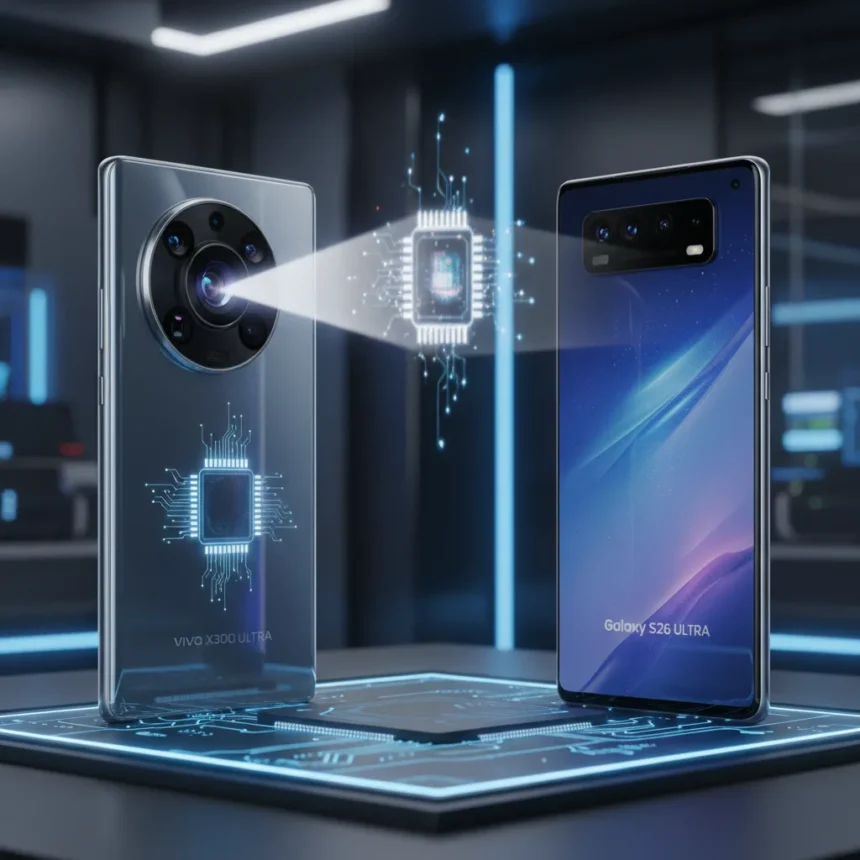
The Vivo X300 Ultra is a flagship smartphone powered by Qualcomm’s Snapdragon 8 Elite Gen 5 chipset, launched on March 30, 2026, in China. This device arrives with camera technology and display specifications that fundamentally challenge Samsung’s unreleased Galaxy S26 Ultra before it even reaches the market.
Key Takeaways
- Vivo X300 Ultra launches March 30, 2026, with Snapdragon 8 Elite Gen 5 and 144Hz 6.82-inch display
- Features world’s first Blueprint × Sony LYTIA-901 main sensor with 30% larger light-sensitive area and 32% improved full-well capacity
- 200MP telephoto with 3-degree micro-gimbal OIS enables 300% more light intake and 24% better video stability
- Supports full-focal-length 4K 120fps 10-bit Log video with 10-bit 422 APV encoding for professional workflows
- Available in China only at launch; no global release date confirmed
Camera System Redefines Mobile Photography
The Vivo X300 Ultra’s camera setup is where this phone genuinely separates itself from competitors. The main sensor—a Blueprint × Sony LYTIA-901—represents a significant leap in mobile imaging hardware. With a 1/1.12-inch sensor size, it delivers a 30% larger single-pixel light-sensitive area and 32% improved full-well capacity compared to conventional flagship sensors. This matters because larger light-sensitive pixels capture more photons, translating to cleaner images in low light and richer color information across all conditions.
The telephoto lens amplifies this advantage. At 200MP with a 3-degree micro-gimbal OIS system, it achieves 300% more light intake than traditional telephoto designs and 24% better video stabilization. The micro-gimbal—a precision mechanical system that shifts the entire lens element to counteract motion—is typically reserved for cinema cameras and high-end mirrorless systems. Vivo’s implementation here brings that level of stabilization to a smartphone form factor. The lens also supports 200mm and 400mm teleconverters, enabling optical reach that few phones can match.
What truly distinguishes the Vivo X300 Ultra is its video codec support. The phone captures full-focal-length 4K at 120fps in 10-bit Log format with 10-bit 422 APV encoding. This means creators can shoot content directly on the phone with the color depth and dynamic range previously available only in dedicated cinema cameras, eliminating the need for external recorders on many productions. The ultra-wide camera pairs a 1/1.28-inch sensor with CIPA 6.0 stabilization, ensuring edge-to-edge stability even in demanding handheld scenarios.


Performance and Display: Overkill or Necessary?
The Snapdragon 8 Elite Gen 5 chipset powers the Vivo X300 Ultra with an octa-core configuration: dual-core running at 4.61 GHz plus hexa-core at 3.63 GHz. This is the same flagship processor found in competing devices like the RedMagic 11 Pro, but Vivo’s implementation benefits from optimized thermal management and the device’s industrial design. The processor handles the phone’s AI Creative Camera engine—a 30-billion-parameter imaging and AI system—without throttling, enabling real-time computational photography and video enhancement.
The 6.82-inch BOE display runs at 144Hz with WQHD+ resolution (1440 x 3168 pixels), delivering 511 ppi pixel density across a flat panel. The 20:9 aspect ratio skews tall, prioritizing screen real estate for content consumption. For comparison, the Galaxy S26 Ultra has not yet launched, but Samsung’s S25 Ultra uses a 6.9-inch curved AMOLED at 120Hz. The Vivo’s flat panel eliminates edge glare and distortion that curved screens introduce, a preference among professionals who rely on color accuracy. The 144Hz refresh rate targets gaming and scrolling smoothness, though the practical difference between 120Hz and 144Hz remains subtle for most daily tasks.



RAM options include 12GB or 16GB configurations with 512GB storage. Battery capacity is reported as 6600mAh with 100W fast charging. A 6600mAh battery in a flagship phone is substantial—larger than most competitors—and combined with the efficient Snapdragon 8 Elite Gen 5, should deliver full-day endurance without aggressive power management.
Design and Availability: China-First Strategy
Vivo’s design philosophy for the X300 Ultra emphasizes visual distinctiveness. The phone features a two-tone green colorway with a large circular rear camera module, a signature design element carried forward from prior X300 generations. This circular camera housing is not merely aesthetic—it accommodates the oversized sensors and gimbal mechanisms without creating awkward camera bumps. The design launched first at MWC 2026 in the premium Green Edition variant.
The critical limitation: the Vivo X300 Ultra is a China-exclusive launch as of March 30, 2026, with no confirmed global release date. This is typical for Vivo’s flagship X-series phones, which prioritize the Chinese market where the company commands significant market share. International availability remains uncertain, though the companion Vivo X300s—powered by MediaTek’s Dimensity 9500 and featuring a 200MP Zeiss camera with 7100mAh battery—may eventually reach global markets.
How does the Vivo X300 Ultra compare to the Galaxy S26 Ultra?
The Vivo X300 Ultra’s main sensor (1/1.12-inch with 30% larger light-sensitive area) and micro-gimbal telephoto represent hardware advantages the Galaxy S26 Ultra has not yet demonstrated. Samsung’s S25 Ultra uses a 1/1.56-inch main sensor and conventional telephoto OIS. Without the S26 Ultra’s final specifications, direct comparison is speculative, but Vivo’s sensor innovations and 10-bit 422 video encoding place it ahead of current Samsung flagships.



When does the Vivo X300 Ultra launch globally?
The Vivo X300 Ultra launches on March 30, 2026, in China. No global release date or international availability has been announced. Interested buyers outside China will likely need to import the device or wait for regional variants, which historically take months to materialize for Vivo’s X-series phones.
What makes the camera sensor revolutionary?
The Blueprint × Sony LYTIA-901 sensor combines a larger 1/1.12-inch size with improved full-well capacity (32% better than conventional sensors) and larger light-sensitive pixels. This allows the phone to capture more light information, resulting in superior low-light performance and richer color depth. Paired with the micro-gimbal telephoto and 10-bit video encoding, the system rivals professional cinema cameras for image quality.
The Vivo X300 Ultra is unquestionably a powerhouse flagship that arrives with genuine technical innovations—particularly in camera hardware and video encoding—that position it ahead of Samsung’s unreleased S26 Ultra. The catch is simple: it’s locked to China. For buyers with access to the Chinese market, the X300 Ultra represents the most advanced mobile imaging system available today. For everyone else, it remains a tantalizing glimpse of what flagship phones can achieve when manufacturers prioritize image quality and video workflows over mass-market appeal.
Edited by the All Things Geek team.
Source: Android Central




