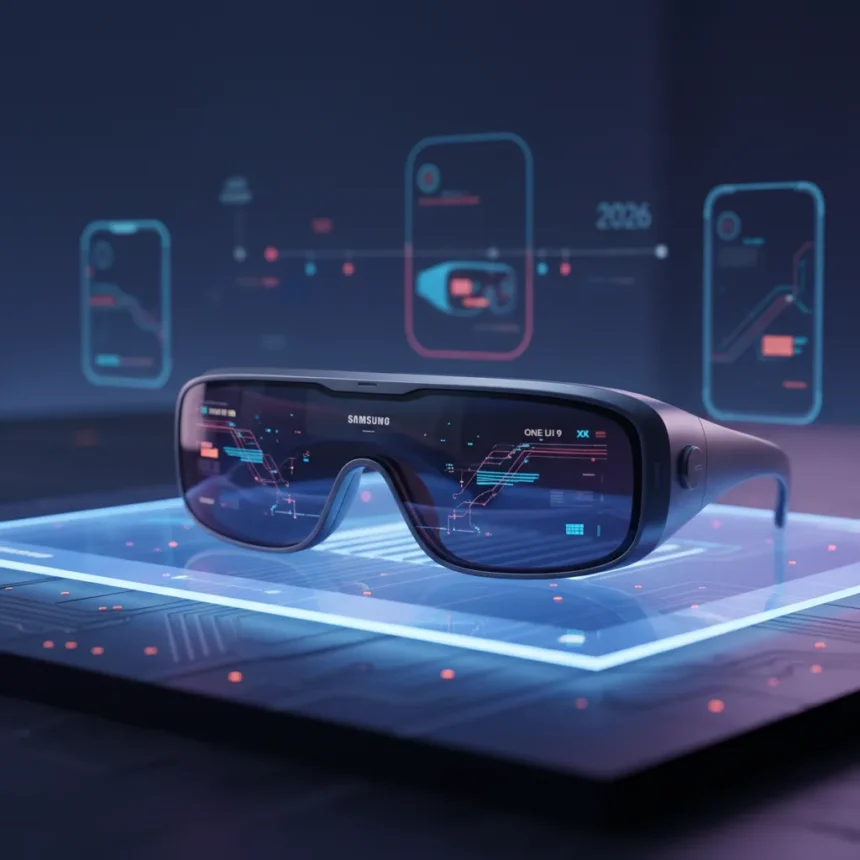
Samsung XR smart glasses are no longer just a rumour. Three distinct models have surfaced inside an early One UI 9 build and a Companion Device Manager APK, confirming that Samsung’s glasses ambitions extend well beyond the Galaxy XR headset that launched in December 2025. With a 2026 launch window now confirmed by Samsung, the company is preparing to challenge Meta’s dominance in the smart glasses market on multiple fronts simultaneously.
Key Takeaways
- Three Samsung smart glasses models are in development: SM-O200P, SM-O200J (codenamed Jinju), and SM-O500 (codenamed Haean).
- The SM-O200 variants resemble Meta Ray-Ban glasses, with camera, microphones, and speakers but no built-in display.
- The more advanced Haean model was originally rumoured for 2025 but was delayed; it has now reappeared in One UI 9 source code.
- Galaxy Glasses icons appeared in One UI 8.5 and a test One UI 9 build running on the Galaxy S26, including find-my-device functionality.
- Samsung has confirmed a 2026 launch window, potentially in the second half of the year, with second-generation AR glasses planned for 2027.
What the One UI 9 Code Actually Reveals About Samsung XR Smart Glasses
The reappearance of Samsung XR smart glasses in One UI 9 source code is the clearest signal yet that a launch is genuinely imminent. Galaxy Glasses icons showed up in the Companion Device Manager APK alongside a test One UI 9 build on the Galaxy S26, and the integration already includes find-my-device functionality — the kind of polish that does not appear in code unless a product is approaching release.
What makes this discovery particularly significant is the model lineup it confirms. The SM-O200P and SM-O200J (Jinju) are the simpler pair: no built-in display, but equipped with a camera, microphones, and speakers, putting them squarely in the same category as Meta’s Ray-Ban smart glasses. The SM-O500, codenamed Haean, carries a higher model number, which typically signals more advanced hardware. Whether that means an in-lens AR display similar to the Meta Ray-Ban Display, or something closer to a lightweight AR headset competing with a cheaper Apple Vision Pro alternative, remains genuinely unclear.
How Samsung’s Glasses Stack Up Against Meta Ray-Ban
The SM-O200 variants are Samsung’s most direct answer to Meta’s Ray-Ban collaboration with EssilorLuxottica. Both offer camera, audio, and AI assistant integration without a display — the form factor that has proven most commercially viable in smart glasses so far. Samsung’s key differentiator is ecosystem integration: the glasses are expected to work tightly with the Galaxy device range and will reportedly use a Perplexity-powered version of Bixby as the onboard AI assistant.


That Bixby angle is worth watching. Meta’s Ray-Ban glasses use Meta AI, which has the advantage of drawing on one of the world’s largest social graphs. Bixby, powered by Perplexity’s search and answer engine, could offer a genuinely different approach — more focused on real-time information retrieval than social context. Whether that translates into a better daily-use experience depends entirely on execution, and Samsung’s track record with Bixby gives reason for cautious optimism rather than enthusiasm.
The Haean model is harder to position competitively because its feature set is still unclear. If it does include an in-lens AR display, it would sit above the Ray-Ban tier and potentially below the XReal Project Aura, which runs Android XR with a 70-degree field of view. That would give Samsung a three-tier glasses strategy: entry-level audio glasses, mid-range display glasses, and the full Galaxy XR mixed reality headset that already launched in December 2025.


Why the 2025 Delay Actually Matters for the 2026 Launch
Haean was originally rumoured to launch in 2025 alongside the Galaxy XR headset. It did not. That delay is not just a scheduling footnote — it suggests Samsung made a deliberate decision to hold the glasses back, possibly to refine the hardware, avoid cannibalising the headset launch, or wait for Android XR to mature as a platform.
The fact that Haean has now resurfaced in One UI 9 code, rather than being quietly cancelled, is the more important story. Samsung confirmed a 2026 launch window, with the second half of the year cited as the likely timeframe. A second generation of more advanced AR glasses with a built-in display is already planned for 2027, which means the 2026 models are essentially the first wave of a multi-year platform strategy, not a one-off product.
All three glasses models are expected to run Android XR, likely a stripped-down version optimised for lower power consumption. That matters because Android XR is a shared platform — the same operating system running the Galaxy XR headset and XReal’s Project Aura — which means app developers can theoretically target all these devices from a single codebase. That ecosystem coherence is something neither Meta nor Apple currently offers in the same way.
Is Samsung’s 2026 smart glasses launch confirmed?
Samsung has confirmed a 2026 launch window for its smart glasses lineup, with the second half of 2026 cited as the likely timeframe. Three models are in development, though exact launch dates and pricing have not been announced.



How do Samsung’s planned glasses differ from Meta Ray-Ban?
The SM-O200 variants are direct competitors to Meta Ray-Ban glasses, offering camera, microphones, and speakers without a built-in display. Samsung’s key differentiator is Galaxy ecosystem integration and a Perplexity-powered Bixby AI assistant rather than Meta AI.
What is the Haean model and why is it interesting?
Haean (SM-O500) is Samsung’s more advanced glasses model, carrying a higher model number than the SM-O200 variants. It may include an in-lens AR display or other premium features, though Samsung has not confirmed specifics. It was delayed from a 2025 launch and has now reappeared in One UI 9 source code.
Samsung’s smart glasses strategy is shaping up to be more ambitious than most people expected. Three models, a confirmed 2026 window, a 2027 second generation already in planning, and deep Android XR integration — this is not a company testing the waters. The real question is whether Samsung can execute on a product category where even Meta, with years of head start and Ray-Ban’s brand muscle, is still working out what consumers actually want from glasses that do more than just sit on their face.
Edited by the All Things Geek team.
Source: Android Central