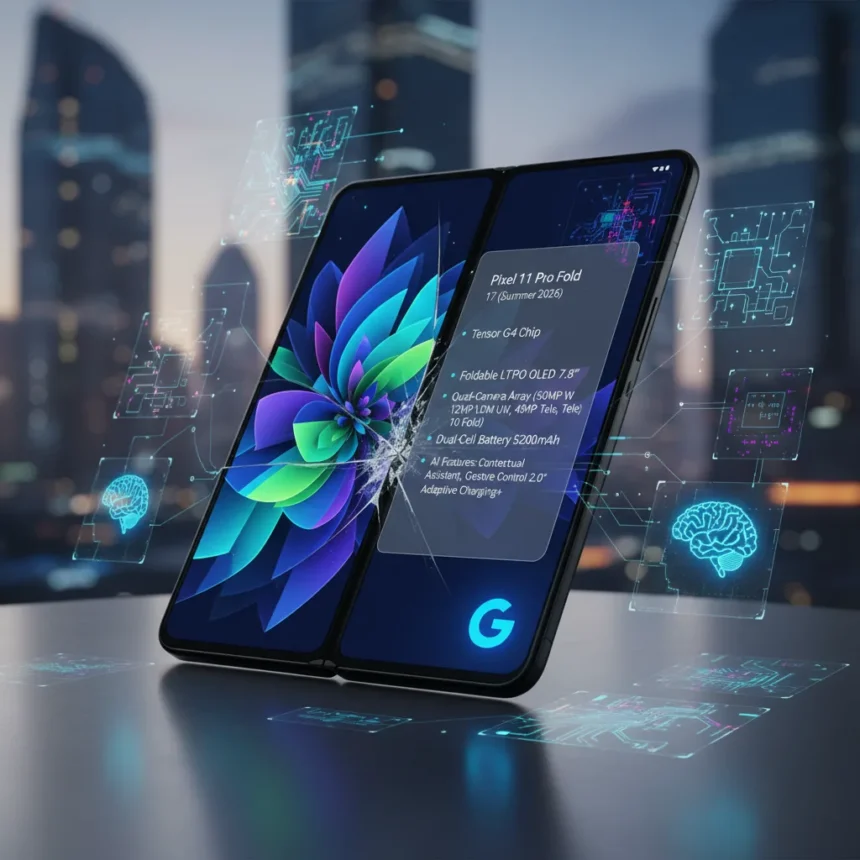
The Pixel 11 Pro Fold is Google’s next-generation foldable phone, expected to launch in summer 2026, and its specs just leaked through an early Android 17 preview build. Software engineer Dylan Roussel and researcher @evowizz discovered wallpaper thumbnails and codename references embedded in Android 17 Beta 4 or QPR1 Beta, offering the first official hints at what Google is building. The leak reveals a thinner, lighter device powered by Tensor G6, packed with new Gemini AI features, and running Android 17 out of the box.
Key Takeaways
- Pixel 11 Pro Fold wallpapers “Tidal Swirl” and “Lunar Tides” discovered in Android 17 preview build with video animations
- Tensor G6 chip (2nm or 3nm process) with Titan M3 security chip and 16GB RAM confirmed
- Thinner design: folded 10.1mm (vs 10.5mm prior), unfolded 4.8mm (vs 5.2mm prior)
- 8-inch inner display and 6.4-inch outer display with potential brightness/width improvements
- Camera setup: 48MP main, 10.5MP ultrawide, 10.8MP 5x telephoto, dual 10MP selfies with 100x zoom via machine learning
- IP68 dust and water resistance, 5,015mAh+ battery with 30W wired and 15W wireless (Qi2) charging
- Gemini AI integration, Advanced Voice Typing, translation, Add Me, Camera Coach, and Best Take features
Pixel 11 Pro Fold hardware specs and design changes
The Pixel 11 Pro Fold will ship with Google’s Tensor G6 processor built on either a 2nm or 3nm process, paired with a Titan M3 security chip and 16GB of RAM. Storage options span 256GB, 512GB, and 1TB. The battery capacity exceeds 5,015mAh, supporting 30W wired charging and 15W wireless charging with Qi2 compatibility. The device earns an IP68 rating for dust and water resistance—a meaningful advantage over Samsung’s foldables, which lack this protection.
Design refinements make the Pixel 11 Pro Fold noticeably thinner and lighter than its predecessor. The folded thickness drops to 10.1mm from the prior 10.5mm, while the unfolded thickness shrinks to 4.8mm from 5.2mm. The phone retains an aluminum and glass construction without major design overhauls, but the reduced bulk should improve everyday handling. Some leaks suggest the ultrawide and telephoto cameras may jump to higher megapixel counts, though this remains unconfirmed.
The dual displays measure 8 inches internally and 6.4 inches externally. The outer screen may be brighter and wider than the current generation, making it more usable for single-handed tasks. An infrared sensor resembling Apple’s Face ID technology may debut on the Pixel 11 Pro Fold, enabling low-light facial recognition similar to iPhone systems.


Camera system and AI photography features
Google is equipping the Pixel 11 Pro Fold with a sophisticated camera array: a 48MP main sensor, 10.5MP ultrawide, and a 10.8MP 5x telephoto on the back, plus dual 10MP selfie cameras (one on the outer screen, one under the inner display). The system supports 100x zoom via machine learning rather than pure optical zoom, and Cinematic Blur will capture 4K video at 30 frames per second. Pixelsnap support is also confirmed.
Android 17 will introduce several AI-powered photography features exclusive to Pixel devices. Add Me lets users insert themselves into group photos after the shot is taken, while Camera Coach provides real-time guidance for composition and lighting. Best Take scans burst shots to suggest the sharpest or most flattering frame. Rear Camera Selfie Preview allows you to use the powerful rear cameras for selfies on the inner display—a feature particularly useful on a foldable where the inner selfie camera is less versatile.



Android 17 and Gemini AI integration
The Pixel 11 Pro Fold will ship with Android 17, bringing deep Gemini AI integration across the system. Gemini Live enables conversational interactions with Google’s AI assistant, while Nano runs on-device AI for offline functionality without cloud dependency. Advanced Voice Typing improves speech-to-text accuracy, and built-in translation features will handle real-time language conversion.
A potential Pixel Glow feature discovered in Android 17 Beta 4 may debut on the Pixel 11 Pro Fold, though its inclusion on the foldable remains uncertain. This feature would add ambient notifications or visual feedback to the device’s edges—a feature more practical on a traditional phone form factor than a foldable, where the hinge occupies the center.
Wallpaper leak and codename details
The Android 17 preview contained two wallpapers specifically coded for the Pixel 11 Pro Fold: “Tidal Swirl” and “Lunar Tides”. Tidal Swirl uses the Pine codename and displays a monochrome aerial delta view, while Lunar Tides uses the Midnight codename and shows a green aerial delta view. Both feature video animations and carry the description: “Streaming waters swirl and flow through curving, rugged landscapes”. These codenames may not match the final color branding at launch, but they hint at Google’s aesthetic direction.
How does the Pixel 11 Pro Fold compare to Samsung foldables?
Samsung’s Galaxy Z Fold 6 and Z Fold Ultra dominate the foldable market with the Snapdragon 8 Elite Gen 5 processor, delivering superior raw performance. However, the Pixel 11 Pro Fold’s IP68 rating gives it a durability edge—Samsung foldables lack dust and water resistance, making them riskier in wet environments or sandy locations. Google’s Pixel ecosystem also offers deeper customization and tighter software integration, whereas Samsung relies on One UI overlays that some users find bloated.



When will the Pixel 11 Pro Fold launch?
Google is expected to announce the Pixel 11 Pro Fold in summer 2026, likely during an August event. The leak through Android 17 preview builds is typical of Google’s development cycle—early hardware details often surface in beta software months before official unveiling. No verified pricing exists yet, but expect flagship foldable pricing in line with the Pixel 10 Pro Fold.
Is the Pixel 11 Pro Fold worth waiting for?
The Pixel 11 Pro Fold promises meaningful upgrades: a thinner, lighter frame, improved displays, Tensor G6 performance, and deeper Gemini AI integration. If you value photography, on-device AI, and ecosystem cohesion over raw processor power, the Pixel 11 Pro Fold will be compelling. However, the design refinements are incremental rather than revolutionary—the phone may feel underwhelming to Pixel 10 Pro Fold owners. Samsung foldables currently offer more power-hungry performance, so the choice depends on whether you prioritize Google’s software polish or peak benchmark scores.
Will the Pixel 11 Pro Fold have Face ID?
An infrared sensor rumored for the Pixel 11 Pro Fold may enable Face ID-like facial recognition, matching iPhone technology and working reliably in low light. This would be a significant upgrade over traditional fingerprint sensors, especially useful on a foldable where the inner display’s selfie camera is less practical for biometric verification.
The Pixel 11 Pro Fold‘s leaked specs paint a picture of a refined, AI-centric foldable that prioritizes durability, software innovation, and photography over raw horsepower. Google is clearly betting that Gemini AI, Android 17 features, and thoughtful hardware tweaks will appeal to power users who value customization and ecosystem depth. The summer 2026 launch is still months away, but this early leak confirms Google is pushing the foldable category forward—even if the steps are measured rather than revolutionary.
Where to Buy
Edited by the All Things Geek team.
Source: Android Central