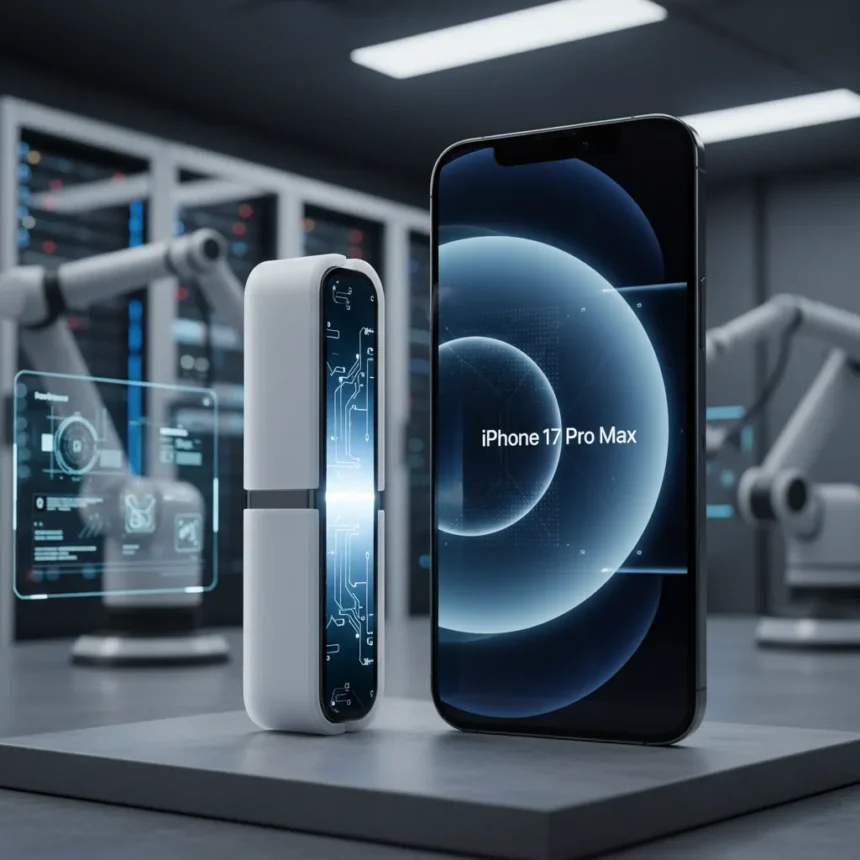
The iPhone Fold design is finally getting a real-world size check, and it’s nothing like what foldable phones have conditioned us to expect. A 3D-printed dummy created by Ben Geskin based on the latest rumors reveals a device that’s shockingly compact when folded—shorter than the iPhone 17 Pro Max despite unfolding to a much larger screen. This isn’t just a minor dimensional tweak; it represents Apple’s fundamental rethinking of how a foldable phone should actually feel in your hand.
Key Takeaways
- iPhone Fold measures 5.3 inches folded, 7.7 inches unfolded with 3:2 aspect ratio.
- Folded iPhone Fold is shorter but slightly wider than iPhone 17 Pro Max.
- iPhone Fold rumored to use titanium chassis and silicon carbon battery technology.
- Apple designing iPhone 17 Pro Max thicker to match folded iPhone Fold thickness feel.
- Oppo Find N5 appears gigantic next to iPhone Fold in size comparisons.
iPhone Fold Design: Unusually Compact Folded Form
The iPhone Fold design fundamentally breaks the foldable phone mold by prioritizing a narrow folded profile over the wide, tablet-like secondary display that dominates competitors. When folded, the device measures 5.3 inches diagonally with a 3:2 aspect ratio—a ratio chosen specifically to keep the device proportionally squarer and easier to grip. The dummy shows the folded iPhone Fold is noticeably shorter than the iPhone 17 Pro Max, though slightly wider, making it feel like a genuinely pocketable foldable rather than a mini tablet masquerading as a phone.
This design philosophy contrasts sharply with Samsung’s Galaxy Z Fold 7 and Oppo’s recent offerings. The Galaxy Z Fold 7 maintains a conventional smartphone footprint when closed, while the Oppo Find N5—with its 6.62-inch secondary display in a 21:9 ratio—appears genuinely gigantic next to the iPhone Fold in direct comparisons. Apple’s approach suggests the company believes users will tolerate a smaller secondary screen if it means the phone doesn’t feel like carrying a brick in your pocket when folded.
The secondary display’s 3:2 aspect ratio is crucial to understanding Apple’s strategy. Unlike the elongated 18:9 ratio on the Oppo Find N2 (which offers 5.54 inches) or the stretched 21:9 on the Find N5, the iPhone Fold’s squarer ratio delivers usable screen real estate without the awkward proportions that make other foldables feel cramped for everyday tasks. This is a deliberate trade-off: less screen width folded, but a shape that actually works for one-handed interaction when you’re not unfolding.


How Apple Is Matching Thickness Perception
Apple’s strategy for the iPhone Fold design extends beyond the folded form factor. The company is reportedly thickening the iPhone 17 Pro Max to approximately 8.725 millimeters to match the thickness feel of the folded iPhone Fold. This counterintuitive move—making the flagship thicker, not thinner—reveals Apple’s confidence that consumers care more about consistent tactile feedback across the lineup than shaving millimeters off a traditional phone.
According to Max Tech’s analysis, Apple is deliberately engineering the iPhone 17 Pro Max to feel nearly identical to the iPhone Fold when held folded. The reasoning is sound: if both phones feel the same thickness in your hand, the transition between using a regular iPhone and unfolding to a larger screen becomes seamless psychologically. You’re not switching between a thin phone and a thick folded device; you’re simply carrying one device that feels consistent regardless of whether it’s open or closed. This philosophy suggests Apple views the iPhone Fold not as a niche luxury device but as a potential replacement for the entire Pro Max tier.



Unfolded: Where the iPhone Fold Design Delivers
The real payoff of the iPhone Fold design emerges when you unfold it. The 7.7-inch main display in a 3:2 ratio provides significantly more usable screen real estate than any competitor’s foldable. While the Oppo Find N2’s 7.1-inch main display feels cramped by comparison due to its 18:9 ratio, the iPhone Fold’s squarer proportions deliver a display that actually feels like a small tablet, not an elongated phone stretched vertically.
The rumored specifications for the unfolded display include a 2460 x 2180 pixel resolution at 424 PPI with 120Hz refresh and HDR support. These numbers matter less than the practical reality: unfolding the iPhone Fold gives you a genuinely useful second screen for productivity, media consumption, or gaming. The 3:2 ratio means you’re not fighting against an awkward aspect ratio designed for scrolling social media; you’re working with proportions that feel natural for actual content consumption.
However, the iPhone Fold design does impose a usability constraint. Even when folded, the device is challenging to use one-handed; two-handed operation is practically required when unfolded. This isn’t a flaw unique to Apple’s approach—it’s inherent to the foldable category—but it’s worth acknowledging. The iPhone Fold design optimizes for the moment you actually open it, not for pretending it’s a traditional phone.
Titanium Chassis and Battery Innovation
The iPhone Fold design reportedly incorporates a titanium chassis to achieve its thin profile without sacrificing durability. Titanium is lighter and stronger than aluminum, allowing Apple to reduce material thickness while maintaining structural rigidity. This is the same material strategy Apple employed for the iPhone 15 Pro and 16 Pro models, suggesting confidence in the material’s long-term reliability.



The battery technology is equally significant. The iPhone Fold is rumored to use silicon carbon battery technology, potentially reaching 5,000 mAh or more. Silicon carbon batteries offer higher energy density than conventional lithium-ion cells, meaning more capacity in a thinner package. For a foldable phone where thickness is the primary design constraint, this technological choice is essential. A 5,000 mAh battery in a traditional iPhone would be considered modest; in a device that folds, it becomes a competitive advantage.
Why Foldable Phone Design Actually Matters Right Now
The iPhone Fold design arrives at a moment when foldable phones have stalled in terms of innovation. Samsung’s Galaxy Z Fold 7 remains the category leader by default rather than by breakthrough. Oppo’s recent models offer larger screens but sacrifice the pocketability that makes a foldable phone useful for everyday carry. Google’s Pixel Fold exists in a middle ground, neither pushing boundaries nor excelling at any particular task.
Apple’s approach—prioritizing a compact folded form and matching thickness to the flagship—suggests the company has identified what consumers actually want from a foldable: a device that doesn’t feel like a compromise in either orientation. You don’t sacrifice the pocketability of a regular phone to get a larger screen; you get both, with the only trade-off being the need for two hands when unfolded.
Does the iPhone Fold design actually work for everyday use?
The 3D-printed dummy suggests yes, with caveats. The folded form is genuinely pocketable and feels closer to a traditional smartphone than competing foldables. However, the 5.3-inch secondary display is smaller than what users of the Galaxy Z Fold 7 or Find N5 might expect, so anyone upgrading from a larger foldable will experience a step backward in folded-mode screen real estate.
How does the iPhone Fold design compare to Samsung’s Galaxy Z Fold 7?
Samsung’s Galaxy Z Fold 7 maintains a conventional smartphone footprint when closed, making it less pocket-friendly than the iPhone Fold design. The iPhone Fold’s shorter, squarer folded profile represents a genuine departure from the foldable phone template Samsung established. The Galaxy Z Fold 7 prioritizes a larger secondary display at the cost of a wider overall footprint; Apple is doing the opposite.
Will the iPhone 17 Pro Max thickness change affect regular users?
The iPhone 17 Pro Max’s increased thickness to 8.725 millimeters is designed specifically to match the feel of the folded iPhone Fold. For users not planning to buy the iPhone Fold, this means their flagship phone becomes slightly thicker—a change most won’t notice in daily use, but one that signals Apple’s confidence that the foldable form factor is becoming mainstream rather than niche.
The iPhone Fold design represents Apple’s most deliberate statement yet about what a foldable phone should be: compact when closed, expansive when open, and consistent in how it feels in your hand regardless of orientation. Whether that philosophy resonates depends entirely on whether you value pocketability over secondary display size. For anyone who’s ever struggled to fit a Galaxy Z Fold into a jacket pocket, the answer is clear.
Edited by the All Things Geek team.
Source: Tom's Guide