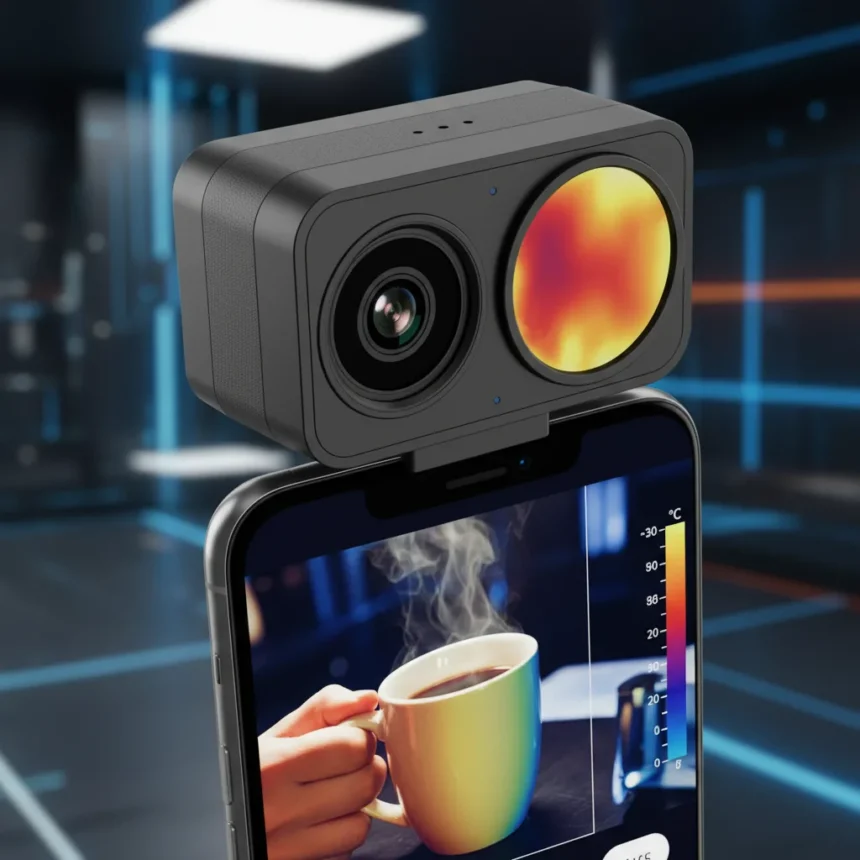
The Thermal Master P4 dual-lens thermal camera is a pocket-sized hybrid device that fuses thermal and visible light imaging, available via USB-C direct connection to Android 6.0+ phones and select PCs without requiring drivers. It combines a 256 x 192 native thermal resolution (upscaled to 512 x 384 via AI processing) with a visible light camera, delivering the sharpest phone-connected thermal imaging yet—though that upscaling claim masks some uncomfortable truths about what you’re actually getting.
Key Takeaways
- Dual-lens design fuses thermal and visible imagery for inspection-grade detail without bulky equipment.
- Native 256 x 192 thermal resolution upscaled to 512 x 384 via AI, raising questions about actual detail capture.
- Temperature range spans -20°C to +600°C with ±2°C accuracy; thermal sensitivity ≤25 mK for pinpointing heat loss.
- Ultra-lightweight 20g form factor and drop-resistant design make it genuinely pocketable for field work.
- P3 predecessor offers manual focus but lacks dual-lens fusion; P4 trades that control for workflow speed.
What Makes the Thermal Master P4 Dual-Lens Thermal Camera Stand Out
The Thermal Master P4 dual-lens thermal camera’s defining feature is its fusion of thermal and visible light imagery into a single composite view. That dual imaging capability works very well and adds a level of detail you simply don’t get from thermal-only sensors. When inspecting a wall for moisture damage or tracking electrical hotspots, seeing the thermal gradient overlaid on actual building geometry transforms how quickly you can diagnose problems. The visible light camera provides context that pure heat maps cannot.
What separates the P4 from its predecessor, the Thermal Master P3, is precisely this dual-lens architecture and the new official Thermal Master app ecosystem. The P3 offers manual focus control and identical native thermal resolution, but it lacks the image fusion capability that makes the P4 genuinely useful for professional inspections. For home inspections, client reports, electrical diagnostics, and industrial troubleshooting, that fusion advantage justifies the upgrade.
The Resolution Upscaling Claim Deserves Scrutiny
Thermal Master markets the P4 with upscaled 512 x 384 resolution via AI processing, but the native thermal sensor captures only 256 x 192 pixels. This is not deception exactly, but it is marketing sleight of hand. The AI upscaling produces smoother images and fills visual gaps, yet it cannot recover detail that the sensor never captured. If you are hunting for a thermal camera that genuinely sees finer thermal gradients, the native 256 x 192 resolution is what matters. The upscaling helps presentation, not thermal acuity.


Thermal sensitivity of ≤25 mK (millikelvin) means the camera can detect temperature differences as small as 0.025 degrees Celsius, which is genuinely impressive for a phone dongle. Paired with a temperature range of -20°C to +600°C and accuracy of ±2°C, the P4 handles everything from frozen pipe detection to hot electrical components. That spec sheet is professional-grade. The resolution upscaling, however, remains the camera’s honest limitation.
Thermal Master P4 Dual-Lens Thermal Camera vs. The P3: What Changed
The P3 remains a capable alternative if you prioritize manual focus control and lower cost. Both devices share the same 256 x 192 native thermal resolution and thermal sensitivity. The P4 sacrifices manual focus to gain the dual-lens fusion workflow, betting that automatic operation and visible light overlay will save you time on-site. For professional inspectors running multiple jobs daily, that trade-off makes sense. For hobbyists or occasional users, the P3’s manual focus flexibility might matter more.



The P4 also introduces the official Thermal Master app for Android, which streamlines data recording, image fusion control, and field reporting. The app ecosystem represents a maturation beyond the P3’s more basic connectivity. If your workflow depends on clean client reports with fused thermal-visible imagery, the P4 is the only choice between these two.
Practical Applications and Real-World Performance
The Thermal Master P4 dual-lens thermal camera excels in auto repair (detecting coolant leaks, finding bad heater cores), electrical inspection (spotting overheating breakers and connections), HVAC diagnostics (locating insulation gaps and ductwork problems), and home leak detection (finding water intrusion in walls and roofs). Its 15x digital zoom, hot/cold spot alarms, and isotherm analysis mode give professionals the tools to isolate problems without guesswork. The adjustable emissivity setting lets you account for reflective surfaces, which matters when inspecting shiny metals or glass.
Weight of approximately 20 grams and an aluminum-like drop-resistant case mean the camera genuinely belongs in a shirt pocket or tool bag without adding bulk. Plug it into an Android phone via USB-C and you have a thermal imaging lab in your hand. No drivers, no setup—immediate functionality.
Where the Thermal Master P4 Dual-Lens Thermal Camera Falls Short
The upscaled resolution marketing, while not technically false, sets expectations higher than the hardware delivers. If you are comparing this to true industrial thermal cameras with native 640 x 480 or higher resolution, the P4 feels like a toy. For the price point of a phone dongle, that is acceptable. For claims of professional-grade imaging, the native 256 x 192 sensor is a real ceiling on detail.



The app is Android-optimized, which means iOS users are out. That limits the addressable market and forces iPhone-carrying inspectors to either use a PC connection or choose a different product entirely. PC support is mentioned but not detailed, leaving Windows and Mac compatibility somewhat ambiguous.
Should You Buy the Thermal Master P4 Dual-Lens Thermal Camera?
If you run a home inspection, electrical, or HVAC business and currently rely on expensive dedicated thermal cameras or smartphone apps without real thermal sensors, the P4 is a genuine upgrade. The dual-lens fusion alone justifies the investment for professional reporting. If you are a homeowner checking for drafts or a hobbyist exploring thermal imaging, the P4 is overkill—but it is also the best entry point into real thermal imaging via phone.
The P3 remains viable if manual focus and lower cost matter more than dual-lens convenience. For everyone else, the P4 sets the new standard for phone-connected thermal cameras, despite its resolution upscaling marketing and Android-only app support.
Does the Thermal Master P4 work with iPhones?
No. The Thermal Master app is Android-optimized, and the P4 connects via USB-C to Android 6.0+ devices. iPhone users can connect via USB-C adapter to some PCs, but direct phone integration is not supported.
How does upscaling improve the Thermal Master P4 thermal images?
AI upscaling takes the native 256 x 192 pixel thermal data and interpolates it to 512 x 384, producing smoother gradients and fewer visible pixel blocks. This enhances presentation and makes thermal patterns easier to read, but it does not recover detail the sensor never captured. The native resolution remains the true limit of thermal acuity.
What temperature range does the Thermal Master P4 measure?
The P4 measures temperatures from -20°C to +600°C (-4°F to +1112°F) with accuracy of ±2°C, making it suitable for everything from frozen pipe detection to electrical hotspot identification.
The Thermal Master P4 dual-lens thermal camera is the best phone-connected thermal option available today, but only if you understand what you are getting. The dual-lens fusion is genuinely transformative for inspections. The AI upscaling is convenient marketing. The Android-only app is a real limitation. Buy it for the fusion capability and real thermal performance—not for inflated resolution claims—and you will have a tool that earns its place in your kit.
Where to Buy
$399 at Amazon | Amazon.com | Amazon.co.uk
Edited by the All Things Geek team.
Source: TechRadar