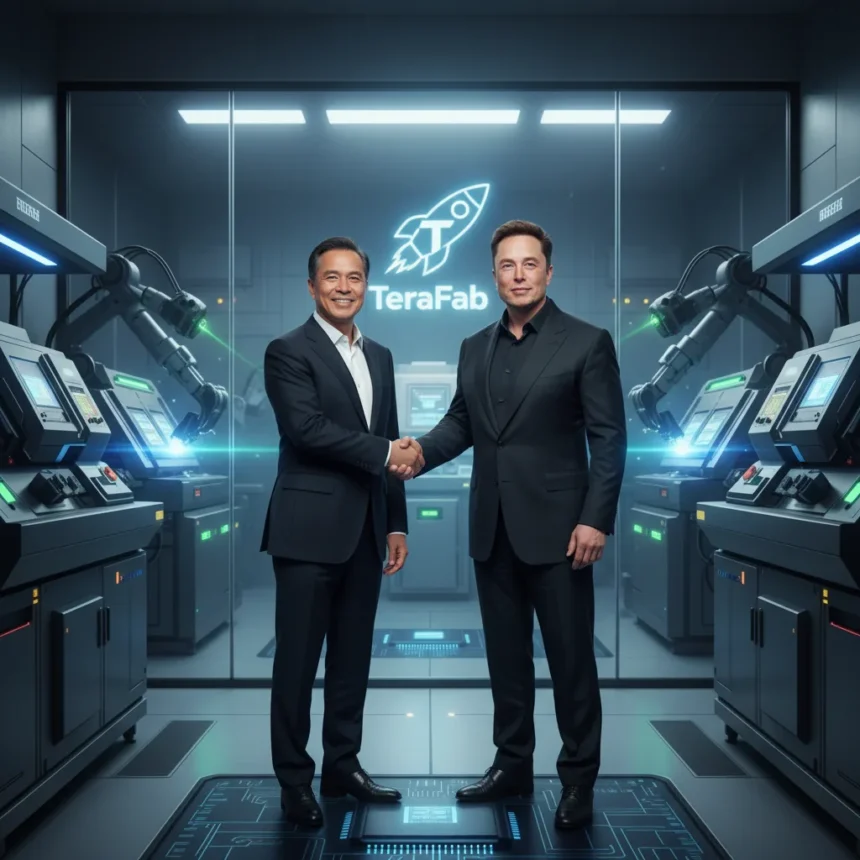
Intel’s decision to partner with Elon Musk on chip manufacturing costs represents a significant bet that unconventional thinking can solve the semiconductor industry’s most pressing problem: production expenses that keep growing while margins shrink. Intel CEO Lip-Bu Tan stated he can “think of no better partner than Elon Musk” to explore radical new approaches to how chips are actually made, signaling that traditional foundry economics may no longer be defensible.
Key Takeaways
- Intel officially joined Elon Musk’s TeraFab project, valued at $20bn, to rethink chip manufacturing processes.
- CEO Lip-Bu Tan praised Musk as an ideal partner for exploring unconventional cost-reduction methods.
- The partnership was announced five months after Musk hinted Tesla might collaborate with Intel.
- TeraFab aims to fundamentally rethink how semiconductor production works to lower manufacturing costs.
- Details of the Intel-TeraFab collaboration remain sparse, raising questions about concrete deliverables.
Why Intel Needs This Partnership Now
The semiconductor industry faces a cost crisis. Foundries spend billions on fabs that take years to build, and those facilities must operate at massive scale to justify their capital expenditure. Smaller players cannot compete. Intel itself has struggled with manufacturing efficiency, losing market share to TSMC and Samsung while burning cash on its own foundry ambitions. Joining TeraFab signals that Intel’s leadership believes incremental improvements to existing fab architecture will not solve this problem—the entire model needs rethinking.
Elon Musk’s track record of disrupting entrenched industries—whether through Tesla’s vertical integration in automotive manufacturing or SpaceX’s reusable rocket approach—makes him a credible partner for this kind of structural reimagining. Lip-Bu Tan’s endorsement reflects Intel‘s willingness to abandon the assumption that chip manufacturing must follow the path set by decades of industry convention. The question is whether that willingness translates into engineering breakthroughs or remains aspirational.
What TeraFab Actually Proposes
TeraFab, valued at $20bn, is positioned as a project to explore unconventional manufacturing methods specifically designed to reduce chip production costs. The research brief offers limited technical specifics on how TeraFab plans to achieve this. Intel’s involvement was announced five months after Musk indicated Tesla might “do something with Intel,” suggesting the partnership may have been in discussion for longer than the public timeline indicates.


The vagueness around TeraFab’s actual technical approach is notable. Are they reimagining the lithography process? Changing materials? Rethinking the fab layout entirely? Without concrete details, the partnership reads as a statement of intent rather than a detailed engineering roadmap. That does not mean the partnership is empty—early-stage moonshot projects often operate in stealth mode—but it does mean investors and industry observers should be skeptical of the hype until deliverables emerge.
The Credibility Gap
Intel’s CEO calling Musk “no better partner” is strong rhetoric, but rhetoric alone does not reduce chip manufacturing costs. The semiconductor industry is littered with announcements of breakthrough partnerships that yielded little. What matters is whether this collaboration produces novel manufacturing techniques, cost reductions, or process innovations that competitors cannot easily replicate. Without milestones, timelines, or technical disclosures, the announcement functions primarily as a confidence signal to markets and governments that Intel is serious about transformation.



For Intel, this partnership is also a hedge against further decline. If TeraFab fails, Intel can claim it tried an unconventional approach. If it succeeds, Intel gains access to cost advantages that could restore its competitive position. For Musk, Intel’s participation legitimizes TeraFab as a serious industrial project rather than a speculative venture. Both sides benefit from the optics even if the technical results remain uncertain.
Does This Solve the Semiconductor Cost Problem?
One partnership, no matter how well-resourced, cannot single-handedly fix an industry-wide cost structure problem. TSMC and Samsung also face the same fab economics. If TeraFab discovers a genuinely novel manufacturing method, competitors will eventually copy it. If the breakthrough is proprietary, it benefits Intel and Musk’s interests but does not transform the broader industry. The real test is whether Intel and TeraFab can move faster than traditional foundries and whether cost savings are substantial enough to create a durable competitive moat.
The semiconductor industry needs cost innovation. Lithography, packaging, materials science, and fab automation all have room for improvement. Musk’s willingness to question conventional wisdom is valuable. But unconventional thinking without rigorous execution becomes expensive failure. Intel and TeraFab have the capital to absorb setbacks, which is an advantage. Whether they have the technical clarity and engineering discipline to deliver is still an open question.
Will Intel’s TeraFab partnership actually reduce chip manufacturing costs?
That depends entirely on whether the unconventional methods TeraFab develops prove technically viable and cost-effective at scale. The partnership is credible in intent but thin on details. Intel and Musk have the resources to experiment, but no partnership announcement guarantees success. Results will take years to materialize.



How does TeraFab differ from Intel’s existing foundry strategy?
Intel’s traditional foundry approach relies on building state-of-the-art fabs and iterating on existing lithography and process node roadmaps. TeraFab explicitly aims to rethink the entire manufacturing model, not just improve existing methods. Whether that translates to meaningful cost advantages remains unproven.
What does this partnership mean for other chipmakers?
If TeraFab succeeds in cutting manufacturing costs, it could pressure competitors like TSMC and Samsung to adopt similar innovations or risk losing customers to Intel. If it fails, it reinforces that semiconductor cost structures are not easily disrupted. Either way, the industry will be watching closely for technical disclosures and production milestones.
Intel and Elon Musk’s TeraFab partnership is a bold acknowledgment that chip manufacturing cannot stay the way it is. High capital costs, long fab build times, and razor-thin margins are unsustainable. Whether this partnership delivers breakthrough manufacturing methods or remains an expensive statement of intent will become clear only when concrete results emerge. For now, skepticism is warranted—the semiconductor industry has heard ambitious promises before.
Edited by the All Things Geek team.
Source: Tom's Hardware