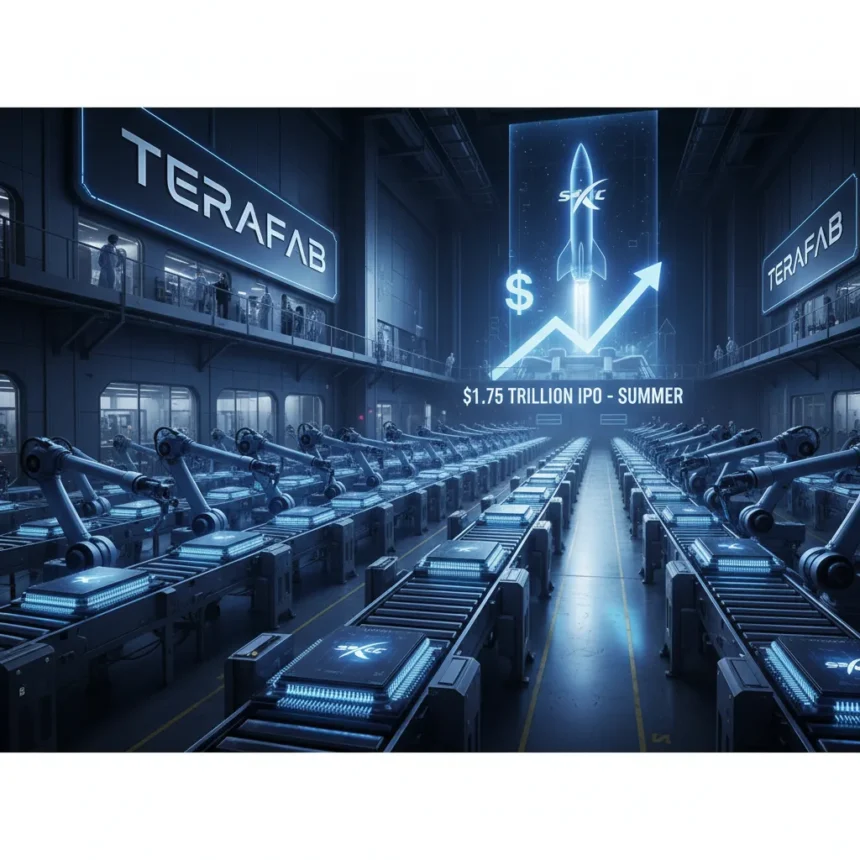
SpaceX GPU manufacturing has emerged as a critical capital expenditure for the aerospace company ahead of its anticipated $1.75 trillion initial public offering this summer, according to disclosures in its S-1 filing with the U.S. Securities and Exchange Commission. The move signals a dramatic shift toward vertical integration, with SpaceX acknowledging substantial risks from chip supply shortages and the need to secure long-term semiconductor sourcing for its AI and space ambitions.
Key Takeaways
- SpaceX lists in-house GPU manufacturing as a major capital expenditure in its S-1 filing ahead of summer 2026 IPO
- Terafab, a joint facility in Austin developed by SpaceX, xAI, and Tesla, targets GPU production for AI and space applications
- S-1 warns of chip supply risks, vendor reliance, and potential delays in Terafab scaling that could constrain growth
- Intel partnership provides 14A process technology; Musk called the partnership “the right move” for Terafab timelines
- SpaceX GPU manufacturing scale and expenditure amount remain undisclosed
Why SpaceX is entering GPU manufacturing
SpaceX GPU manufacturing represents a defensive response to semiconductor supply constraints that threaten its AI infrastructure and space operations. The company’s S-1 filing explicitly warns investors that insufficient chip supply, lack of long-term supplier contracts, and reliance on third-party vendors pose material risks to growth. By manufacturing GPUs in-house, SpaceX aims to reduce dependency on external suppliers and secure capacity for its expanding AI workloads—from training models at xAI to powering space-based data centers. This vertical integration mirrors strategies adopted by major cloud providers but represents uncharted territory for an aerospace manufacturer.
The timing matters. SpaceX’s IPO valuation of $1.75 trillion reflects investor confidence in the company’s core space business, but the S-1 filing reveals that semiconductor supply has become a bottleneck. Rather than compete for chips on the open market against Nvidia, cloud giants, and defense contractors, SpaceX is building its own production capacity. The move also signals that the company views GPU manufacturing as essential to its long-term competitive position—not a peripheral venture.
Terafab: The Austin facility driving SpaceX GPU manufacturing
SpaceX GPU manufacturing will primarily flow through Terafab, an advanced chip manufacturing complex in Austin, Texas, jointly developed by SpaceX, its xAI subsidiary, and Tesla, under the direction of Elon Musk. Terafab targets GPU production for three key use cases: autonomous vehicles, humanoid robots, and space-based data centers. However, the specific types of GPUs or AI chips Terafab will produce remain unclear, as does the facility’s ultimate production scale.



Terafab partners with Intel, leveraging the chipmaker’s 14A advanced manufacturing process. Elon Musk stated that by the time Terafab scales up, Intel’s 14A process “will be probably fairly mature or ready for prime time” and “seems like the right move”. This statement suggests Terafab will not rush production but wait for Intel’s process technology to mature—a deliberate strategy that acknowledges the technical complexity of GPU manufacturing. The division of responsibilities between SpaceX, Terafab developers, and Intel remains opaque; SpaceX has not responded to media requests for comment on the specifics.
SpaceX GPU manufacturing vs. the incumbent GPU market
SpaceX GPU manufacturing enters a market dominated by Nvidia, which has spent decades perfecting GPU design, manufacturing partnerships, and software ecosystems. Nvidia’s competitive moat is formidable: the company controls both chip architecture and software (CUDA), making it nearly impossible for new entrants to replicate its ecosystem advantage. Alphabet’s TPUs represent an alternative, but they are purpose-built for Google’s own AI workloads and not sold commercially at scale.



SpaceX’s advantage lies not in competing with Nvidia’s consumer or data center GPUs, but in optimizing chips for its own use cases—space-based computing, autonomous systems, and xAI’s inference workloads. By integrating design, manufacturing, and testing in-house through Terafab, SpaceX could theoretically reduce costs and latency compared to buying finished GPUs from third parties. However, GPU manufacturing poses steep technical and capital barriers. The S-1 filing’s warning about “potential delays in Terafab objectives” suggests SpaceX recognizes these risks. Nvidia’s decades of experience in both chip design and production partnerships give the company a structural advantage that SpaceX cannot easily overcome, even with substantial capital investment.
What the S-1 filing reveals about SpaceX’s chip supply strategy
SpaceX’s S-1 filing lists in-house GPU manufacturing alongside other substantial capital expenditures, signaling that semiconductor production is now a core business priority. The filing also warns of specific risks: insufficient chip supply, lack of long-term contracts with suppliers, and reliance on third-party vendors could constrain growth and delay key projects. These warnings suggest that SpaceX has experienced real supply friction—either in securing GPUs for xAI’s training operations or in planning space-based AI infrastructure.
The S-1 also warns that “potential delays in Terafab objectives” could materially impact the company’s ability to execute its AI and space strategies. This cautious language indicates that Terafab is not yet producing at scale and that timelines are uncertain. SpaceX has not disclosed the size or scope of its GPU manufacturing expenditure, leaving investors and competitors to guess whether the company is investing hundreds of millions or billions of dollars into Terafab.
What remains unknown about SpaceX GPU manufacturing
SpaceX has provided few concrete details about its GPU manufacturing plans. The company has not announced production timelines, chip specifications, or the scale of its manufacturing ambitions. It is unclear whether Terafab will produce GPUs exclusively for internal SpaceX, xAI, and Tesla use, or whether it will eventually sell chips to external customers. The specific types of GPUs—whether for AI training, inference, space computing, or automotive applications—remain unspecified.


The capital expenditure amount is also undisclosed. GPU fabrication facilities cost billions of dollars to build and operate, but SpaceX may be leveraging Intel’s existing Austin-area capacity or partnering more closely than public statements suggest. Without detailed disclosure, investors and industry analysts cannot assess whether SpaceX’s GPU manufacturing strategy is a transformative competitive advantage or an expensive hedge against supply risk.
FAQ
When will SpaceX begin manufacturing GPUs?
SpaceX has not announced a production timeline for GPUs. The S-1 filing warns of “potential delays in Terafab objectives,” suggesting the facility is not yet operational at scale. Elon Musk’s statement that Intel’s 14A process will be “ready for prime time” by the time Terafab scales implies production is still years away, likely aligned with the summer 2026 IPO or beyond.
Will SpaceX sell GPUs to other companies?
SpaceX has not disclosed whether Terafab will produce GPUs for external sale or exclusively for internal use by SpaceX, xAI, and Tesla. The lack of public commitment to commercial GPU sales suggests the facility is designed to serve the companies’ own needs rather than compete with Nvidia in the open market.
Why is SpaceX manufacturing GPUs instead of buying from Nvidia?
SpaceX GPU manufacturing addresses chip supply risks and vendor dependency documented in the S-1 filing. By producing GPUs in-house, SpaceX secures capacity for its AI and space operations without competing for limited Nvidia supply. The strategy also allows optimization of chips for SpaceX’s specific use cases—space-based computing, autonomous systems, and xAI workloads—where off-the-shelf GPUs may not be ideal.
SpaceX GPU manufacturing marks a pivotal moment in the semiconductor industry: a major aerospace and AI company is betting that vertical integration and in-house chip production are essential to its future competitiveness. Whether Terafab succeeds or becomes a cautionary tale about the difficulty of entering GPU manufacturing will shape not just SpaceX’s trajectory but also signal whether other tech giants should follow suit.
Edited by the All Things Geek team.
Source: Tom's Hardware