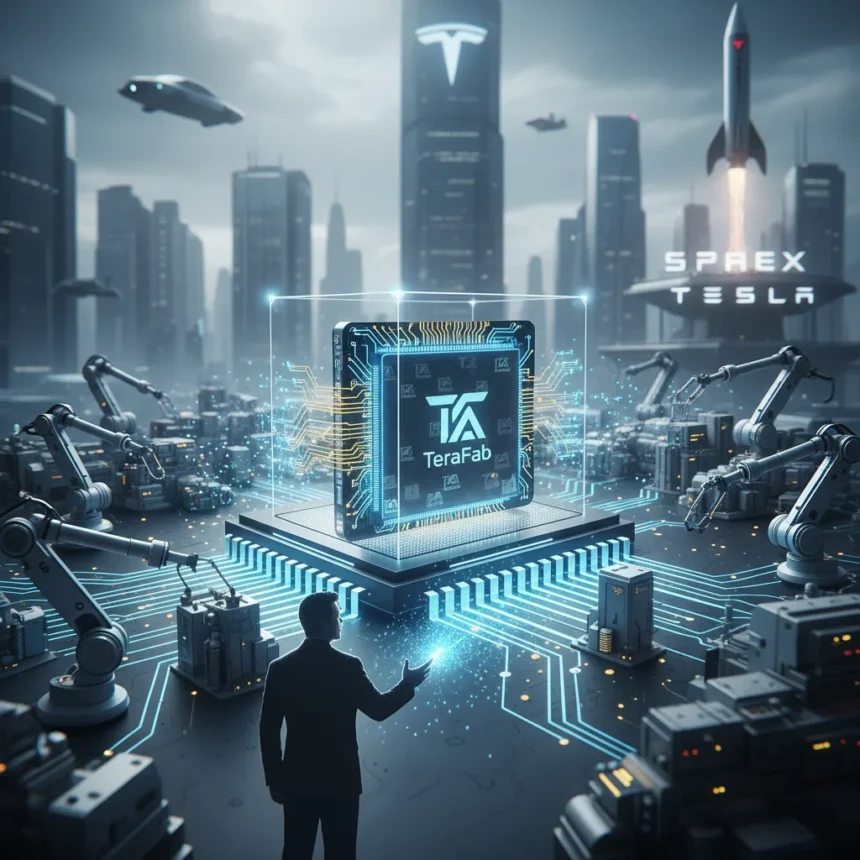
Intel’s 14A process technology will power TeraFab’s ambitious plan to manufacture AI chips at unprecedented scale, marking a significant shift in how advanced semiconductors get produced outside traditional foundries. Elon Musk announced on Wednesday, April 22, 2026, that his Austin-based TeraFab complex will leverage Intel’s advanced 14A fabrication technology when the project gains its own production capacity later this decade, positioning Tesla as Intel’s first major customer for the process.
Key Takeaways
- TeraFab will use Intel’s 14A process technology for AI chip production when manufacturing capacity becomes available later this decade
- Tesla will build and operate the pilot production line, while SpaceX handles high-volume manufacturing
- TeraFab targets 1 terawatt of annual computing capacity, compared to roughly 0.5 terawatt across the entire US currently
- The project represents an estimated $5–13 trillion capital investment for achieving 1 terawatt compute capacity, according to Bernstein analysts
- Intel joined the TeraFab partnership earlier in April 2026 alongside SpaceX and Tesla to produce processors for robotics and data centers
How Intel’s 14A Process Technology Fits TeraFab’s Scale
Intel’s 14A process technology represents the company’s most advanced manufacturing node, designed to deliver the performance density required for next-generation AI accelerators and data center processors. TeraFab’s adoption of this technology signals confidence in Intel’s roadmap while establishing a direct manufacturing partnership that bypasses traditional third-party foundry models. The 14A process will enable TeraFab to produce chips optimized for robotics, humanoid robots, and AI data center applications—sectors where compute density directly translates to competitive advantage.
Tesla’s role as the pilot production operator is critical to this equation. By running the research and development fabrication line, Tesla gains early access to 14A yields and manufacturing characteristics, allowing the company to refine chip designs before SpaceX scales production to high volumes. This two-tier approach—Tesla handling pilot work, SpaceX managing mass manufacturing—mirrors how advanced chipmakers typically transition from engineering to production, but with two separate companies managing each phase rather than one vertically integrated facility.
The Terawatt Computing Ambition and What It Means
TeraFab’s stated goal of producing 1 terawatt of computing capacity annually dwarfs current US semiconductor manufacturing output of approximately 0.5 terawatt. To put this in perspective, achieving 1 terawatt compute would require capital expenditure estimated between $5–13 trillion, according to Bernstein analysts—a figure that underscores both the scale of the ambition and the financial barriers to realizing it. This target reflects the explosive growth in AI infrastructure demand, where data centers and robotics systems require exponentially more compute than traditional consumer electronics.



The original TeraFab vision, unveiled earlier by Musk, positioned the project as a $20 billion facility designed to integrate chip design, memory manufacturing, and packaging under one roof. The subsequent partnership with Intel and the adoption of 14A process technology suggest TeraFab has evolved beyond a single mega-fab into a distributed manufacturing ecosystem where Tesla and SpaceX each contribute specialized expertise. Tesla brings automotive manufacturing discipline and supply chain management; SpaceX brings experience scaling production rapidly for space hardware.
Intel’s Role and the Licensing Question
While Musk has not explicitly confirmed a licensing arrangement, the partnership structure strongly suggests Intel is providing technology access rather than simply supplying equipment. Intel’s participation in the TeraFab consortium—announced in April 2026—positions the chipmaker as a technology partner with ongoing involvement in process maturation and optimization. This differs from traditional foundry relationships where a customer pays per wafer; instead, TeraFab appears to be gaining long-term rights to manufacture using the 14A process as it matures over the next several years.



The exact scope of Intel’s role remains undefined, including questions about equipment funding, process support, and operational governance. However, naming Tesla as Intel’s first major 14A customer establishes a clear pecking order: Tesla gets priority access to the technology before other potential customers, a significant advantage in the race to deploy advanced AI chips. This arrangement benefits Intel by securing a high-volume customer committed to scaling production, while TeraFab gains access to a proven process without waiting for Intel’s own foundry services to mature.
Why This Matters for the AI Chip Market
Current semiconductor manufacturing is concentrated among a handful of foundries—primarily Taiwan’s TSMC, Samsung, and Intel itself—creating supply bottlenecks for AI accelerators and data center processors. TeraFab’s entry into high-volume production using Intel’s 14A technology introduces a new competitor to this landscape, though success depends on achieving the promised manufacturing yields and cost targets. The partnership with SpaceX and Tesla also signals that vertically integrated tech companies are willing to invest heavily in captive chip manufacturing rather than relying entirely on external foundries.
The 1-terawatt production goal, while ambitious, reflects genuine market demand. AI data centers are doubling compute requirements every 12–18 months, and current manufacturing capacity cannot keep pace. TeraFab’s commitment to use Intel’s 14A process technology positions it as a serious attempt to address this supply gap, though execution risk remains substantial given the capital requirements and manufacturing complexity involved.
What timeline should we expect for TeraFab production?
TeraFab will use Intel’s 14A process technology when the manufacturing process matures and TeraFab gains its own production capacity later this decade. Tesla will operate the pilot research fab first, with SpaceX handling high-volume manufacturing afterward. No specific production dates have been announced, and many operational details—including equipment funding and facility construction timelines—remain undisclosed.


How does Intel’s 14A process technology compare to current manufacturing nodes?
Intel’s 14A process represents the company’s most advanced fabrication technology, designed for next-generation AI and data center processors. The process delivers superior performance density compared to older nodes, enabling the compute-intensive applications that TeraFab targets. However, detailed performance comparisons with competing processes from TSMC or Samsung are not available in current public information.
Why did Tesla and SpaceX partner with Intel on TeraFab?
Tesla and SpaceX partnered with Intel to access the 14A process technology for manufacturing AI chips at scale, with Tesla gaining first-customer status for the advanced node. SpaceX’s involvement in high-volume production leverages the company’s experience scaling manufacturing rapidly, while Tesla’s pilot line provides early access to yields and manufacturing optimization. This partnership allows both companies to secure chip supply for their respective robotics, data center, and space applications without relying solely on third-party foundries.
Elon Musk’s TeraFab project, powered by Intel’s 14A process technology, represents a bold bet that vertically integrated tech companies can compete with established foundries in advanced chip manufacturing. Whether the project achieves its 1-terawatt ambition depends on execution—process maturation, capital deployment, and manufacturing discipline. For now, the partnership confirms that Intel’s 14A process technology is credible enough to anchor a major new manufacturing initiative, and that demand for AI compute is driving unconventional manufacturing partnerships.
Edited by the All Things Geek team.
Source: Tom's Hardware