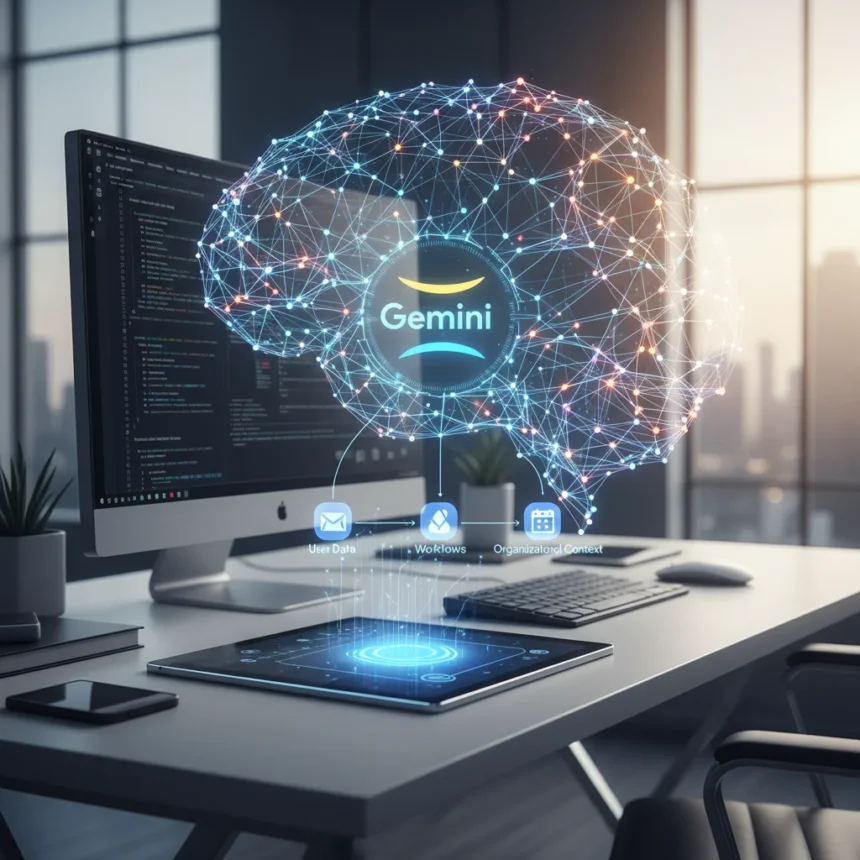
Workspace Intelligence refers to Google’s platform for autonomous, context-aware AI assistance across Workspace apps, announced at Cloud Next 2026. Rather than treating Gemini as a passive chatbot, Workspace Intelligence grounds AI in users’ actual data, workflows, and organizational knowledge to enable true agentic behavior—AI that proactively suggests actions, automates tasks, and understands semantic relationships without manual prompting.
Key Takeaways
- Workspace Intelligence delivers unified understanding of users’ Workspace apps, projects, collaborators, and domain knowledge for autonomous automation.
- Gemini now suggests to-dos and topics in Gmail, synthesizes email threads via AI Overviews, and creates documents via Chat without explicit instructions.
- Integration spans Gmail, Docs, Sheets, Slides, Drive, Chat, and Meet for Workspace subscribers, with connections to third-party apps like Salesforce and Nira.
- Google announced a $750 million partner fund to accelerate agentic AI development and enterprise adoption.
- Workspace Intelligence contrasts with passive AI assistants by enabling proactive, orchestrated task execution with memory and context awareness.
How Workspace Intelligence Differs from Traditional AI Assistants
Workspace Intelligence moves beyond chatbots that wait for commands. Instead of requiring users to manually provide context in every prompt, the system analyzes work habits, active projects, collaborators, and organizational domain knowledge to understand what users actually need. This semantic layer connects data from Docs, Slides, Gmail, and other apps to enable autonomous decision-making and task orchestration.
Traditional AI assistants treat each interaction as isolated. Workspace Intelligence maintains memory of your workflows, understands who you collaborate with, and knows your organization’s processes. Gmail’s inbox assistant, for example, now suggests to-dos and topics to catch up on without being asked, then synthesizes information from email threads during search via AI Overviews. This is fundamentally different from a chatbot that responds only when prompted.
However, some observers note that Gmail’s current Gemini integration still falls short of fully autonomous agentic behavior, acting more as a personal assistant than a true agent capable of independent decision-making. Workspace Intelligence addresses this gap by embedding agents deeper into workflows and enabling them to orchestrate actions across multiple apps.



Key Features and Capabilities of Workspace Intelligence
Workspace Intelligence powers several concrete features across Google’s ecosystem. In Gmail, the AI Inbox suggests to-dos and topics to catch up on, while AI Overviews synthesize information from email threads when users search. Gemini in Google Chat can create documents, schedule meetings, and find files without manual context, and it integrates with third-party apps like Nira and Salesforce to pull relevant data.
Google Workspace Studio enables automation of everyday tasks—from simple workflows to complex processes—without requiring coding. Gems, a team of customizable AI experts, handle repeatable tasks or complex projects like coding, deep research, and data analysis. NotebookLM has been enhanced with customization options, advanced sharing, usage analytics, and increased output limits for Audio Overviews, queries, notebooks, and sources.



The platform also integrates Workspace Intelligence with Gemini Enterprise, which connects to Microsoft 365, Salesforce, SAP, and BigQuery for grounded relevance across enterprise systems. Partner agents built on the Gemini Enterprise platform—such as Typeface for creative campaigns and UKG Agentic People Assist for HR workflows—extend capabilities into specialized domains.
Why Workspace Intelligence Matters Now
The shift to agentic AI represents a fundamental change in how enterprise software works. Rather than employees manually orchestrating tools and copying context between apps, Workspace Intelligence automates the glue that connects workflows. This reduces friction, eliminates repetitive manual work, and allows teams to focus on higher-level decisions.
Google’s $750 million partner fund signals serious investment in scaling this ecosystem. The company is building an Agent Marketplace where enterprise developers can deploy specialized agents for industry-specific tasks. This contrasts with earlier AI implementations that treated Gemini as a general-purpose chatbot rather than a platform for autonomous work orchestration.
The timing also reflects competitive pressure. Microsoft has been advancing its Copilot ecosystem with similar agentic features, and enterprises are increasingly demanding AI that understands their specific workflows rather than generic AI that requires constant manual input. Workspace Intelligence is Google’s answer to that demand.



Availability and Integration
Workspace Intelligence is available today to Google Workspace subscribers through the Workspace side panel in Gmail, Docs, and other apps, as well as via the Gemini app on laptop and mobile. The platform includes access to Gemini Enterprise, which has been adopted across millions of paid seats at thousands of companies.
Integration extends beyond Google’s native apps. Gemini in Google Chat connects to third-party services like Salesforce and Nira, allowing Workspace Intelligence to pull context from external systems. Workspace Studio enables teams to build custom automations without coding, lowering the barrier to deploying agentic workflows specific to organizational needs.
NotebookLM, another key component, has expanded its capabilities with enhanced customization and sharing options, making it easier for teams to collaborate on AI-powered research and analysis. These integrations suggest Google is positioning Workspace Intelligence as a platform, not just a feature set.
The Competitive Landscape
Workspace Intelligence distinguishes itself by grounding AI in actual user data and workflows rather than treating Gemini as a generic assistant. Unlike passive chatbots that require explicit prompts, Workspace Intelligence analyzes digital habits and organizational context to enable proactive suggestions and autonomous task execution.
This approach contrasts with earlier implementations where Gmail’s Gemini integration, while useful, still fell short of true agentic behavior. Workspace Intelligence addresses that limitation by enabling agents to maintain memory, understand semantic relationships across apps, and orchestrate actions without constant human intervention.
Partner agents like Typeface and UKG Agentic People Assist demonstrate how the platform can be extended into specialized domains. This ecosystem approach—where third-party developers build domain-specific agents on Google’s infrastructure—gives enterprises more flexibility than closed, monolithic AI systems.
Is Workspace Intelligence available for all Google Workspace plans?
Workspace Intelligence is included in Google Workspace plans for subscribers, with premium AI access to Gemini Enterprise and NotebookLM. However, the research brief does not specify which tier of Workspace subscription includes Workspace Intelligence features, so you should check with Google Workspace administrators about your specific plan’s eligibility.
How does Workspace Intelligence compare to Microsoft’s Copilot for Microsoft 365?
Both platforms aim to deliver agentic AI across enterprise apps. Workspace Intelligence grounds Gemini in Workspace data and integrates with third-party services like Salesforce and Nira. Microsoft’s Copilot similarly connects to Microsoft 365 and external systems. The key difference is the underlying architecture: Workspace Intelligence emphasizes semantic understanding of workflows and organizational context, while Copilot has focused on integration breadth. Google’s $750 million partner fund suggests aggressive investment in expanding Workspace Intelligence’s ecosystem.
What happens to my data when Workspace Intelligence analyzes my workflows?
Google describes Workspace Intelligence as a secure, dynamic system that understands semantic relationships within your Workspace apps, projects, collaborators, and organizational knowledge. The platform is designed to operate within the context of Google Workspace’s existing security and privacy controls. For specific details about data handling and compliance, consult your organization’s Google Workspace administrator or Google’s privacy documentation.
Workspace Intelligence marks a meaningful shift in how enterprise AI works. Rather than treating Gemini as a tool users summon on demand, Google is embedding agentic reasoning into the apps employees use daily. That transition from passive assistance to proactive automation is the real story here—and it signals that the era of generic AI chatbots is ending. Enterprises that adopt Workspace Intelligence gain the ability to automate workflows at scale without hiring armies of automation engineers, which is why Google’s $750 million investment in partner agents matters. The question now is whether this approach can deliver on its promise of true autonomy or whether it will, like many enterprise AI initiatives, fall short of its marketing claims.
Edited by the All Things Geek team.
Source: Android Central