




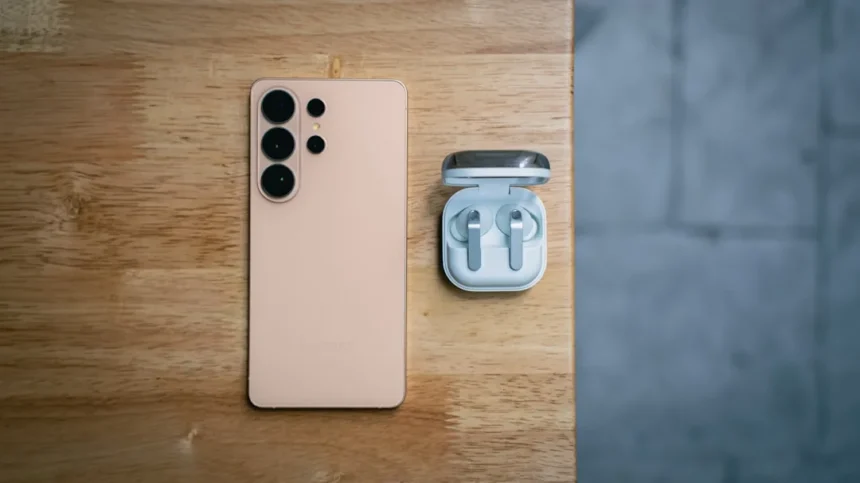
The Galaxy S26 Ultra is Samsung’s latest flagship smartphone, featuring improved cameras, faster performance, and enhanced AI capabilities including Perplexity integration with Bixby. After three weeks of daily use, the device demonstrates where Samsung has genuinely innovated and where it still lags behind its own ambitions.
Key Takeaways
- Galaxy S26 Ultra cameras show measurable improvement over previous generations with better low-light performance and video stabilization.
- Perplexity integration with Bixby provides AI search capabilities, though adoption depends on user workflow preference.
- Privacy display and Super Steady video are standout features that justify the flagship price point for content creators.
- Performance gains are incremental rather than revolutionary—sufficient for daily tasks but not a dramatic leap forward.
- Three weeks of testing reveal that Samsung’s AI features work best when integrated into existing habits, not forced into new ones.
Camera Improvements Actually Matter on the Galaxy S26 Ultra
The Galaxy S26 Ultra‘s camera system represents the most tangible upgrade from previous generations. The improved sensor array handles low-light photography noticeably better than older flagships, producing clearer detail in dimly lit environments without excessive noise reduction artifacts. Night mode no longer feels like a computational workaround—it delivers usable images in conditions where competitors still struggle.
Super Steady video is the feature that convinced me the camera upgrade justifies the flagship price. Handheld video stabilization reaches a level where you genuinely do not need a gimbal for casual content. The system compensates for micro-movements that would typically require professional equipment, making the Galaxy S26 Ultra appealing for anyone shooting video on a phone.
Where the Galaxy S26 Ultra falls short is in zoom consistency. Telephoto performance remains solid but not exceptional compared to competitors like the iPhone 16 Pro Max, which handles 3x and 5x zoom with slightly more natural color rendering. This is not a dealbreaker—it is a refinement issue that matters mostly to photography enthusiasts.



AI Features Work When They Do Not Feel Forced
Perplexity integration with Bixby introduces genuine search capability beyond Google’s standard offerings. Instead of returning indexed results, Bixby can now synthesize real-time information and provide sourced answers. The feature works best for research queries where you need current information—stock prices, weather patterns, breaking news—rather than for simple factual lookups.
The problem is adoption friction. Most users have already trained themselves to use Google Search or ChatGPT for these tasks. Bixby’s integration feels like an addition to the system rather than a natural part of the workflow. Three weeks in, I found myself defaulting to Google Search out of habit, even when Bixby would have been faster. Samsung cannot force behavior change through hardware alone.

Privacy display is a more subtle but more useful AI feature. The system learns which apps you use most frequently and adjusts display settings accordingly—reducing brightness and refresh rate for background apps, maximizing performance for active ones. You do not notice it working, which is exactly the point. It just happens, saving battery without requiring manual intervention.
Performance Is Sufficient, Not Spectacular
The Galaxy S26 Ultra handles demanding tasks smoothly. Gaming, multitasking, and app switching feel responsive without lag. Performance gains over the S25 Ultra exist but are incremental—the kind of upgrade that matters if you are upgrading from an older device, less so if you already own a recent flagship.
Real-world performance differences between the Galaxy S26 Ultra and competitors like the iPhone 16 Pro Max are negligible for everyday use. Both devices handle their respective ecosystems flawlessly. The gap widens only in specialized tasks—video editing, 3D rendering, or intensive gaming—where the specific optimization of each platform becomes relevant.
Three Weeks Reveals the Real Trade-offs
Extended testing reveals that the Galaxy S26 Ultra excels at specific tasks—photography, video, and AI-assisted research—while remaining competent but unspectacular elsewhere. Battery life is solid but not exceptional, lasting a full day of heavy use with 15-20% remaining. Thermal management is good, though sustained gaming or video recording does trigger noticeable warmth near the camera module.



The display is excellent but not revolutionary. The Privacy display feature is genuinely useful, yet most users will never notice it working. The processor is fast enough that performance rarely becomes a limiting factor in real-world scenarios. These are not criticisms—they are reminders that flagship phones have largely converged on a baseline of competence, and differentiation now comes from specialized features rather than across-the-board superiority.
Should You Upgrade to the Galaxy S26 Ultra?
If you own an S24 Ultra or newer, the upgrade is not urgent. The improvements are real but incremental. If you shoot video regularly or use AI-powered search as part of your workflow, the Galaxy S26 Ultra justifies its flagship price. If you are upgrading from an older device—anything three years or older—the jump in camera quality and overall performance will feel substantial.
How does the Galaxy S26 Ultra camera compare to the iPhone 16 Pro Max?
The Galaxy S26 Ultra excels in low-light photography and video stabilization, while the iPhone 16 Pro Max handles zoom more naturally. Both are exceptional cameras; the choice depends on whether you prioritize video work (Galaxy S26 Ultra) or overall color accuracy (iPhone 16 Pro Max).
Does the Galaxy S26 Ultra have better battery life than the S25 Ultra?
Battery life is comparable between the two devices, with minimal real-world difference. Both devices last a full day of heavy use. Battery performance depends more on your specific usage patterns than on the hardware generation.
Three weeks with the Galaxy S26 Ultra confirms that Samsung has refined its flagship formula rather than reshaped it. The camera improvements are genuine, the AI features work when integrated thoughtfully, and the overall experience is polished. Whether that justifies the flagship price depends entirely on whether the specific strengths—particularly video and low-light photography—match your actual needs. For general users, a previous-generation flagship remains a smarter choice. For content creators and photography enthusiasts, the Galaxy S26 Ultra earns its position at the top of Samsung’s lineup.
This article was written with AI assistance and editorially reviewed.
Source: Android Central