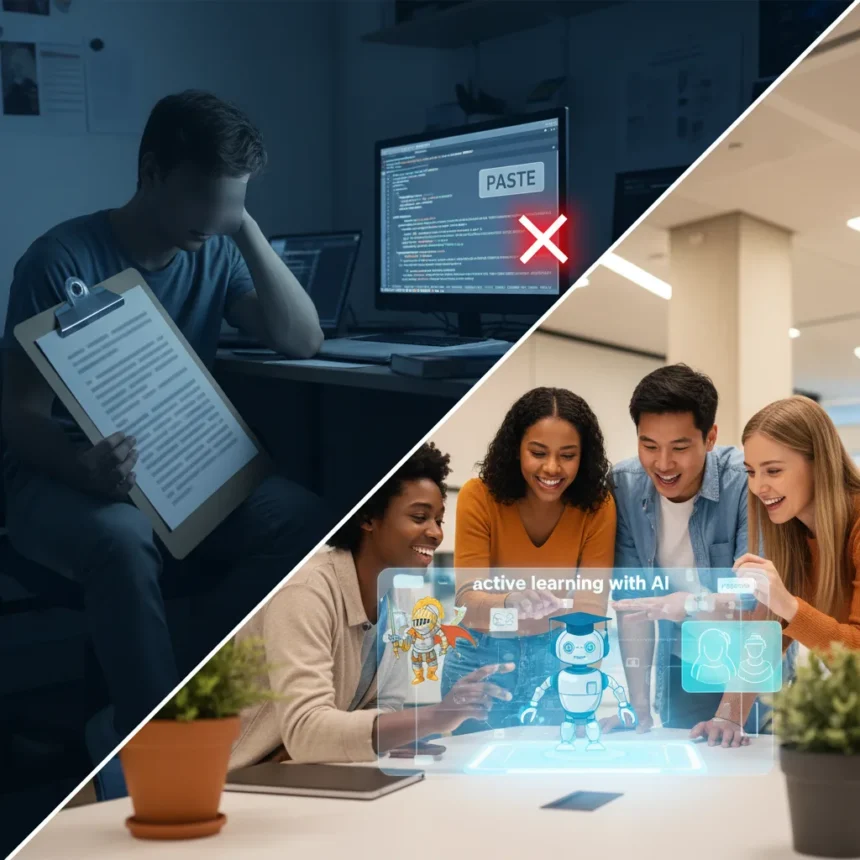
Active learning with AI is not about pasting answers into your next essay. It is about using AI as a thinking partner that forces you to engage directly with material, argue with ideas, and build understanding through interaction rather than passive reception. A three-year study by Lampropoulos and Sidiropoulos (2024) found that gamified active learning significantly improves engagement, motivation, and success rates compared to traditional or online methods. Meanwhile, a meta-analysis by Lord et al. (2021) confirmed that active learning outperforms lecturing in humanities and social sciences. The gap between copy-pasting and genuine learning is not subtle—it is measurable.
Key Takeaways
- Copy-pasting from AI provides zero learning; active engagement with AI content drives measurable improvement in retention and critical thinking.
- Gamified learning—Jeopardy boards, scavenger hunts, vocabulary games—boosts motivation and performance over passive study methods.
- AI-generated personas let you argue, question, and evaluate ideas by interacting with fictional characters based on course material.
- Personalized tutoring via AI creates custom study tools tailored to your learning gaps, not generic textbook summaries.
- Adaptive learning platforms assess your skills in real-time and adjust content difficulty, mimicking one-on-one tutoring at scale.
Why Passive AI Use Fails You
Here is the hard truth: basic facts are readily available online. What matters educationally is your transformation of those facts into new products—analysis, arguments, connections, applications. When you copy-paste an AI response, you skip the transformation entirely. You get information without learning. Active learning involves hands-on and minds-on activities that engage you through interactive discussions and problem-solving, not passive reception of finished answers. The moment you stop thinking and start copying, the learning stops.
Passive AI use also trains a dangerous habit: outsourcing your thinking. You become dependent on the tool rather than developing the cognitive skills the material is meant to build. Contrast this with active learning strategies, where AI becomes a scaffold for your own reasoning, not a replacement for it.
Four Active Shifts to Use AI as a Study Partner
Active learning with AI works through specific strategies that force engagement. Here are the most effective approaches backed by educational research and classroom implementation.



Build Personas to Explore Ideas
Use ChatGPT to create fictional personas based on your course material, then interact with them directly. You might generate a persona explaining a difficult concept from your textbook, then interrogate that persona: ask it to defend its position, challenge its logic, or apply its ideas to a new scenario. This forces you to think critically about the material rather than accept it passively. You are not reading an answer—you are arguing with one. Reflect afterward on what the interaction taught you. Did the persona’s explanation clarify something you misunderstood? Did your questions reveal gaps in your own understanding? That reflection is where learning happens.
Gamify Your Study Sessions
AI can generate interactive learning games tailored to your course content. Ask it to create a Jeopardy board for a novel you are reading, a scavenger hunt through historical events, vocabulary games for a language class, or crossword puzzles covering key terms. Gamification works because it replaces passive review with active problem-solving. You are not memorizing facts—you are retrieving them under conditions that mirror real use. Research shows this approach significantly boosts engagement and retention. The game format also makes studying less tedious, which means you study longer and retain more.



Personalize Your Tutoring and Test Prep
Rather than using generic study guides, ask AI to build custom study tools based on your specific needs. Request vocabulary games at the depth-of-knowledge level where you struggle, summaries of only the concepts you find confusing, or practice questions that target your weak points. Personalized tutoring has long been the gold standard in education—one-on-one instruction adjusted to your pace and gaps. AI makes this scalable. Platforms like DreamBox use intelligent tutoring systems that track your progress in real-time and adjust lessons dynamically, showing significant math skill gains. You are not studying generic material—you are studying exactly what you need.
Embrace Adaptive Learning Pathways
Adaptive learning platforms assess your skills in real-time and tailor content to your current level. Rather than forcing you through a fixed curriculum, these systems identify where you are struggling and adjust difficulty accordingly. This mimics what a skilled tutor does—observe, diagnose, adjust. The result is more efficient learning because you spend time on material that challenges you, not material you have already mastered. You also avoid the frustration of material that is too advanced before you are ready.
How Active Learning Differs from Passive Copy-Pasting
The difference is not subtle. Passive copy-pasting involves finding an AI answer and inserting it into your work unchanged. Active learning with AI involves using AI as a tool to generate material you then engage with—by arguing, questioning, summarizing in your own words, applying to new contexts, or testing against real examples. One requires zero thinking. The other requires constant thinking. One builds no skills. The other builds the exact skills your course is designed to teach.
Consider a history essay. Passive approach: ask ChatGPT to write it, submit it. Active approach: ask ChatGPT to generate multiple perspectives on a historical event, then write your own synthesis arguing which perspective you find most convincing and why. You have used AI, but you have also thought critically, made judgments, and created original analysis. That is learning.


Why Educators and Institutions Are Shifting to Active AI
Schools and universities are not banning AI—they are redefining how it can be used. The realization is that AI is not going away, so the question becomes: how do we use it to enhance learning rather than replace it? Active learning strategies answer that question. They acknowledge that AI is a powerful tool while insisting that students remain the active agents in their own education. Institutions implementing gamified active learning, persona-based exploration, and personalized tutoring are seeing measurable improvements in engagement and performance. The future of education is not AI versus learning—it is AI as a partner in active learning.
FAQ
What is active learning with AI, and why does it work better than copy-pasting?
Active learning with AI means engaging directly with AI-generated material through interaction, questioning, and application rather than passive consumption. It works because it forces you to think critically and transform information into understanding, whereas copy-pasting skips thinking entirely and produces zero learning.
Can I use AI for test preparation without it becoming passive?
Yes. Ask AI to generate custom practice questions at the difficulty level where you struggle, create vocabulary games for weak areas, or build personalized summaries of confusing concepts. Then engage with those materials actively—take the quiz, play the game, explain the concept in your own words. That is active test prep.
What tools support active learning with AI?
ChatGPT works for persona-building and custom question generation. Platforms like DreamBox use intelligent tutoring systems for adaptive learning. Kahoot! and Minecraft: Education Edition gamify learning. The tool matters less than how you use it—active engagement beats passive consumption regardless of platform.
The stakes are clear: AI is in education now, and it is not leaving. Students who treat it as a shortcut will fall behind those who treat it as a study partner. Active learning with AI is not harder than copy-pasting—it just requires you to stay in the thinking process instead of outsourcing it. That is where real learning happens.
Edited by the All Things Geek team.
Source: Tom's Guide