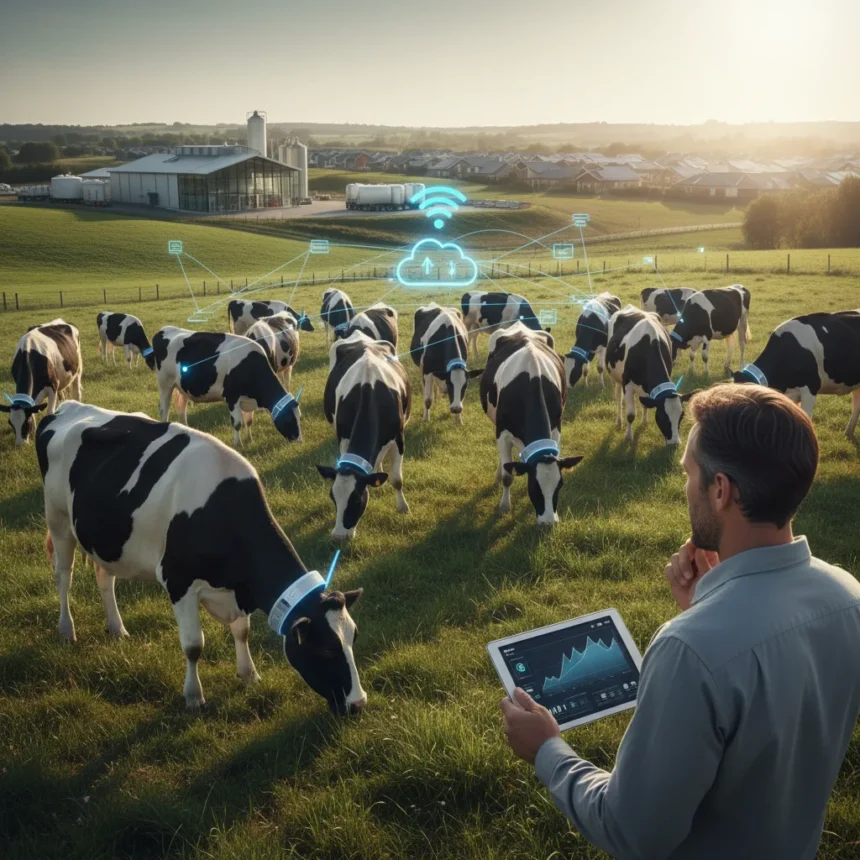
AI collars for cows are moving beyond the farm’s edge into a broader conversation about food production costs and consumer prices. Dairy farmers worldwide are adopting wearable technology that tracks heat cycles, monitors health metrics, and controls grazing patterns—cutting operational expenses and labor demands in ways that ripple through global supply chains.
Key Takeaways
- AI collars detect cow heat with greater accuracy than human observation, improving conception and submission rates.
- Solar-powered virtual fencing collars save farms 20 to 40 hours per week by eliminating manual fence work.
- Early illness detection via collar monitoring reduces unnecessary antibiotic treatments and milk withholding costs.
- In Ireland, only 25% of suckler herd calves come from artificial insemination sires, a gap AI collars help close.
- Three distinct collar systems—Nedap, Halter, and Moocall HEAT—target different herd management challenges.
How AI collars for cows reduce farm labor and costs
The labor savings alone justify adoption for many farmers. Halter collars, which are solar-powered and GPS-enabled, use sound and vibration to guide cows across virtual boundaries drawn on a smartphone app. A farmer can set invisible fences, timed gates, and automated movement patterns without stringing physical wire or hiring workers to move animals manually. The result: 20 to 40 hours of labor saved per week on a typical farm.
Beyond fencing, Nedap smart collars provide real-time monitoring through the Lely Horizon dashboard, displaying heat detection, rumination patterns, activity levels, and eating duration for every animal. Jeff McCauley, a third-generation dairy farmer in Cora Lynn, Australia, manages two high-performing farms using Nedap collars and reports increased conception rates, higher submission rates, lower days in milk, and greater milk production. Early illness detection means farmers can monitor whether a sick cow is recovering without defaulting to antibiotics—avoiding the cost and milk-withholding period that follows treatment.
Why heat detection matters for breeding and genetics
Accurate heat detection is the bottleneck that prevents many farmers from using artificial insemination. In Ireland, only 25% of suckler herd calves are born from AI sires; the other 75% rely on stock bulls because farmers struggle to reliably identify when cows are in standing heat. Moocall HEAT addresses this by fitting a collar to a vasectomised bull and RFID tags to all cows in the herd. When the bull detects a cow in standing heat through his activity patterns, the system sends a text alert, allowing the farmer to perform insemination 12 to 14 hours later.



This matters because AI sires carry superior genetics for milk production, disease resistance, and other traits. When farmers cannot reliably detect heat, they resort to keeping stock bulls as a backup—an expensive, labor-intensive alternative. Nine farmers in a New Zealand study found collar-based heat monitoring useful during AI mating, reducing reliance on other observation aids and cutting straw usage. The technology essentially democratizes access to premium genetics for farmers who lack the time or skill to spot heat manually.
The broader impact on food production and consumer prices
These cost reductions compound across herds and regions. Fewer antibiotics used means lower veterinary expenses and less milk withholding. Less labor spent on fencing and herd movement frees farmers to focus on other productivity gains. Lower conception cycles and higher milk production per cow increase output per dollar spent. None of these savings is earth-shattering alone, but collectively they address a persistent pressure: rising farm operating costs that get passed to consumers.



Virtual fencing also delivers environmental benefits that may lower compliance costs. Halter collars can protect waterways by preventing cattle from congregating in sensitive areas, improve pasture utilization by rotating cows more frequently and precisely, and support regulatory compliance for grazing practices. As food producers face tighter environmental standards, technology that improves land stewardship while cutting labor is a dual win.
What separates the three main collar systems?
Nedap collars excel at health and fertility monitoring. The dashboard approach gives farmers a single screen to track individual cow performance, making it easy to spot trends and decide whether intervention is needed. Halter prioritizes labor reduction and pasture management through virtual fencing and GPS tracking. Moocall HEAT is purpose-built for suckler herds where grazing-based AI is the goal, using a vasectomised bull as a biological heat detector.
The choice depends on farm type and priority. A dairy farmer focused on milk production and conception rates chooses Nedap. A grazing-intensive operation seeking labor savings and pasture control chooses Halter. A suckler herd wanting to increase AI adoption chooses Moocall HEAT. No single collar solves every problem, but the existence of multiple options means farmers can match technology to their specific challenge.
Are AI collars worth the investment?
The case is strongest for large-scale operations and those with acute labor shortages. A farm saving 40 hours per week on fencing alone recovers the collar investment quickly. Improved conception rates and lower days in milk compound savings. Early illness detection prevents costly treatments and production loss. For smaller operations or those with abundant low-cost labor, the return may be slower. The research brief contains no pricing data, so farmers must evaluate cost against their own labor rates and productivity targets.


Can AI collars replace traditional herd management entirely?
No. Collars provide data and automation, but they do not replace veterinary care, nutrition planning, or strategic breeding decisions. They are tools that make human management more efficient, not substitutes for it. A farmer still needs to interpret dashboard alerts, decide on treatment protocols, and manage genetics strategy. What collars eliminate is the routine drudgery—the daily fence checks, the manual heat observation, the constant movement of animals by hand or dog.
How do AI collars compare to ear tags and boluses for heat detection?
Collar-based systems detect heat through behavioral changes (rumination, activity, standing heat itself) whereas ear tags and boluses rely on temperature or other physiological markers. Collars offer broader data—activity, eating, location—making them more versatile for herd management beyond breeding. A New Zealand study found collars useful for reducing reliance on other heat observation aids, suggesting they outperform simpler alternatives in practical farm settings.
The shift toward AI collars reflects a maturation of farm technology from single-purpose gadgets to integrated systems. Farmers are not just buying a heat detector; they are buying visibility into herd behavior, labor automation, and data-driven decision-making. As farm costs rise and labor becomes scarcer, that visibility becomes less of a luxury and more of a necessity. The collars themselves are the headline, but the real story is how technology is reshaping the economics of food production—and potentially stabilizing the costs consumers pay at the grocery store.
Edited by the All Things Geek team.
Source: Tom's Guide