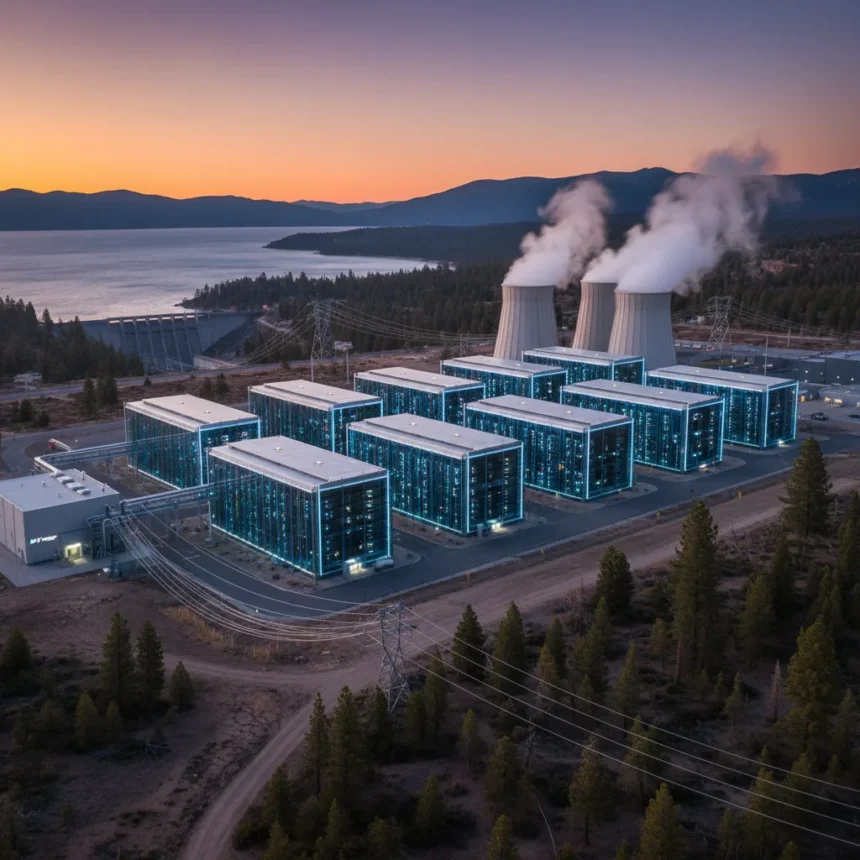
The collision between artificial intelligence infrastructure and residential power needs is no longer theoretical. AI data centers power grid demands are about to hit Lake Tahoe hard. NV Energy, the region’s power provider, plans to redirect electricity originally allocated for up to 49,000 residents to feed 12 proposed AI data centers—a move that could leave homes dark starting May 2027 unless regulators approve alternative supply arrangements.
Key Takeaways
- NV Energy wants to redirect Lake Tahoe residential power to 12 AI data centers consuming up to 2 gigawatts.
- Up to 49,000 residents could lose power by May 2027 if no alternative supply is secured.
- The California Public Utilities Commission and Nevada regulators have not approved the reallocation, creating regulatory limbo.
- Data center power demand is described as unprecedented, driven by AI computing needs.
- Competing proposals include solar microgrids and power imports from PG&E.
Why AI data centers power grid conflicts are escalating now
The timing is brutal. NV Energy filed notices in late 2025 describing demand from AI data centers as unprecedented. The 12 proposed facilities would consume approximately 2 gigawatts of power—equivalent to the electricity needs of a major city. This is not a regional anomaly. Data center electricity consumption is projected to reach 8 percent of total US power generation by 2030, according to industry forecasts. Lake Tahoe happens to sit at the intersection of two states, two regulatory bodies, and decades-old environmental agreements that never anticipated this scenario.
The power supply currently allocated to Lake Tahoe residents was permitted under specific environmental rules governing the Tahoe Basin. Those rules were written for residential use. Redirecting that supply to commercial data centers requires new approvals from both the California Public Utilities Commission (CPUC) and Nevada regulators. That process is moving slowly. An anonymous CPUC regulator noted in a filing that residential loads have priority, but permits were never intended for this explosion in AI infrastructure. The backlog is real. Approvals that might have taken months in 2020 now face months of delays.
The regulatory limbo blocking solutions
Neither the CPUC nor Nevada regulators have approved the reallocation of Lake Tahoe’s residential power to data centers. This creates a dangerous gap between demand and permission. NV Energy spokesperson stated the company is working with stakeholders to explore all options, but the scale of data center demand requires reallocating resources where possible. That statement, polite as it is, masks a hard truth: without regulatory approval, the power cannot legally be redirected. Without redirection, the data centers cannot be built. And without new power sources, residents face outages.



The May 2027 deadline is not arbitrary. It reflects NV Energy’s project timeline and regulatory filing schedule. But deadlines slip. What matters is that the company has already signaled its intent. Residents and environmental groups, including the Sierra Club, are pushing back. They argue that redirecting power violates Tahoe Basin water and power compacts designed to protect the region’s delicate ecosystem and residential stability. Tech firms—xAI, Microsoft, and others—counter that data centers boost regional economies and job growth. This is the core tension: immediate local pain versus promised economic gain.
What alternatives exist for AI data centers power grid demands
Lake Tahoe residents are not powerless, though the irony is sharp. Advocates are pushing three paths forward. First, solar microgrids could supply some AI data center load, reducing the draw on the main grid. Second, power imports from Pacific Gas & Electric (PG&E) could supplement NV Energy’s supply. Third, data centers could be sited elsewhere—Nevada approved a 1.5 gigawatt data center project in Reno, and Meta has built a 1 gigawatt AI farm in Iowa. None of these alternatives are being actively pursued by NV Energy or the tech companies. That silence is telling.



The comparison to Reno and Iowa matters. Both regions approved large data center projects without threatening residential power. Reno’s project and Iowa’s Meta facility suggest that AI infrastructure and residential stability are not mutually exclusive—they require planning, regulatory clarity, and alternative supply sources. Lake Tahoe has none of those yet. The region is caught between a power company seeking to maximize revenue from high-demand tenants and regulators who have not yet decided whether residential needs or commercial opportunity takes priority.
What happens if regulators say no?
If the CPUC and Nevada regulators reject the reallocation, the 12 data centers cannot be built—at least not in Lake Tahoe. NV Energy would need to find alternative power sources or the projects would move elsewhere. If they say yes without securing new supply, residents lose power. If they delay past May 2027, the projects stall and NV Energy faces pressure from tech firms demanding certainty. This is regulatory limbo at its most consequential. Residents have no guarantee of power. Tech companies have no guarantee of sites. Regulators have no good options.
The broader question is whether this scenario will repeat across America. Data centers are clustering in regions with cheap power and cool climates. Lake Tahoe has both. So do parts of Oregon, upstate New York, and the upper Midwest. If regulators in those regions face the same pressure to redirect residential power to commercial data centers, the precedent set in Lake Tahoe matters enormously. A yes vote signals that AI infrastructure takes priority over residential stability. A no vote signals that communities can resist. Either way, the electricity crisis is real, and it is arriving faster than anyone expected.
Could Lake Tahoe residents actually lose power?
Yes, but only if three conditions align: the CPUC and Nevada regulators approve the power reallocation, no alternative supply is secured by May 2027, and NV Energy proceeds with the redirection. The research brief describes this as a could happen scenario, not an inevitable one. Regulatory approval is uncertain. Alternative power sources exist but are not being pursued. Tech companies and the power company could negotiate different terms. What is certain is that the conflict is real, the deadline is firm, and the stakes for 49,000 residents are high.


Why does AI demand so much electricity?
Training and running large language models consumes vast amounts of power. A single query to an AI system like ChatGPT or Claude uses more electricity than a traditional Google search. Multiply that by millions of daily queries, add the power needed for training new models, and data centers become power-hungry facilities that rival small cities. The 2 gigawatts proposed for Lake Tahoe reflects the scale of AI workloads that companies like xAI and Microsoft are planning. This is not a temporary spike—it is the new baseline for AI infrastructure.
What could resolve the Lake Tahoe power crisis?
Three realistic paths exist. First, NV Energy could negotiate with tech companies to build smaller data centers that do not require residential power reallocation. Second, regulators could approve new power imports from PG&E or other sources, eliminating the need to redirect existing residential supply. Third, data center projects could be relocated to regions with more abundant power, like Iowa or Nevada’s Reno area. None of these solutions are currently on the table. Inaction favors the status quo: regulatory limbo, May 2027 deadline approaching, and residents waiting to see if they will have power.
The Lake Tahoe power crisis is not about technology or innovation—it is about infrastructure, regulation, and priorities. AI data centers power grid demands are real and growing. So is the need to keep homes lit and communities stable. Regulators must choose. Tech companies must compromise. And power companies must stop treating residential electricity as a commodity to be redirected at will. Until one of those things changes, 49,000 residents are watching a clock count down to a deadline that could reshape their lives.
Edited by the All Things Geek team.
Source: Tom's Hardware