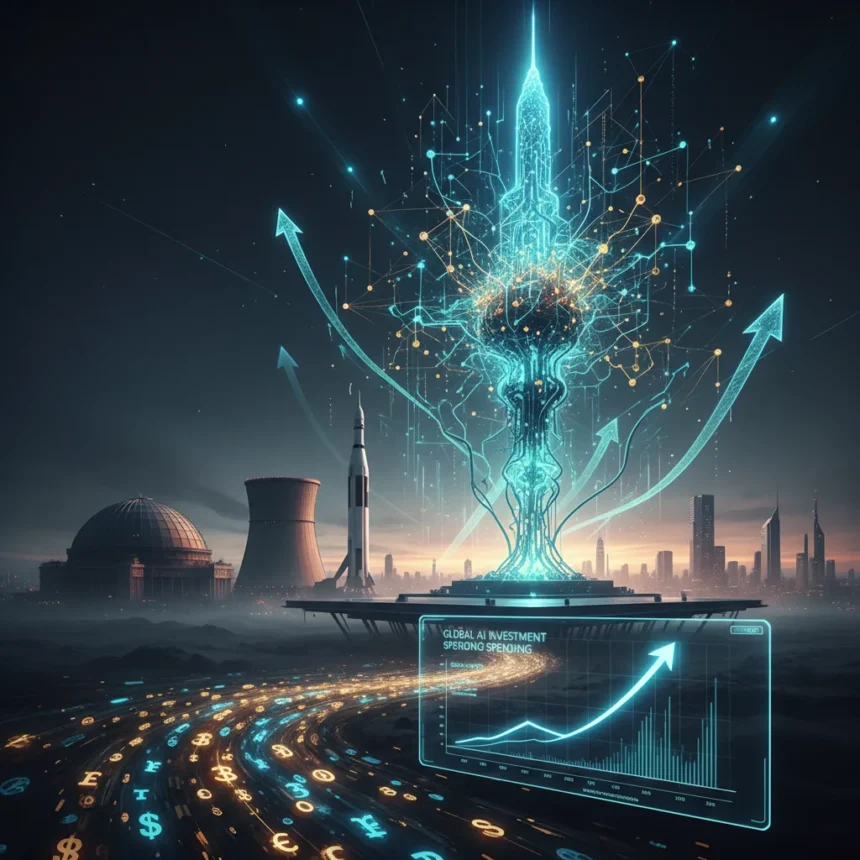
AI investment spending has reached a threshold that puts it in the company of humanity’s most ambitious projects. The total capital flowing into artificial intelligence development and infrastructure now exceeds the combined budgets of the Apollo program, the International Space Station, and the Manhattan Project—and the money keeps flowing harder in 2026.
Key Takeaways
- AI investment spending now surpasses Apollo, ISS, and Manhattan Project budgets combined.
- Gartner forecasts approximately $2.5 trillion in AI investment for 2026 alone.
- Data centre expansion plans face significant delays, with 30–50% of 2026 deployments projected to be postponed or cancelled.
- The acceleration shows no signs of slowing despite infrastructure constraints.
- This spending level reflects investor confidence in AI’s transformative potential across industries.
The Scale of AI Investment Spending Compared to Historic Programs
When you stack AI investment spending against the most expensive government projects in history, the numbers become staggering. The Apollo program cost roughly $280 billion in today’s dollars. The International Space Station has consumed approximately $150 billion over its operational lifetime. The Manhattan Project, adjusted for inflation, cost around $28 billion. Combined, these three monumental undertakings total less than what the AI industry is projected to spend in 2026 alone.
This comparison reveals not just the scale of AI investment spending but the velocity of capital deployment. These historic projects unfolded over decades. AI is consuming comparable resources in single years. The speed matters because it signals how intensely the technology sector and investors believe in artificial intelligence’s near-term commercial potential.
What Gartner’s 2026 AI Investment Forecast Reveals
Gartner is forecasting approximately $2.5 trillion in AI investment for 2026 alone. That figure encompasses everything from software development and model training to data centre construction and GPU procurement. For context, $2.5 trillion exceeds the annual GDP of all but a handful of nations. It is larger than the entire defence budget of most countries.


The forecast underscores a critical reality: AI investment spending is not a bubble that peaked in 2024 or 2025. Instead, capital continues to accelerate into the space. Companies from established tech giants to well-funded startups are all competing to secure computing resources, hire talent, and build proprietary models. This competition drives spending upward regardless of whether individual projects deliver immediate returns.
Infrastructure Bottlenecks Are Not Slowing Investment
Despite ambitious expansion plans, data centre infrastructure cannot keep pace with demand. Gartner research indicates that 30–50% of AI data centres planned for 2026 deployment will be delayed or cancelled. Chip shortages, real estate constraints, power availability limitations, and construction timelines all contribute to these delays.



Yet this infrastructure gap has not deterred investment. Instead, companies are bidding up prices for existing capacity and placing orders years in advance for future supply. The bottleneck creates scarcity economics that actually accelerates AI investment spending rather than dampening it. When you cannot buy the hardware you need today, you spend more to secure it tomorrow.
Why AI Investment Spending Keeps Accelerating
Three factors explain the relentless growth in AI investment spending. First, the technology demonstrates genuine capabilities that justify commercial interest. Large language models, image generation systems, and reasoning frameworks are producing outputs that businesses can monetize. Second, competitive pressure forces spending—no major tech company can afford to fall behind in AI capability or they risk losing market position. Third, venture capital and institutional investors remain convinced that AI represents a generational opportunity worth massive capital allocation.
The comparison to Apollo, the ISS, and the Manhattan Project is instructive but incomplete. Those projects had defined endpoints and fixed budgets. AI investment spending has neither. It is an open-ended commitment to a technology that is still in early stages of development. As long as the technology continues to improve and find commercial applications, the spending will likely continue to grow.
How does AI investment spending compare to other technology booms?
The dot-com bubble saw peak venture capital deployment of roughly $100 billion annually in 1999–2000. Mobile computing attracted comparable levels of investment at its peak. AI investment spending is running at multiples of those figures, suggesting either greater conviction in the technology’s potential or a more dangerous speculative excess. Likely, it is some combination of both.



Will AI investment spending decline in 2027?
Short-term pullbacks are possible if major models fail to deliver expected returns or if capital markets tighten. However, the structural factors driving investment—competitive pressure, genuine capability improvements, and the belief that AI will reshape industries—show no signs of reversing. A sustained decline would require either technological stagnation or a major financial crisis, neither of which is currently evident.
Why do infrastructure delays not slow AI investment spending?
Scarcity increases prices and urgency. When data centre capacity is constrained, companies bid higher for available resources and commit to future orders at premium rates. This dynamic actually accelerates total spending even as it delays individual projects. The bottleneck creates a vicious cycle where constrained supply drives up costs, which in turn justifies larger budgets.
The sheer magnitude of AI investment spending—now exceeding the combined cost of Apollo, the ISS, and the Manhattan Project—should prompt reflection on what this capital is actually building and whether the returns will justify the outlay. For now, the money keeps flowing, and 2026 will likely see AI investment spending continue its steep climb.
Edited by the All Things Geek team.
Source: TechRadar