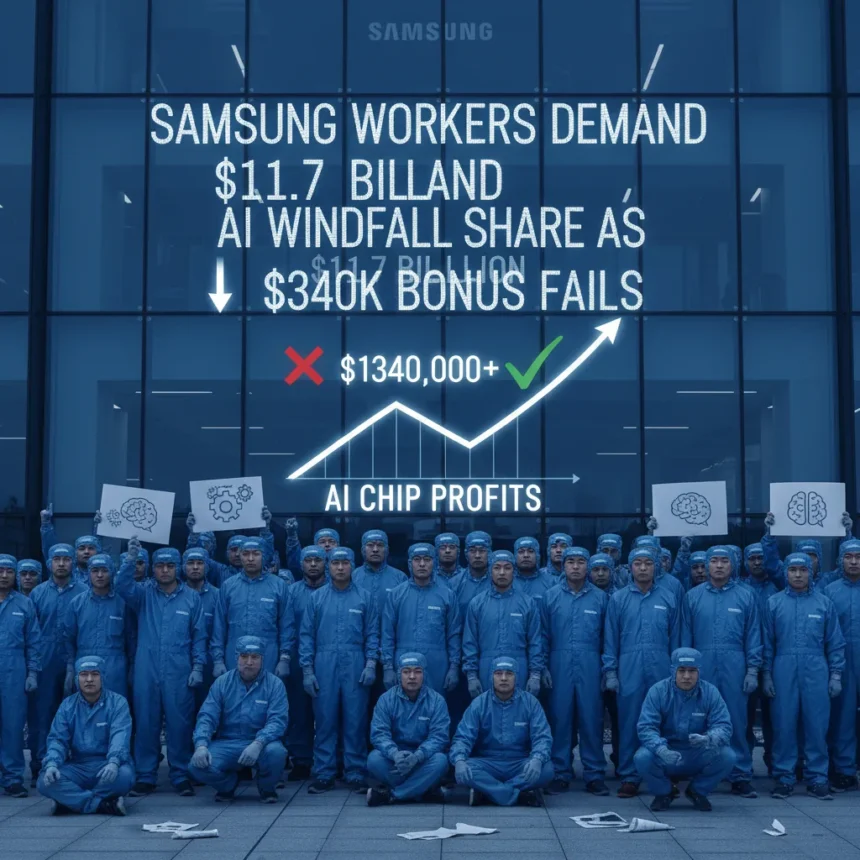
Semiconductor worker compensation AI has become the flashpoint of a historic labor dispute at Samsung Electronics. Over 30,000 workers in the chipmaker’s semiconductor division rejected a one-time bonus package worth up to $340,000 per employee in late April 2026, arguing that the AI boom demands permanent, recurring payouts instead.
Key Takeaways
- Samsung offered a one-time $340,000 bonus; workers demand annual payouts worth $400,000 to $1 million tied to AI profits.
- SK hynix workers already secured $477,000 bonuses in 2026, rising to $900,000 in 2027 under a 10-year guarantee.
- A potential 18-day strike by 74,000 workers starting May 21, 2026, could cost Samsung up to $11.7 billion.
- Samsung’s Q1 2026 operating profit hit a record 57.2 trillion KRW, driven by AI memory chip demand.
- The dispute centers on whether AI profits represent a one-time windfall or a new structural reality requiring permanent compensation restructuring.
Why AI Profits Are Reshaping Semiconductor Labor
The semiconductor worker compensation AI dispute reflects a fundamental disagreement about how to share the spoils of artificial intelligence’s explosive growth. Samsung’s chip division, which employs roughly 74,000 to 77,000 workers—80 percent of the company’s total workforce—has become the engine of record profits as demand for memory chips powering AI data centers and systems skyrockets. The company’s Q1 2026 operating profit reached 57.2 trillion KRW, a historic peak driven almost entirely by AI infrastructure demand.
Samsung management framed the $340,000 bonus as a generous one-time reward, tied to a percentage of operating profit but explicitly structured not to recur annually. Workers and their union representatives rejected this framing outright. They argue that AI demand for high-bandwidth memory (HBM) and other semiconductor products represents a structural shift in the industry, not a temporary spike. If AI profits are permanent, the logic goes, compensation tied to those profits should be permanent too.
The union’s demands are concrete: 15 percent of the chip division’s operating profits as annual bonuses (equivalent to roughly $400,000 per employee based on forecasts), removal of bonus caps that currently limit payouts to 50 percent of annual base salary, and 7 percent wage increases across the board. These figures are not arbitrary—they reflect direct comparison to rival SK hynix, which has already secured far better terms for its own workers.



The SK Hynix Precedent and Competitive Pressure
SK hynix, Samsung’s closest competitor and the world’s second-largest memory chip manufacturer, has fundamentally altered the labor landscape in semiconductors. The company guaranteed its workers $477,000 in bonuses for 2026, with payouts nearly doubling to $900,000 in 2027 and beyond, locked in for a full decade. This is not a promise—it is a contractual guarantee, immune to quarterly earnings volatility or management whims.
Samsung management responded by pledging that total compensation would exceed SK hynix’s levels, but the offer remained structured around one-time payments and restricted stock rather than the cash bonuses workers demanded. The union saw this as a bait-and-switch: Samsung was offering paper wealth and restricted equity while SK hynix was delivering cash. For workers with mortgages and families to support, the distinction is material.



The competitive dynamic is brutal. Samsung and SK hynix together produce roughly two-thirds of the world’s memory chips, giving them outsized power to set industry wages—and giving workers at either company leverage to demand parity. If Samsung loses 74,000 workers to an 18-day strike, or if those workers migrate to SK hynix or other competitors offering better terms, Samsung’s AI chip dominance becomes a liability rather than an asset.
The Strike Threat and Financial Stakes
The union’s bargaining position is backed by concrete action. In late April 2026, 74,000 workers voted to authorize an 18-day strike beginning May 21, 2026, if negotiations failed to produce acceptable terms. The financial consequences for Samsung are staggering: analysts estimate that a strike of that duration could cost the company up to $11.7 billion in lost revenue and disrupted orders.
That figure is not hyperbole. Samsung‘s memory chip division supplies AI infrastructure providers worldwide—the data centers powering ChatGPT, Claude, and other large language models depend on steady supplies of HBM and DRAM. A three-week production halt would ripple across the entire AI industry, creating backlogs that would take months to clear. Customers would be forced to source from SK hynix or other suppliers, and some might never return to Samsung even after production resumed.
Samsung has also offered 6.2 percent base salary increases and preferential housing loans, but the union dismissed these as insufficient. The core issue is not marginal wage growth—it is the principle of whether workers share structurally in the profits their labor generates. The AI boom has created a once-in-a-generation wealth transfer. The question is whether that wealth stays concentrated at the executive and shareholder level or flows to the workers whose expertise and overtime made the chips possible.


Why This Matters Beyond Samsung
The Samsung semiconductor worker compensation AI battle is not isolated to one company or one country. It signals a broader reckoning in technology labor markets: as AI generates unprecedented profits, workers are demanding permanent, transparent cuts rather than discretionary bonuses. Wall Street traders have long received annual bonuses tied to firm profitability; semiconductor workers are arguing they deserve the same structure.
If Samsung capitulates and agrees to 15 percent profit-sharing, other chipmakers—and other tech companies—will face similar demands. If Samsung holds the line, it risks a strike that could reshape the global AI infrastructure supply chain. Either way, the era of one-time bonuses masquerading as generosity is ending. The AI boom has made it impossible to pretend that semiconductor workers are fungible labor rather than the architects of trillion-dollar industries.
What happens if Samsung workers strike on May 21?
An 18-day strike by 74,000 workers would halt production at Samsung’s major chip facilities, including the Pyeongtaek complex where the April 2026 rally took place. Global AI data center operators would face severe memory chip shortages, potentially delaying AI infrastructure expansion through 2027. Samsung’s revenue loss could exceed $11.7 billion, and customer relationships could suffer permanent damage.
How much are SK hynix workers actually getting?
SK hynix workers secured $477,000 in bonuses for 2026, rising to $900,000 in 2027 and locked in for ten years. This is guaranteed cash, not stock options or restricted equity, making it directly comparable to Samsung’s offer and demonstrating why Samsung workers view the $340,000 one-time bonus as inadequate.
Why does the union want 15 percent of operating profits?
The union calculates that 15 percent of Samsung’s forecasted full-year 2026 operating profit (roughly 30 trillion KRW) would create a bonus pool of approximately 4.5 trillion KRW, or about $400,000 per worker. This figure aligns with SK hynix benchmarks and reflects the union’s position that workers deserve permanent, transparent profit-sharing rather than discretionary one-time payouts.
The Samsung semiconductor worker compensation AI dispute crystallizes a fundamental shift in tech labor dynamics. Workers have moved from accepting one-time bonuses as windfalls to demanding permanent structures that tie their compensation directly to company profitability. With an 18-day strike looming and billions of dollars at stake, Samsung faces a choice: restructure compensation to acknowledge workers as permanent stakeholders in AI profits, or risk the most costly labor action in its history. Either way, the semiconductor industry’s approach to worker compensation will never be the same.
Edited by the All Things Geek team.
Source: Tom's Guide