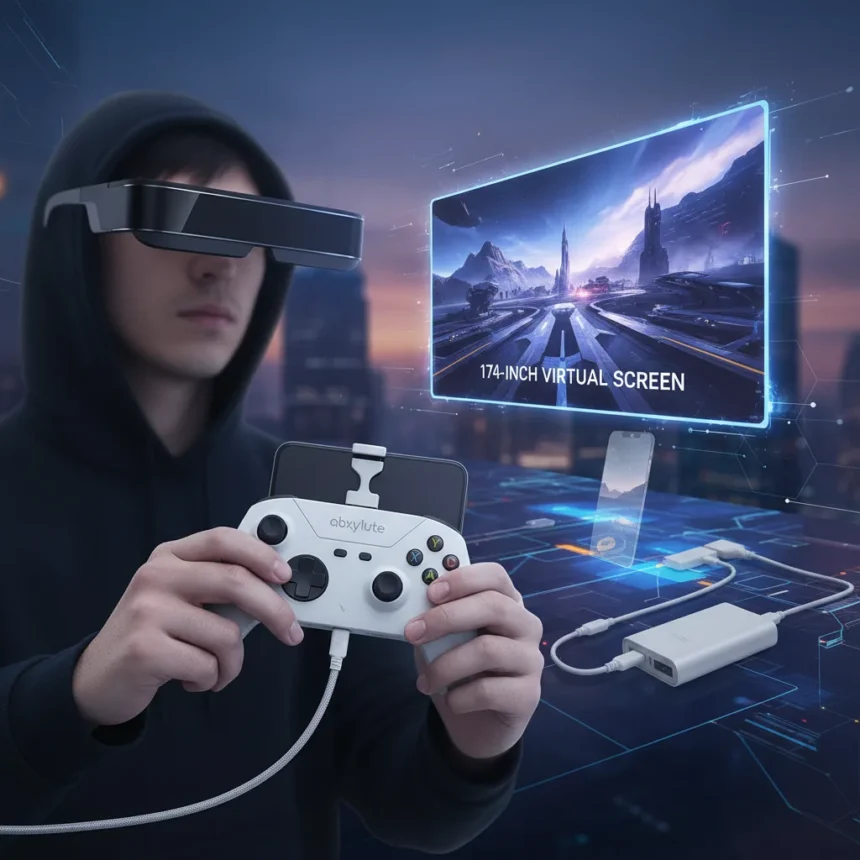
VITURE Beast smart glasses represent the company’s most ambitious push yet into portable XR gaming, arriving alongside the abxylute S9V controller to create what may be the most cohesive XR ecosystem for smartphone users. Launched in April 2026, the Beast weighs just 88 grams and projects a 174-inch ultra-sharp virtual display with a 58-degree field of view, powered by Sony’s latest micro-OLED panels for 4K-like visuals.
Key Takeaways
- VITURE Beast XR glasses weigh 88g and feature a 174-inch virtual display with 3DoF anchoring and dynamic tinting.
- abxylute S9V controller adds USB-C video passthrough specifically designed for VITURE XR glasses and mobile devices.
- Beast connects via single USB-C cable to iPhones, MacBooks, Windows PCs, and Steam Deck for immediate compatibility.
- Pro Mobile Dock ($129) enables console gaming on PS5, Xbox, and Nintendo Switch 2.
- VITURE Beast costs $549; Beast Cloud Pack bundle with Pro Neckband is $798.
Why VITURE Beast Dominates the Portable XR Space
The VITURE Beast solves a problem that Apple Vision Pro and other standalone headsets ignore: most people want to game on their phone without tethering themselves to a desktop. At 88 grams, it’s light enough for extended gaming sessions. The 174-inch virtual display transforms any smartphone into a cinema-scale gaming device. Unlike competitors that force you into their ecosystem, the Beast connects to whatever device you already own—iPhone, Android, Windows laptop, or Steam Deck—through a single USB-C cable. No proprietary ecosystem lock-in, no mandatory app store approval.
The display itself matters. Sony’s micro-OLED panels deliver the kind of image quality that makes portable gaming feel legitimate, not like a compromise. The 58-degree field of view is wide enough for immersion without the claustrophobic tunnel vision of cheaper AR glasses. Three-degree-of-freedom anchoring means virtual windows stay put when you move your head, a critical feature for gaming that lesser glasses skip entirely.
abxylute S9V Fills the Mobile Controller Gap
The abxylute S9V is VITURE’s second telescopic mobile controller, and it’s purpose-built for XR. Where the original relied on Bluetooth and a 3.5mm jack, the S9V adds USB-C video passthrough—meaning your phone’s video signal flows directly through the controller to the Beast glasses without additional cables. This simplifies setup dramatically. Clip your iPhone or Android phone into the S9V, connect the controller to the Beast via USB-C, and you’re gaming on a 174-inch screen within seconds.


The controller works with both iPhone and Android, a flexibility that Xreal’s ecosystem struggles to match. One reviewer noted the S9V’s main limitation: it only works with VITURE’s XR glasses, not as a standalone gaming controller. That’s a fair trade-off for a device engineered specifically for one ecosystem rather than compromised to serve many.
VITURE Beast Smart Glasses vs. the Competition
Apple Vision Pro weighs 600 grams and costs $3,500. The VITURE Beast weighs 88 grams and costs $549. That’s not just a price difference—it’s a different product category entirely. Vision Pro is a spatial computer; Beast is a portable display for devices you already own. The comparison matters because it clarifies what VITURE is actually selling: the best way to turn your smartphone into an XR gaming machine, not a replacement for your phone.


Xreal’s One and 1S remain solid competitors, but they lack VITURE’s breadth. The Beast connects to consoles via the Pro Mobile Dock ($129), enabling PS5 and Xbox gaming on a 174-inch virtual screen. Xreal offers no equivalent. VITURE’s ecosystem now spans the Luma line (Luma, Luma Pro, Luma Ultra) plus the Beast, with accessories like the Pro Neckband for cloud gaming and streaming. That ecosystem depth—multiple glasses tiers, compatible controllers, console docks, cloud-streaming accessories—is what separates VITURE from one-off products.
Console Gaming Gets Serious
The Pro Mobile Dock transforms the Beast into a console gaming display. Connect your PS5, Xbox, or Nintendo Switch 2 controller to the dock, clip your phone in, and the Beast glasses display the console’s output on a 174-inch virtual screen. At $129, it’s not free, but it’s cheaper than most gaming monitors and infinitely more portable. This is where VITURE’s ecosystem thinking really shows—they’re not just selling glasses, they’re selling a complete portable gaming platform that spans phones, PCs, and consoles.
The Cloud Gaming Angle
The Beast Cloud Pack bundles the glasses with the Pro Neckband, a wearable that handles cloud connectivity with reduced latency and improved graphics. Priced at $798 (down from $906), it’s VITURE’s answer to the question: what if you could stream AAA games to your glasses anywhere? The neckband offloads processing from your phone, keeping the glasses lightweight while delivering console-quality visuals over the cloud.
What Holds VITURE Back
The ecosystem is powerful, but it’s still phone-dependent. Unlike Vision Pro, which is a standalone device, the Beast requires a smartphone to function. That’s not a flaw—it’s the entire point—but it means you’re carrying two devices instead of one. The abxylute S9V, while excellent, only works with VITURE glasses, limiting its appeal to existing ecosystem members. If you own Xreal glasses or any other XR headset, the S9V is useless to you.

Should You Buy VITURE Beast Smart Glasses?
If you game on your phone or want to stream console games anywhere, the VITURE Beast is the most compelling option available. At $549, it costs less than a high-end gaming monitor and delivers a 174-inch display you can take anywhere. The abxylute S9V controller ($price unlisted in sources) makes setup seamless. The Pro Mobile Dock ($129) adds console support. The Pro Neckband ($price included in $798 Cloud Pack) enables cloud gaming. Every accessory solves a real problem rather than adding bloat.
The only reason not to buy is if you’re deeply invested in a competing ecosystem or if you need a standalone device that doesn’t require a phone. For everyone else—mobile gamers, cloud streaming enthusiasts, console players who travel—VITURE Beast is the portable XR display to beat.
How does the VITURE Beast compare to Xreal One?
The Beast and Xreal One both connect to phones and offer large virtual displays, but the Beast has a larger 174-inch screen, lighter 88-gram weight, and console support via the Pro Mobile Dock. Xreal One lacks console compatibility and a comparable ecosystem of accessories. The Beast is the first truly compelling alternative to Xreal’s leadership in portable XR.
Can you use VITURE Beast with any phone?
Yes. The Beast connects via USB-C to iPhones, Android phones, MacBooks, Windows laptops, and Steam Deck. Any device with USB-C or USB-A (via adapter) is compatible. This universal approach is a major advantage over closed ecosystems that lock you into one brand’s phones.
What’s the difference between VITURE Beast and Luma Pro?
The Beast is the flagship with a 174-inch display, 58-degree FOV, and the latest Sony micro-OLED panels. The Luma Pro is an earlier generation in VITURE’s lineup with smaller display and lower specs. Beast is the superior choice for gaming and cloud streaming; Luma Pro suits casual use and lower budgets.
VITURE Beast and the abxylute S9V represent a maturation of portable XR. They prove that you don’t need a $3,500 spatial computer to game on a massive virtual display. You just need glasses that weigh less than a smartphone, a controller designed for the job, and a company willing to build an ecosystem around your existing devices. That’s what VITURE delivers.
Where to Buy
Amazon | $689 | Viture's Pro Neckband | Abxylute S9
Edited by the All Things Geek team.
Source: Android Central