





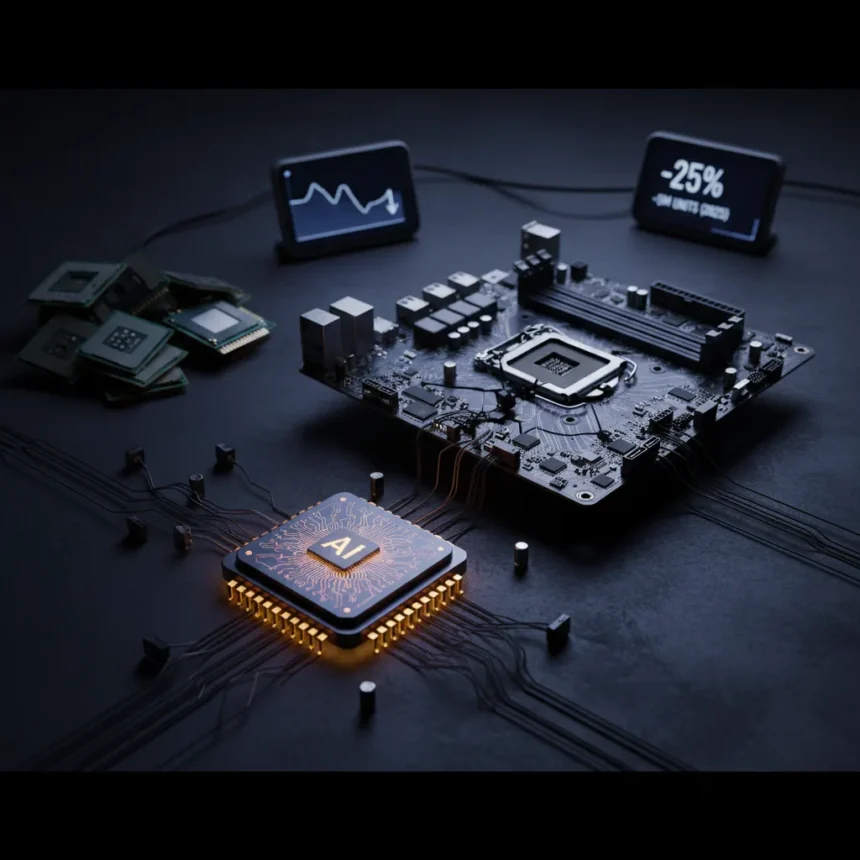
The motherboard sales collapse is reshaping the PC enthusiast market in 2025, with chipmakers redirecting production capacity toward AI chips and leaving traditional PC builders stranded. Asus alone is projected to sell 5 million fewer motherboards in 2025 compared to the prior year, while Gigabyte, MSI, and ASRock face similarly devastating declines. This is not a gradual slowdown—it is a structural realignment that threatens the entire consumer PC ecosystem.
Key Takeaways
- Motherboard sales for Asus, Gigabyte, and MSI down 40-50% versus the same period in 2024
- Combined sales of the four largest manufacturers expected to fall 28% in 2026, with 11.7 million fewer units shipped industry-wide
- DDR5 memory prices skyrocketed from $125 to $560 for a kit between Fall 2025 and Winter 2026, pricing out consumers
- CPU shipments in Germany dropped nearly 25 times lower in late 2025 compared to January 2025
- AMD and Intel expect 15-20% processor shipment declines in Q1 2026 due to motherboard market collapse
Why the Motherboard Sales Collapse Is Happening
The motherboard sales collapse stems from two converging forces: exploding memory costs and chipmakers’ deliberate shift toward AI production. DDR5 memory kits that sold for $125 in Fall 2025 now cost $560 in Winter 2026—a 348% increase that has made new PC builds economically irrational for most consumers. When a single memory upgrade costs more than a used graphics card, builders simply stop building. The knock-on effect cascades through the entire supply chain, starting with motherboards.
Simultaneously, semiconductor manufacturers have reallocated fab capacity to AI chips, which command premium pricing and attract institutional demand. This is not accidental scarcity—it is a calculated business decision. A chipmaker can produce fewer AI processors at higher margins than it can produce consumer CPUs and chipsets. Enthusiast PC components become the collateral damage of this pivot.
The German retailer Mindfactory data paints a stark picture: CPU shipments in late 2025 were nearly 25 times lower than in January 2025. This is not normal seasonal variation. This is market collapse.


The Motherboard Sales Collapse by the Numbers
Asus is projected to sell 5 million fewer motherboards in 2025 than in the prior year. Gigabyte and MSI are tracking similar declines, with industry reports citing 40-50% year-over-year drops for these manufacturers. The combined effect is staggering: the four largest motherboard makers—Asus, Gigabyte, MSI, and ASRock—are expected to see combined sales fall by at least 28% in 2026, representing 11.7 million fewer units shipped across the entire industry.
Even manufacturers trying to hit ambitious targets are doing so from a much lower baseline. MSI is on track to ship over 10 million motherboards in 2025, a milestone that would match Gigabyte. But this achievement is hollow when placed in context: MSI experienced a 40% decline in 2022 and is now operating in a market where growth is impossible. Hitting 10 million units in a collapsing market is like celebrating a gold medal in a shrinking sport.



AMD and Intel are bracing for 15-20% declines in processor shipments in Q1 2026, directly tied to the motherboard market’s implosion. When motherboard demand falls, CPU demand follows immediately. This creates a vicious cycle: fewer PC builds mean fewer CPUs sold, which means chipmakers have even less incentive to allocate capacity to consumer processors.
Component Costs Are Strangling Builders
The motherboard sales collapse cannot be separated from the broader PC component crisis. Beyond DDR5 memory, SSDs and GPUs have also become prohibitively expensive. High-end 1TB SSDs jumped from $90 to $200, while 4TB drives climbed from $210 to $650. A complete high-end PC build that cost $1,800-2,000 two years ago now exceeds $2,400 with identical components, assuming you can even find them in stock.
This pricing environment has effectively frozen the consumer market. Analysts predict a 10% overall decline in PC sales in 2025, with MSI forecasting an even grimmer 20% decline. When the cost of entry for a new build becomes prohibitive, enthusiasts either delay purchases indefinitely or exit the market entirely. Motherboard manufacturers pay the price first.
What Happens to Chipmakers When Motherboard Sales Collapse?
The collapse creates a feedback loop that threatens chipmakers themselves. AMD and Intel are not just losing motherboard-related revenue—they are losing the volume that justifies fab investments in consumer CPU production. A 15-20% decline in Q1 2026 processor shipments is a signal that the consumer PC market is no longer worth prioritizing. This accelerates the pivot toward data center and AI chips, further starving the enthusiast market.



Gigabyte and MSI are lowering sales targets and preparing for product delays, according to industry reports. Asus is absorbing a 5 million unit loss with no clear recovery timeline. ASRock, the smallest of the four, faces proportionally larger challenges. These manufacturers cannot simply reduce production and wait for demand to return—they have fixed costs, supply chain commitments, and inventory they must move.
Will Motherboard Demand Ever Recover?
Recovery depends on two factors: memory prices stabilizing and chipmakers restoring capacity to consumer CPU production. Neither is guaranteed. DDR5 prices could remain elevated if memory manufacturers continue prioritizing data center demand. Chipmakers show no signs of reversing their AI focus, and institutional AI spending continues to accelerate. The enthusiast PC market may simply be permanently smaller than it was in 2020-2023.
MSI’s achievement of 10 million motherboards in 2025 suggests that some manufacturers may stabilize around a lower equilibrium, but this is not recovery—it is adaptation to a smaller market. Asus, Gigabyte, MSI, and ASRock will survive the motherboard sales collapse, but they will emerge as leaner companies serving a more niche audience.
Is the motherboard sales collapse affecting GPU prices?
Yes, indirectly. High-end GPUs like the RTX 5080 have also risen sharply in price as component costs climb across the board. When memory, storage, and processors all become expensive simultaneously, the total cost of a new build becomes unaffordable, which suppresses demand for GPUs as well.
Will CPU prices drop as motherboard sales collapse?
Unlikely in the short term. AMD and Intel expect 15-20% declines in processor shipments in Q1 2026, but this reflects lower volume, not lower pricing. Both companies are likely to maintain or increase prices to offset reduced volume. Consumer CPUs may actually become more expensive relative to performance as chipmakers deprioritize the segment.
Should I buy a motherboard right now?
Only if you are building or upgrading immediately. Motherboard prices are unlikely to fall significantly given the sales collapse—manufacturers will maintain margins rather than cut prices. Memory and storage remain expensive, so delaying a build does not solve the affordability problem. If you need a new system, waiting for component prices to normalize (which could take years) is riskier than building now and accepting current costs.
The motherboard sales collapse reveals a fundamental shift in semiconductor priorities. Chipmakers are abandoning the consumer PC market not because demand disappeared overnight, but because AI chips are more profitable. Enthusiasts will continue building PCs, but at smaller scale and higher cost. The golden age of affordable, accessible PC building is over.
Edited by the All Things Geek team.
Source: Tom's Hardware




