





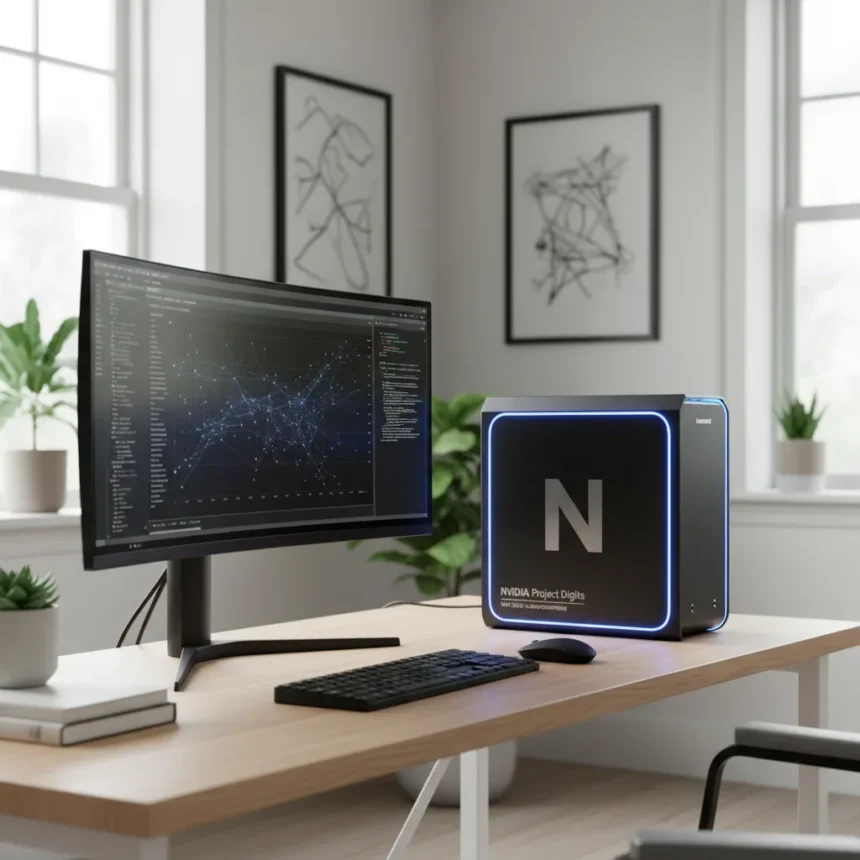
NVIDIA Project Digits is a personal AI supercomputer powered by the GB10 Grace Blackwell Superchip, designed to bring data center-class AI performance to desktops and homes starting May 2025 at $3,000. This shift matters now because AI models are exploding in size—running a 200-billion-parameter model locally eliminates the need for expensive cloud GPU rentals and queuing for shared supercomputing resources. For researchers, developers, and data scientists tired of waiting for cloud compute time, Project Digits offers a tangible alternative.
Key Takeaways
- NVIDIA Project Digits delivers 1 petaFLOP of AI performance with 128GB unified memory in a palm-sized form factor.
- Runs sophisticated AI models up to 200 billion parameters locally; two units linked handle 405 billion parameter models.
- Priced at $3,000 with sales beginning May 2025 via NVIDIA Marketplace.
- Includes NVIDIA DGX OS, CUDA libraries, RAPIDS, and frameworks for LLMs, protein folding, robotics, and computer vision.
- Outperforms dual H100 GPUs in certain 200B parameter model tasks due to higher VRAM capacity.
What Makes NVIDIA Project Digits Different
NVIDIA Project Digits represents a fundamental shift in how AI workloads reach the edge. The device resembles an Intel NUC mini-PC in size but packs the GB10 Superchip—a 20-core Grace CPU paired with a GPU featuring fifth-generation Tensor Cores with FP4 support. This architecture delivers 1 petaFLOP of AI performance, measured on sparse 4-bit floating-point workloads, alongside 128GB of unified coherent system memory and up to 4TB of storage. The entire system runs from a standard power outlet, making it genuinely desktop-friendly rather than a server-room curiosity.
The real competitive advantage lies in memory bandwidth and unified architecture. Running a 200-billion-parameter model requires massive VRAM—something cloud H100 clusters struggle with due to memory fragmentation across multiple GPUs. Project Digits houses all that memory in a single coherent pool, which hands-on demonstrations show outperforms dual H100 GPUs in certain 200B parameter model tasks. For developers accustomed to waiting hours in cloud GPU queues, this is transformative.
Local AI Training Without Cloud Dependency
Project Digits runs NVIDIA DGX OS, a Linux-based operating system preloaded with CUDA-optimized libraries, RAPIDS, NemoClaw, Isaac, Metropolis, and Holoscan frameworks. Support for PyTorch, Python, and Jupyter notebooks means developers can fine-tune models up to 70 billion parameters directly on the device. The architecture also enables Multi-Instance GPU (MIG) technology, allowing up to 7 isolated compute instances—transforming the device from a single-user desktop into a multi-tenant compute node.


This flexibility addresses a critical pain point in AI development. Protein folding research, content creation, AI chatbots, computer vision, robotics, and smart city applications all demand local compute for privacy and latency reasons. Cloud-based alternatives expose sensitive data to third-party infrastructure and introduce unpredictable network delays. Project Digits eliminates both constraints. Two units can be linked to handle models with 405 billion parameters, scaling beyond what a single device supports while maintaining complete local control.
Performance Reality Check
The 1 petaFLOP specification deserves clarification. NVIDIA measures this on sparse 4-bit floating-point workloads—a specialized configuration optimized for certain AI inference tasks. Dense full-precision benchmarks will yield lower numbers. The GB10 GPU delivers approximately 1/40th the performance of twin Blackwell GPUs in NVIDIA’s GB200 AI server, so this is not a replacement for enterprise data center infrastructure. It is, however, a replacement for renting cloud H100 clusters for development, fine-tuning, and inference workloads that fit within 200-billion-parameter bounds.



Hands-on testing already underway shows Project Digits running large language models that rival cloud-based alternatives in practical scenarios. The device trades raw peak throughput for memory capacity and unified architecture—a worthwhile trade for most research and development workflows. For teams prototyping AI applications or fine-tuning proprietary models, the privacy and cost benefits far outweigh the performance ceiling.
Ecosystem and Software Support
NVIDIA has bundled Project Digits with a mature software stack designed for enterprise and research workflows. The preloaded frameworks support inference acceleration for LLMs, data analysis, content creation, AI chatbots, protein AI models like AlphaFold, robotics, smart city systems, and computer vision applications. This breadth reflects NVIDIA’s confidence that edge AI is not a niche—it is the future of how AI workloads will be distributed.
Optional pairing with an RTX PRO 6000 GPU can enhance compute, simulation, and visualization capabilities for physical AI applications. The combination transforms Project Digits from a standalone inference engine into a complete development and deployment platform, though the RTX PRO pairing adds cost and complexity beyond the base $3,000 device.
Who Should Buy NVIDIA Project Digits?
Project Digits targets three audiences: developers tired of cloud GPU wait queues, researchers who need local compute for sensitive data, and organizations building AI applications that demand sub-100-millisecond latency. A startup fine-tuning a 70-billion-parameter model for customer service chatbots saves thousands monthly in cloud GPU rental fees. A biotech firm running AlphaFold-like protein folding keeps proprietary research off shared infrastructure. A robotics company developing autonomous systems eliminates network latency that could compromise real-time decision-making.



The $3,000 price tag is not trivial, but it becomes attractive when compared to annual cloud GPU costs. A single month of renting dual H100 GPUs on a major cloud platform costs $2,000 to $3,000—meaning Project Digits pays for itself in one month for continuous workloads. For intermittent development and testing, the calculus shifts, but the ability to iterate locally without cloud billing friction is genuinely valuable.
When Will NVIDIA Project Digits Ship?
Sales begin May 2025 via NVIDIA Marketplace. The device is already being tested in hands-on demonstrations, suggesting NVIDIA has resolved major hardware and software issues. Early adopters ordering in May should expect delivery in summer 2025, though NVIDIA has not published specific shipping timelines. Availability may initially be limited to direct NVIDIA channels before expanding to authorized resellers.
Can two NVIDIA Project Digits units work together?
Yes. Two Project Digits units can be linked to handle models with 405 billion parameters, doubling the memory and compute capacity. This configuration targets organizations running larger models that exceed single-device limits while maintaining local deployment advantages.
What models can NVIDIA Project Digits run locally?
Project Digits supports fine-tuning and inference for models up to 200 billion parameters on a single device, with support for 405 billion parameter models when two units are linked. It also accelerates inference for LLMs, protein folding models, robotics AI, computer vision systems, and chatbot applications through its preloaded framework stack.
How does Project Digits compare to renting cloud GPUs?
Cloud GPU rental costs $2,000 to $3,000 monthly for dual H100 clusters, while Project Digits costs $3,000 upfront. For continuous or frequent workloads, Project Digits breaks even in one month and offers privacy, latency, and control advantages. Cloud GPUs remain cheaper for sporadic, one-off tasks, but the local alternative is more economical and flexible for sustained development.
NVIDIA Project Digits is not a replacement for enterprise data center infrastructure or a gaming machine—it is a genuine shift in how AI development happens. By moving 200-billion-parameter models from cloud data centers to desktop form factors, NVIDIA is betting that the future of AI is local, private, and developer-owned. For anyone currently waiting in cloud GPU queues or paying monthly rental fees, May 2025 cannot arrive soon enough.
Edited by the All Things Geek team.
Source: Tom's Guide




