





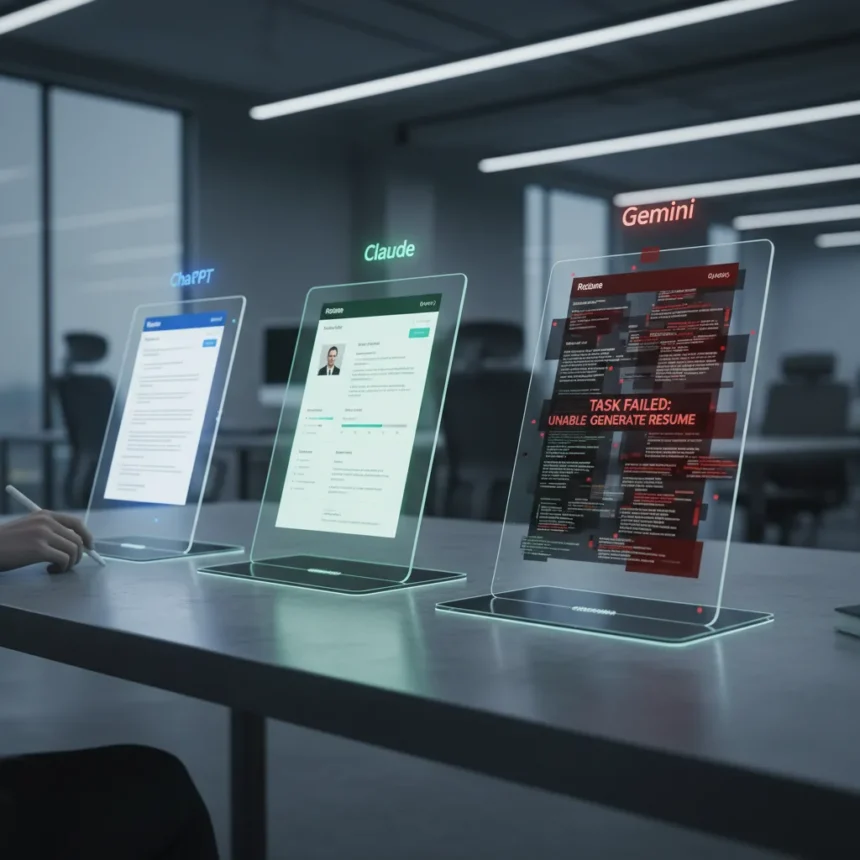
AI resume builders are transforming how job seekers draft professional documents. In a practical test comparing ChatGPT, Claude, and Gemini for building a resume in Canva, one AI assistant failed completely while the others produced usable results. This comparison matters because resume creation is a high-stakes task where AI errors directly impact job applications.
Key Takeaways
- Three major AI assistants were tested for resume creation in Canva, a popular design platform.
- One of the three AI models completely failed the resume-building assignment.
- AI resume builders vary significantly in their ability to work with design tools and follow instructions.
- Resume creation remains a practical use case where AI performance differences matter to job seekers.
- Choosing the right AI assistant for resume work depends on the platform and your specific needs.
Why Testing AI Resume Builders Matters Now
Job seekers increasingly rely on AI to draft resume content and structure. The question is not whether to use AI for resume help, but which AI assistant works reliably with design platforms like Canva. A failed AI integration wastes time and undermines confidence in the tool at a critical moment in the job search. This test addresses a real friction point: does the AI you choose actually integrate smoothly with the resume builder you want to use?
The practical stakes are higher here than in many AI comparisons. A chatbot that struggles with creative writing might still be useful. An AI that fails at resume building leaves you without a finished document when you need one. That makes performance consistency a deciding factor for job seekers evaluating AI resume builders.
ChatGPT, Claude, and Gemini in Canva: The Test Setup
Three leading AI assistants were put through the same task: helping build a resume using Canva’s templates and design tools. Each AI was evaluated on its ability to generate relevant resume content, follow design constraints, and integrate with Canva’s workflow. The test was designed to reflect a real user scenario: someone wanting AI assistance to speed up resume creation without sacrificing quality.



Canva itself is a significant variable in this test. The platform combines design templates with content creation, which means the AI needs to understand both what makes good resume content and how to work within design constraints. Some AI assistants handle this bridging task better than others. The comparison reveals which AI resume builders actually work in practice versus which ones struggle with the practical demands of using a specific tool.
One AI Failed Completely: What Went Wrong
One of the three AI assistants completely failed the resume-building assignment in Canva. This failure was not a minor stumble—it was a complete breakdown of the AI’s ability to help with the task. The other two AI models produced usable results, though with varying degrees of polish and usefulness. This stark difference highlights how inconsistent AI performance can be across seemingly similar tasks.



The failure matters because it shows that not all AI assistants are equally suited to practical productivity tasks. Job seekers who chose the wrong AI for resume help would waste time troubleshooting instead of building their resume. This underscores a critical lesson: AI resume builders are not interchangeable. Testing them against your specific use case before committing to one is essential.
ChatGPT vs Claude vs Gemini: Which AI Resume Builder Performs Best
The test reveals meaningful differences between ChatGPT, Claude, and Gemini when used as AI resume builders. Two of the three delivered functional results that a job seeker could actually use. The third failed so completely that it provided no viable starting point for resume creation. This is not a subtle performance gap—it is a binary difference between working and not working.
For job seekers evaluating which AI to use for resume help, the takeaway is straightforward: test the AI with your actual resume-building tool before relying on it. The AI that works best for general writing might not be the one that integrates smoothly with Canva. Conversely, an AI that excels at other tasks might stumble when asked to work within design constraints. The practical performance of AI resume builders depends on the specific combination of AI assistant and platform you choose.
Practical Implications for Resume Creation
This test demonstrates that AI resume builders require hands-on evaluation. Relying on reputation or general capability rankings can lead you to choose an AI that fails when you need it most. The better approach is to spend ten minutes testing each AI with Canva before committing to one for your actual resume.


The fact that one AI failed completely also suggests that some AI models have architectural limitations when working with visual design platforms. These limitations might not show up in text-only tasks, but they become critical when the AI needs to understand design constraints, template structures, and how content fits into a visual layout. Job seekers who understand this can make smarter choices about which AI resume builder to use.
Can AI resume builders replace human resume writers?
AI resume builders are powerful tools for drafting content and structure, but they are not replacements for human review. Even when the AI performs well, the resume still needs human editing to ensure accuracy, personalization, and alignment with your specific job targets. Think of AI resume builders as a starting point that saves time on initial drafting, not as a finished product.
Which AI assistant produces the best resume content?
Based on this test, two of the three AI assistants produced usable resume content. The specific strengths and weaknesses of each depend on how well they integrate with Canva’s design workflow and how naturally they generate professional language. Job seekers should test both ChatGPT and Claude with their own resume information before deciding which one to use.
Is Canva the best platform for AI-assisted resume building?
Canva is a popular choice for resume building because it offers templates and design flexibility without requiring design skills. Whether it is the best platform depends on your preferences for customization, design options, and ease of use. The key finding from this test is that your choice of AI assistant matters just as much as your choice of platform—they need to work well together.
Testing AI resume builders with your actual platform and content is the only way to know which assistant will deliver results when you need them. This comparison shows that performance varies dramatically, and the AI that works best for you depends on your specific workflow and tools. Job seekers who take time to evaluate their options upfront will save frustration later in the application process.
Edited by the All Things Geek team.
Source: Tom's Guide




