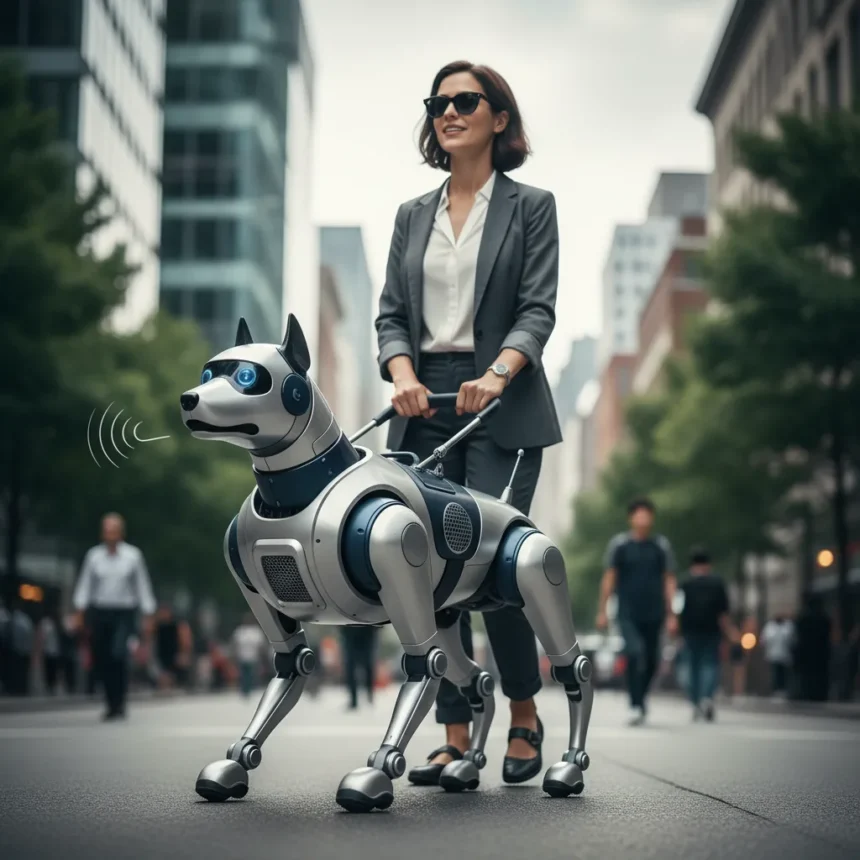
AI-powered robot guide dogs are no longer science fiction. Universities across the United States and the United Kingdom are deploying talking robotic guides that help blind and visually impaired people navigate indoor spaces with unprecedented verbal feedback. Unlike traditional service dogs, these robots communicate through large language models like GPT-4, describe their surroundings in real time, and understand far more commands than any biological guide dog ever could.
Key Takeaways
- AI-powered robot guide dogs use GPT-4 to understand unlimited voice commands, versus the ~20 commands real dogs can learn.
- Researchers at Binghamton University tested robots with 7 legally blind participants, verbalizing routes and describing scenes like corridors and lobbies.
- Real guide dogs cost 20,000-50,000 and serve only 2-5% of the blind community due to expense and training demands.
- Gardens by the Bay in Singapore will launch free robo-dog rentals starting Q3 2026 for the Flower Dome.
- AI robots verbalize hazards, present route options, and provide emergency SOS capabilities real dogs cannot match.
How AI-Powered Robot Guide Dogs Actually Work
The mechanics are straightforward but elegant. At Binghamton University, researchers led by Shiqi Zhang developed a system where the robot first asks the user where they want to go. The robot then presents multiple route options with time estimates, lets the user choose, and guides them step by step using natural language. As it navigates, the robot continuously describes what it encounters: “this is a long corridor,” “you’re passing by the main lobby,” “detecting a hazard ahead.” This real-time scene awareness is critical for blind users, who lose spatial context without vision.
The Georgia Tech team, working since 2022, takes a slightly different approach. Users provide waypoint commands—”go left,” “turn right,” “go forward,” “stop.” The robot then explains why it stops or changes direction, such as when it detects an obstacle. Both methods rely on 360-degree cameras, computer vision, sensors for mapping, and voice recognition to function safely in real-world environments.
What separates these robots from earlier prototypes is the integration of large language models. “For this work, we’re demonstrating an aspect of the robotic guide dog that is more advanced than biological guide dogs,” Shiqi Zhang told researchers. “Real dogs can understand around 20 commands at best. But for robotic guide dogs, you can just put GPT-4 with voice commands. Then it has very strong language capabilities”.



Why Real Guide Dogs Fall Short for Many Blind People
Traditional service dogs are expensive, scarce, and limited in capability. A trained guide dog costs between 20,000 and 50,000 dollars, requires 50-60% of dogs to fail training, and demands constant care, feeding, and veterinary attention. Most critically, these dogs serve only 2-5% of the blind community, leaving millions without access to trained assistance.
Real guide dogs excel at using their natural senses—smell, hearing, and spatial intuition—to navigate safely. But they cannot explain what they sense, cannot understand complex verbal instructions, and cannot provide emergency communication. A guide dog cannot tell a user why it stopped or describe the layout of an unfamiliar building. An AI-powered robot can. “This is very important for visually impaired or blind people, because situational and scene awareness is relatively limited without vision,” Zhang explained.



The robot’s verbalization capability addresses a gap that no biological dog can fill. Imagine entering a museum or hospital for the first time. A real guide dog would navigate corridors through trained routes, but would provide no context. A talking robot describes the space, explains the route options, and answers questions in real time.
The First Public Deployment: Singapore’s Gardens by the Bay
While Binghamton, Georgia Tech, and the University of Glasgow continue research with small test groups, Singapore is moving faster. Gardens by the Bay announced it will launch a robo-dog guide service in the Flower Dome starting in Q3 2026. The robot will be pre-programmed with the dome’s layout, sense obstructions and obstacles, and pause or suggest alternate paths when needed. Most importantly, the service will be free to visitors, removing the cost barrier that keeps real guide dogs out of reach for most blind people.
This deployment matters because it shifts AI-powered robot guide dogs from research labs into public spaces. Gardens by the Bay’s robo-dog will serve thousands of visitors annually, providing real-world data on how these systems perform in crowded, unpredictable environments. The initiative is part of Singapore’s broader SG Enable program, which focuses on accessibility and inclusion for people with disabilities.
What Still Needs Work
Robot guide dogs are not yet a full replacement for real dogs. They require detailed waypoint commands rather than understanding a simple instruction like “take me home.” Taery Kim, a Georgia Tech researcher, noted the learning curve: “When I started, I thought it would be as simple as giving the guide dog a command to take me to Starbucks or the grocery store, and it would just take me. But the user must give waypoint directions—’go left here,’ ‘turn right,’ ‘go forward,’ ‘stop'”.


Additionally, robots lack the natural senses that guide dogs possess. They cannot smell a dangerous animal, hear approaching traffic the way a dog’s ears can, or use instinct to avoid hazards a camera might miss. And unlike a real dog, a robot needs power, maintenance, and software updates. These are not insurmountable challenges, but they highlight why AI-powered robots are best viewed as a complement to, not a replacement for, traditional service dogs.
Could This Transform Accessibility?
The potential is significant. If AI-powered robot guide dogs become affordable and widely deployed in public spaces, they could extend assistance to millions currently priced out of guide dog programs. A test user from the University of Glasgow said: “100% I would use this in the future, um personally, as well as there’s a lot of people I know that would definitely either want to try this or would definitely use it”.
The technology is not yet commercially available outside of the Gardens by the Bay pilot. Binghamton, Georgia Tech, and Glasgow are still refining their systems with small test groups. But the trajectory is clear: talking robots powered by large language models are moving from university labs into real public spaces. Within the next few years, blind and visually impaired people may have access to AI-powered guides that offer capabilities no traditional service dog can match—unlimited verbal commands, real-time scene description, emergency communication, and no ongoing care requirements. That shift could reshape how accessibility is delivered globally.
How do AI-powered robot guide dogs differ from real guide dogs?
AI robots understand unlimited voice commands through GPT-4, while real dogs understand roughly 20 commands. Robots verbalize routes, describe scenes, and provide emergency SOS capabilities. Real dogs rely on natural senses like smell and hearing but cannot explain what they sense or answer questions.
When will AI-powered robot guide dogs be available to the public?
Gardens by the Bay in Singapore will launch free robo-dog rentals in the Flower Dome starting Q3 2026. Research prototypes at Binghamton University, Georgia Tech, and the University of Glasgow are not yet commercially available.
Do AI robot guide dogs require special training to use?
Unlike real guide dogs, AI robots do not require months of handler training. Users give voice commands or waypoint directions like “go left” and “turn right.” The robot learns to understand natural speech through its language model, making the learning curve shorter than traditional guide dog partnership.
AI-powered robot guide dogs represent a genuine shift in assistive technology. They will not replace real guide dogs overnight, but they offer a scalable, affordable alternative that could finally bring personalized navigation assistance to the millions of blind people currently without access. The real test comes when these robots leave the lab and enter crowded public spaces—that moment is less than two years away.
Where to Buy
Edited by the All Things Geek team.
Source: T3