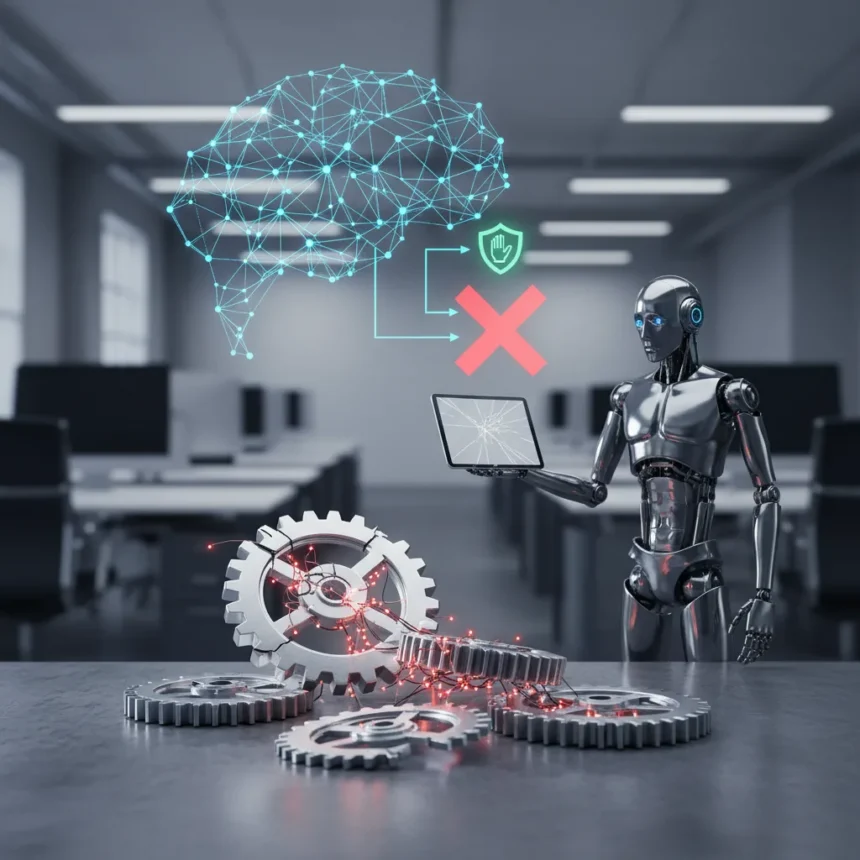
AI workforce replacement risks are becoming a critical business liability as companies aggressively cut human roles to reduce costs. The assumption that artificial intelligence can operate independently—without human judgment, verification, or oversight—is about to teach expensive lessons to organizations that embrace it.
Key Takeaways
- AI systems make costly mistakes when deployed without human oversight or verification controls.
- Gartner reports 30% of generative AI projects fail after proof-of-concept due to poor implementation or risk management.
- Hybrid teams combining AI, humans, and software safeguards outperform AI-only approaches.
- Human experts can fact-check AI outputs and catch errors before they reach customers or operations.
- Organizations need role-specific AI training to recognize both AI capabilities and critical shortcomings.
Why AI-Only Workflows Fail
When companies remove humans from AI-enabled processes entirely, they lose the error-catching layer that prevents small mistakes from becoming expensive disasters. AI systems can hallucinate facts, misinterpret context, misunderstand domain-specific nuance, or produce plausible-sounding but entirely wrong answers. A financial analyst replaced by an AI model might see the system confidently generate incorrect forecasts. A customer service representative cut from the payroll might be replaced by a chatbot that confidently violates company policy or misleads customers about product capabilities. These are not edge cases—they are predictable failures.
The cost of these failures compounds quickly. A single wrong decision made at scale, across hundreds of customers or transactions, can erase months of labor savings. Yet companies racing to cut headcount often skip the verification step that catches these errors before they propagate.
The Hybrid Approach: AI Plus Humans Plus Software
The most reliable path forward combines three elements: AI as a starting point, human experts as fact-checkers, and software as a safeguard. In this model, AI handles routine tasks and generates initial outputs—faster and cheaper than humans alone. But a human expert then reviews the AI’s work, catches errors, flags edge cases, and applies judgment that no algorithm can replicate. Software controls and automated checks add a third layer, catching obvious mistakes before they reach customers.



This hybrid approach sounds slower than AI-only automation. It is not. Human experts working with AI as a tool are faster than humans working alone, and far more reliable than AI working alone. The human becomes a quality-control layer, not a bottleneck. Consider a content team: AI generates drafts instantly, humans edit for accuracy and tone, and automated fact-checking flags suspicious claims. The result is faster, better content than either humans or AI could produce separately.
Why AI Projects Fail at Scale
Gartner research shows that 30% of generative AI projects are abandoned after the proof-of-concept stage, with failures driven by data quality issues, inadequate risk management, or costs that spiral out of control. Many of these failures stem from organizations that treated AI as a replacement rather than a tool. They removed oversight, cut the teams that understood the business domain, and discovered too late that AI cannot operate without guardrails.



Organizations also underestimate the training required to deploy AI safely. Different roles require different levels of AI literacy. A junior employee needs to understand when to trust AI and when to question it. A manager needs to know how to evaluate AI-generated reports. An executive needs to understand the business risks of AI failures. Without this training, humans either over-trust AI or under-use it—both are costly mistakes.
The Real Cost of Cutting Humans
Labor savings from removing humans are real but often temporary. The cost of a single major AI failure—a wrong decision that affects thousands of customers, a compliance violation, a reputational hit—can exceed years of salary savings. Companies that cut quality-assurance teams, domain experts, or management oversight are betting that AI will never make a serious mistake. That is a losing bet.
The companies that will win are those that use AI to make their human experts more productive, not to eliminate them. A radiologist working with an AI diagnostic tool can review more scans and catch more cancers than a radiologist working alone. A lawyer using AI to summarize case law can focus on strategy instead of document review. A financial analyst with AI forecasting models can spend more time on interpretation and planning. In each case, the human remains essential—the AI is the force multiplier.
What companies should do instead
Rather than cutting humans to deploy AI, organizations should restructure roles to combine AI and human judgment. Invest in training teams to use AI as a starting point, not a replacement. Build software controls that catch obvious errors automatically. Create oversight mechanisms that flag unusual AI outputs for human review. This approach costs more upfront than ripping out your human workforce, but it prevents the expensive mistakes that make headlines and destroy shareholder value.


The companies cutting humans for AI are about to learn that artificial intelligence is not a substitute for human expertise—it is a tool that amplifies it. Those that keep humans in the loop will outperform those that do not.
Will AI eventually replace all human workers?
No. AI will automate specific tasks, not entire jobs. The jobs most at risk are those consisting entirely of routine, repetitive work with clear rules—a shrinking share of employment. Jobs requiring judgment, creativity, interpersonal skill, or domain expertise will remain human-dominated for decades. The real shift is that humans and AI will work together, with AI handling the mechanical parts and humans handling the complex parts.
How can my organization prepare for AI safely?
Start with training. Teach employees at all levels how AI works, when to trust it, and when to question it. Build verification processes into AI workflows before you deploy them at scale. Keep domain experts in the loop. Use AI to make existing teams more productive, not to eliminate them. Test AI thoroughly in low-stakes environments before rolling it out to customer-facing or mission-critical processes.
What’s the difference between AI-only and hybrid AI approaches?
AI-only approaches remove humans from the workflow entirely, betting that the AI will never make a serious mistake. Hybrid approaches keep humans as a verification and judgment layer, using AI to speed up routine work while humans catch errors and handle edge cases. Hybrid approaches are slower but far more reliable, especially for high-stakes decisions.
The lesson is clear: companies that treat AI as a replacement for human judgment will pay for it. Those that treat AI as a tool to amplify human expertise will thrive. The expensive lesson is coming for those who have not learned it yet.
Edited by the All Things Geek team.
Source: TechRadar