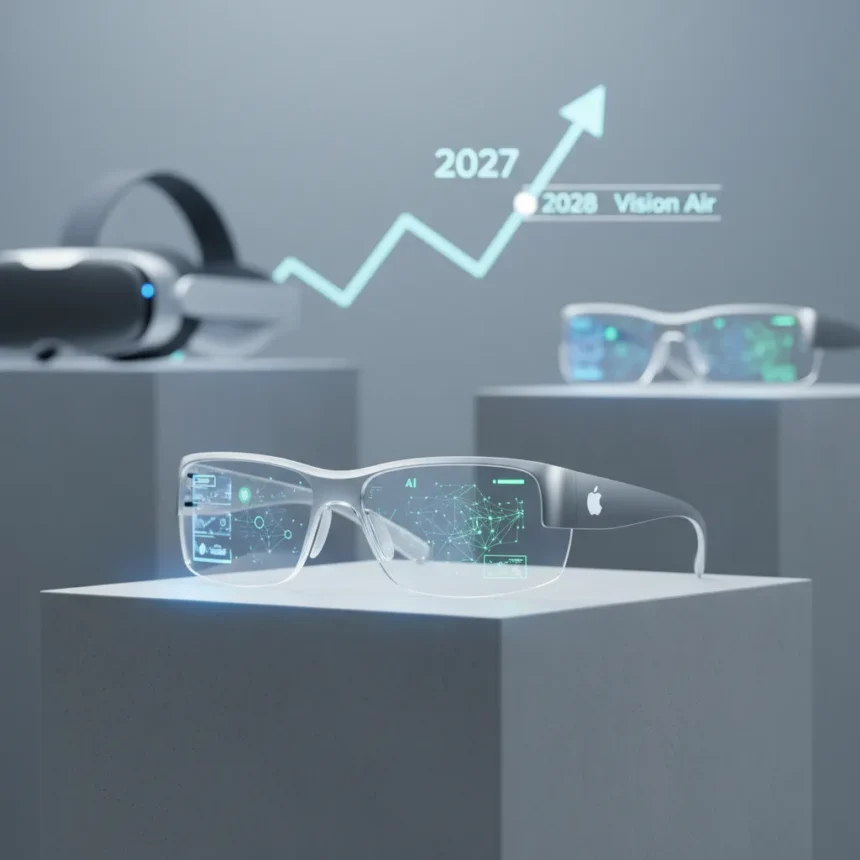
Apple’s AI glasses roadmap appears to be accelerating, with lightweight AI glasses now expected in 2027, according to reported timelines that suggest the company is pivoting away from its expensive Vision Pro headset. The cheaper Vision Air model, meanwhile, is not expected to arrive until at least 2028. This timeline shift reflects Apple’s strategic response to Google’s aggressive push into AI-powered eyewear, even as the Vision Pro struggles to gain mainstream traction in the market.
Key Takeaways
- Apple’s lightweight AI glasses are reportedly targeted for a 2027 launch
- Vision Air, a more affordable headset, is expected no earlier than 2028
- The timeline shift comes as Vision Pro demand remains underwhelming
- Google’s AI glasses initiative is driving competitive pressure on Apple’s roadmap
- Apple appears to be rebalancing its mixed-reality strategy toward lighter, more practical form factors
Why Apple’s AI glasses roadmap matters now
The shift in Apple’s AI glasses roadmap signals a fundamental recalibration of the company’s mixed-reality ambitions. After betting heavily on Vision Pro—a bulky, expensive device that has failed to achieve the sales momentum Apple expected—the company is now prioritizing a lighter, more accessible approach to spatial computing. This is not a retreat from AR and AI integration; rather, it is a recognition that the market wants glasses-form eyewear, not a ski-goggle-sized headset.
Google’s aggressive development of AI glasses has clearly influenced Apple’s timeline. By targeting 2027 for its lightweight AI glasses, Apple is attempting to establish a foothold in the emerging AI eyewear category before competitors solidify their market position. The competitive pressure is real: smart glasses that layer AI capabilities directly into everyday eyewear represent the next frontier in consumer tech, and Apple cannot afford to be a distant second player.
Vision Pro’s commercial struggles reshape Apple’s strategy
The Vision Pro’s commercial underperformance is the elephant in the room. Reports of production cuts due to underwhelming sales have forced Apple to rethink its spatial computing strategy. Rather than doubling down on a single expensive product, Apple is now pursuing a tiered approach: the lightweight AI glasses for the mainstream market, and Vision Air as a mid-market option that bridges the gap between glasses and a full headset.



This tiered roadmap is pragmatic. High-end spatial computing devices like Vision Pro will always appeal to professionals and enthusiasts, but the real market opportunity lies in products that feel like everyday accessories, not laboratory equipment. Lightweight AI glasses fit that description far better than Vision Pro ever could.
Apple AI glasses roadmap vs. Google’s competitive position
Google has not waited for Apple to make its move. The search giant is actively pushing its own AI glasses initiative, combining its strengths in AI, software, and hardware to create a compelling alternative to Apple’s ecosystem. Google’s advantage is speed to market and integration with its existing AI services, while Apple’s advantage is brand loyalty and the seamless integration with iPhone and other Apple devices.



The 2027 target for Apple’s lightweight AI glasses suggests Apple believes it can deliver a competitive product within that timeframe. Whether Apple can match Google’s AI capabilities or beat it to market remains uncertain, but the reported timeline indicates Apple is treating this category as a priority rather than a distant future bet.
What the 2028 Vision Air timeline tells us
The Vision Air launch window of at least 2028 is telling. This product sits between the lightweight AI glasses and the premium Vision Pro tier, suggesting Apple is building a product line rather than betting everything on a single device. A 2028 arrival means Apple is likely still in development and refinement stages, taking time to ensure the product meets the company’s quality standards and delivers genuine value to consumers.
The gap between the 2027 glasses and 2028 Vision Air also suggests these are distinct products serving different use cases. The glasses are likely designed for all-day wear and quick AI interactions, while Vision Air may target users who need more immersive experiences but do not want the bulk of Vision Pro.
Does Apple’s roadmap change the mixed-reality landscape?
Yes, substantially. If Apple delivers lightweight AI glasses in 2027, it will validate the category and likely accelerate adoption across the market. Other manufacturers will follow, and suddenly smart glasses will shift from niche gadgetry to mainstream consumer electronics. Apple’s entry into this space—even if it is not first—carries enormous weight because of the company’s ability to define category standards and drive consumer demand.


The question is whether Apple can execute. The company has a track record of taking existing categories and refining them into must-have products, but smart glasses are still a nascent market with unresolved questions about battery life, display quality, privacy, and killer use cases. Getting those fundamentals right matters more than hitting a 2027 date.
When will Apple’s lightweight AI glasses actually launch?
The reported 2027 target is not an official Apple announcement—it is an industry expectation based on supply chain reports and product development timelines. Apple rarely confirms product roadmaps in advance, so the actual launch date could shift earlier or later. What matters is that Apple is clearly prioritizing this category and has allocated resources to bring a product to market within the next couple of years.
What is the difference between Apple’s AI glasses and Vision Air?
Based on the reported roadmap, the lightweight AI glasses are designed as everyday eyewear optimized for quick AI interactions and augmented reality overlays, while Vision Air appears to be a more capable but still more affordable device than Vision Pro. Vision Air likely offers more immersive experiences and longer sessions but sacrifices some of the portability and all-day-wear comfort of lightweight glasses.
Why is Google’s AI glasses push forcing Apple to move faster?
Google’s early momentum in AI glasses development creates a first-mover advantage that Apple cannot ignore. If Google ships a compelling AI glasses product before Apple, it gains mindshare, developer support, and ecosystem lock-in that becomes harder for Apple to overcome. Apple’s reported 2027 timeline reflects the company’s determination to avoid being left behind in a category that could define the next decade of consumer technology.
Apple’s reported AI glasses roadmap represents a strategic pivot that acknowledges both the failure of Vision Pro and the rising importance of lightweight smart eyewear. The 2027 target for AI glasses and 2028 window for Vision Air suggest Apple is building a product portfolio rather than betting on a single device. Whether the company can execute on these timelines and deliver products that compete with Google’s offerings remains to be seen, but the direction is clear: Apple is moving away from bulky headsets and toward glasses-form factor computing. That shift alone could reshape the entire mixed-reality market.
Edited by the All Things Geek team.
Source: Tom's Guide