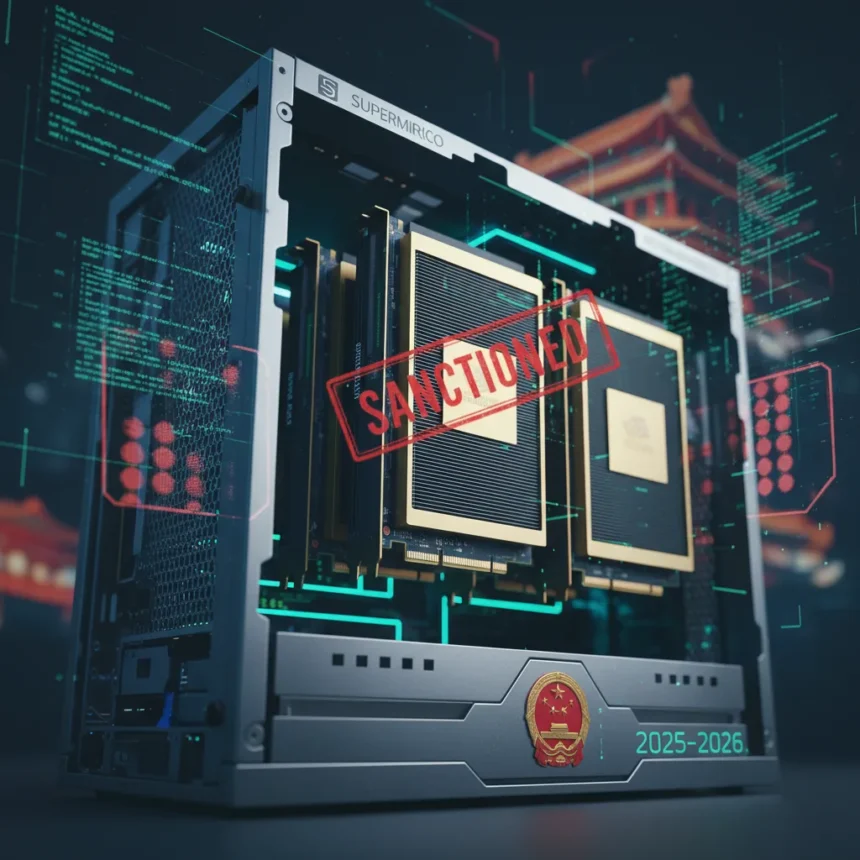
Sanctioned Nvidia AI chips have turned up in the hands of Chinese universities with direct ties to the People’s Liberation Army, according to public procurement documents reviewed in early 2026. Four Chinese universities acquired Supermicro servers equipped with restricted Nvidia A100 GPUs over the past year, raising fresh questions about enforcement of U.S. export controls on advanced artificial intelligence hardware.
Key Takeaways
- Beihang University and Harbin Institute of Technology, both PLA-linked and blacklisted by the U.S., purchased Supermicro systems with Nvidia A100 chips in 2025-2026.
- Harbin’s system contained eight A100 GPUs designated for missile, satellite, and robotics research.
- Nvidia A100 exports to China have been banned since 2022; availability ended globally in early 2024.
- Recent DOJ indictments charged three people linked to Supermicro with smuggling $2.5 billion in U.S. AI technology to China via Thailand.
- Two U.S. senators demanded Commerce Secretary Howard Lutnick freeze all export licenses for advanced Nvidia chips to China and Southeast Asian intermediaries.
How military-linked universities obtained sanctioned Nvidia AI chips
Beihang University in Beijing announced a machine learning workstation based on a Supermicro platform containing four Nvidia A100 chips on March 16, 2026. Harbin Institute of Technology acquired a separate Supermicro system with eight A100 GPUs in July 2025, explicitly designating the hardware for research into missile, satellite, and robotics technologies. Both universities are classified as part of China’s “Seven Sons of National Defense” and appear on U.S. export blacklists, yet procurement documents show the acquisitions proceeded without apparent obstruction.
The timing of these purchases is particularly sensitive. The Nvidia A100 became available in May 2020 but availability ended globally in early 2024. U.S. export controls on A100 and H100 GPUs have been in effect since 2022. Two additional Chinese universities, including one with military connections, attempted to purchase similar Supermicro systems in 2025 according to tender documents, though confirmation of successful acquisition remains unclear.
This is not an isolated incident. In April 2024, roughly ten Chinese entities reportedly acquired restricted Nvidia AI chips through servers supplied by Supermicro, Dell, and Gigabyte. The pattern suggests a systematic effort to circumvent restrictions rather than scattered unauthorized sales.



DOJ indictments expose smuggling operation tied to Supermicro
The U.S. Department of Justice charged three people linked to Supermicro with helping smuggle approximately $2.5 billion in U.S. AI technology to China, with transactions routed through Thailand. The indictments came within two weeks before March 27, 2026, and specifically targeted individuals and contractors rather than Supermicro itself, though the company claims it was the victim of the smuggling scheme.
The charges underscore a critical vulnerability in export enforcement: even when governments ban specific chips, the physical servers containing them can be diverted through intermediaries. Supermicro’s position as a server manufacturer makes its products particularly valuable to smugglers because the company integrates GPUs into complete systems before sale, reducing the number of separate transactions that might trigger regulatory scrutiny.



Congressional pressure mounts on export enforcement
Two U.S. senators responded to the revelations by calling on Commerce Secretary Howard Lutnick to freeze all export licenses for advanced Nvidia AI chips and server systems destined for China and Southeast Asian intermediaries. The request reflects growing frustration with the effectiveness of existing controls and suggests lawmakers believe current enforcement mechanisms are insufficient to prevent technology transfer to military-focused institutions.
The sanctioned Nvidia AI chips found in these universities represent a direct challenge to U.S. strategic technology policy. Unlike consumer electronics that degrade over time, AI accelerators retain their capability indefinitely. A Nvidia A100 GPU purchased in 2025 will perform the same advanced computation tasks in 2030 as it does today, meaning these acquisitions represent permanent additions to China’s military AI research infrastructure.
Why export controls are failing
The gap between policy and enforcement appears substantial. Supermicro, Dell, and Gigabyte all manufacture servers in facilities outside the United States, which may complicate direct export control jurisdiction. Additionally, the complexity of the supply chain—where GPUs are integrated into systems by manufacturers before reaching end customers—creates opportunities for diversion that may outpace government monitoring capacity.
Public procurement documents, which these universities are required to post for transparency, became the primary evidence of the acquisitions. This suggests that enforcement officials may not have been checking these sources systematically, or that the purchases occurred through channels designed to obscure their true destination.



Is Supermicro itself responsible for the smuggling?
Supermicro denies culpability, claiming it was the victim of the smuggling operation rather than a willing participant. The DOJ charged individuals and contractors, not the company, which suggests prosecutors found evidence of deliberate diversion by specific actors rather than systemic corporate complicity. However, the repeated appearance of Supermicro servers in Chinese military-linked procurement documents raises questions about whether the company implemented adequate controls to prevent its products from reaching blacklisted institutions.
What happens next to sanctioned Nvidia AI chips already in China?
Once A100 GPUs are physically located in China and integrated into university research systems, recovery becomes nearly impossible. The U.S. government cannot seize equipment already in foreign territory, and Chinese authorities have no incentive to surrender advanced AI hardware. This means the sanctioned Nvidia AI chips now operating in Beihang and Harbin will likely remain in use for years, accelerating military AI research that the export controls were designed to slow.
Could this happen with newer chips?
Yes. The Nvidia H100, the successor to the A100, is also subject to export restrictions, and evidence suggests Chinese entities are actively seeking these newer chips as well. The supply chain vulnerabilities that enabled A100 acquisition remain unresolved, making future diversions likely unless enforcement mechanisms change substantially.
The discovery of sanctioned Nvidia AI chips in Chinese military universities reveals a fundamental gap between U.S. export policy and enforcement reality. Public documents expose what government monitoring apparently missed, and recent indictments show the diversion was deliberate rather than accidental. Without stricter controls on server manufacturers and their supply chains, future restrictions on advanced AI hardware will face similar challenges. The technology is already deployed in the hands of China’s military research institutions, and no policy change can reverse that outcome.
Edited by the All Things Geek team.
Source: Tom's Hardware