





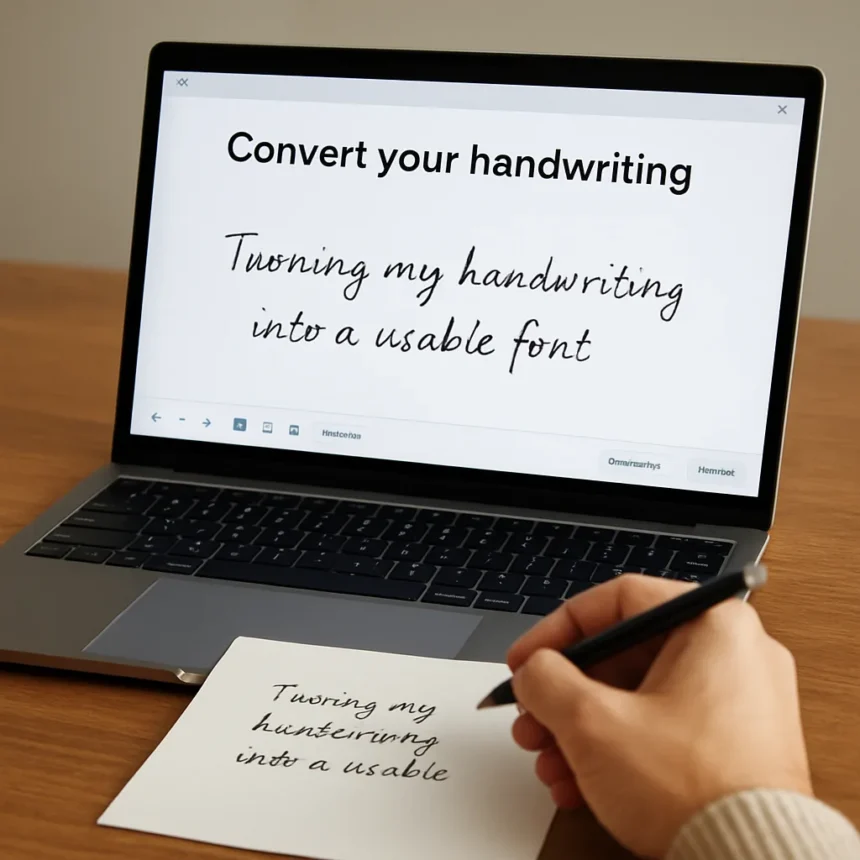
Handwriting to font conversion has existed as a niche service for years, but Claude’s new capability brings it into the mainstream AI assistant space in a way that feels genuinely personal. The feature, highlighted by TechRadar, allows users to submit samples of their own handwriting and have Claude generate a usable font from it — turning something deeply individual into a reusable digital asset. It’s a small idea with real staying power.
TL;DR: Claude can now convert your handwriting into a personal font, making it one of the few AI tools to offer something that feels truly individual rather than generic. The feature builds on Claude’s existing handwritten text recognition capabilities and represents a meaningful step toward AI that adapts to you, not the other way around.
What the Claude handwriting to font feature actually does
Claude’s handwriting to font capability works by analysing a user’s handwritten input and generating a font that mirrors the unique characteristics of that person’s writing style. Rather than producing a generic cursive or print approximation, the goal is a font that carries the idiosyncrasies — the slightly uneven letterforms, the personal loops — that make handwriting recognisable as yours. Claude’s underlying handwritten text recognition is already well-regarded for accuracy on diverse scripts and styles.
This matters because most AI tools flatten individuality. They generate text in system fonts, produce images in broadly similar styles, and optimise for average outputs. A handwriting-to-font tool inverts that logic entirely. The output is only as good as the input, and the input is irreducibly personal. That’s a fundamentally different value proposition from a chatbot that answers questions or summarises documents.



Claude has also demonstrated strong capability in structured content conversion tasks, turning unformatted or hand-formatted material into organised digital formats. The handwriting font feature sits in that same lineage — taking analogue input and producing something structured and reusable on the other side.
Why handwriting to font matters more than it sounds
Personal font creation isn’t new, but it has historically required dedicated software, significant manual effort, or paid specialist services. Tools like Calligraphr have offered handwriting font generation for years, requiring users to print templates, fill them in by hand, scan them, and upload the results through a multi-step process. Claude’s approach, embedded within a conversational AI assistant, dramatically lowers that barrier.



The use cases are broader than they might first appear. Personalised digital notes, custom greeting cards, branded content that carries a human signature, educational materials with a teacher’s own handwriting — all of these become accessible without specialist design skills. For small business owners, educators, and anyone who wants their digital communications to carry a human touch, this is genuinely practical.
It also signals something about where Anthropic thinks Claude should sit in the market. Rather than competing purely on reasoning benchmarks or coding performance, features like this position Claude as a tool for self-expression, not just productivity. That’s a meaningful distinction in a market where most AI assistants feel interchangeable.
How does Claude’s approach compare to existing handwriting tools?
Claude’s handwriting to font capability, integrated into a conversational AI assistant, is more accessible than standalone tools that require template printing and scanning. Existing dedicated services offer more granular control over individual glyphs and spacing, which matters for professional typography work. Claude’s version is better suited to personal use and quick turnaround rather than commercial font production.
Claude 3.5 Sonnet’s handwritten text recognition has already shown strong results on varied handwriting samples, handling different scripts and informal writing styles with notable accuracy. That recognition foundation is what makes font generation plausible — you can’t reliably convert handwriting into a font if you can’t first accurately read and map the letterforms. The recognition capability and the font generation capability are two sides of the same technical coin.


Where Claude has an edge over standalone font tools is in the conversational workflow. You’re not navigating a separate application or learning new software. The interaction happens where you’re already working, which removes friction in a way that dedicated tools simply can’t match.
Is Claude’s handwriting font feature available to all users?
The feature has been reported by TechRadar as part of Claude’s expanding personal AI capabilities. Specific availability details — which subscription tiers include it, whether it requires a paid plan — were not confirmed in the available reporting at the time of writing. Users interested in the feature should check directly within their Claude interface or Anthropic’s official documentation for current access details.
What can you actually use a personal font for?
A font generated from your own handwriting can be used anywhere a standard font would work — word processors, design tools, presentation software, and digital note-taking apps. The practical applications include personalised digital correspondence, custom social media graphics, educational worksheets that carry a teacher’s handwriting, and any creative project where a human touch matters more than typographic perfection.
The closing argument for this feature is simple: most AI tools make you sound like everyone else. A font built from your own handwriting makes you sound like yourself. That’s rarer than it should be.
Edited by the All Things Geek team.
Source: TechRadar




