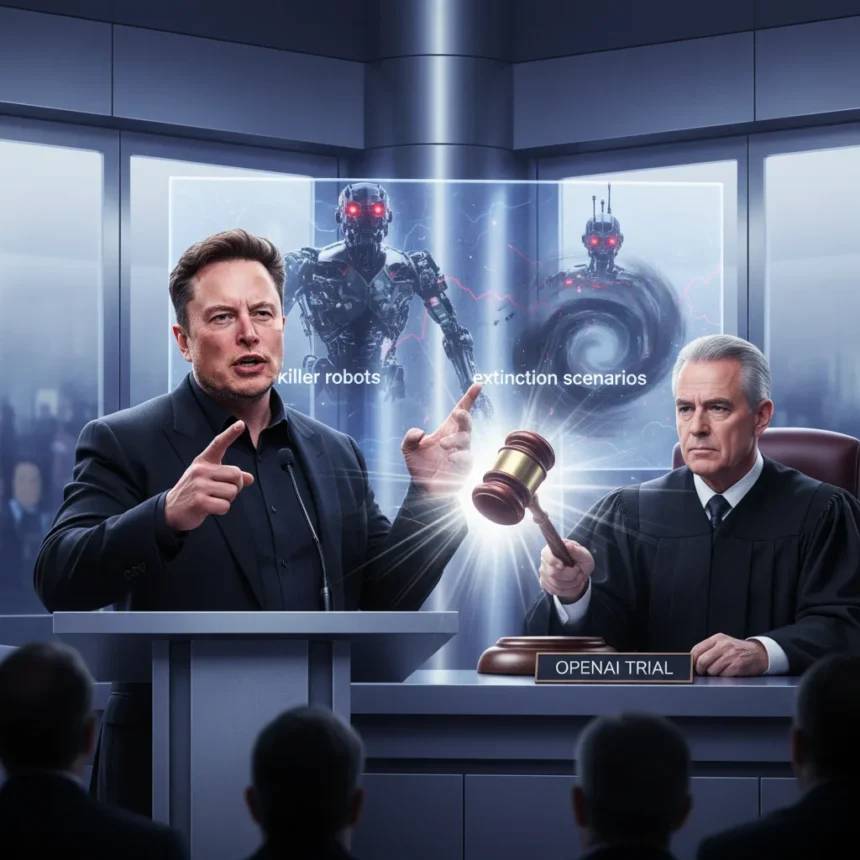
Elon Musk’s AI apocalypse warnings during his testimony in the OpenAI lawsuit have become a courtroom spectacle, derailing the legal focus from corporate fraud onto existential robot scenarios. Musk, who co-founded OpenAI as a nonprofit with Sam Altman and others, is suing to reverse the company’s 2023 transition to a for-profit model, arguing the shift violated the organization’s humanitarian mission. Instead of sticking to financial arguments, Musk repeatedly invoked “Terminator” scenarios and warned that uncontrolled artificial intelligence could “kill us all”.
Key Takeaways
- Elon Musk testified against OpenAI CEO Sam Altman in a California federal court lawsuit over the company’s nonprofit-to-for-profit transition.
- Musk donated $38 million to OpenAI’s nonprofit phase and alleges cofounders committed fraud by abandoning the humanitarian mission.
- Judge Yvonne Gonzalez Rogers explicitly shut down Musk’s AI apocalypse references, ruling extinction talk irrelevant to the case.
- Musk’s long-standing AI concerns center on machines surpassing human intelligence and the need for safety guardrails.
- The trial highlights tension between AI safety discourse and corporate law, with the judge prioritizing fraud claims over doomsday scenarios.
Why Musk’s AI apocalypse warnings backfired in court
On Thursday, the third day of Musk’s testimony, Judge Yvonne Gonzalez Rogers intervened directly to shut down his repeated references to killer robots and extinction. “We’re not going to talk about extinction in this case,” the judge stated bluntly. She followed with a more measured boundary: “AI safety, yes. AI apocalypse, no”. This rare judicial rebuke exposed a fundamental mismatch between Musk’s worldview and the legal framework governing the case.
Musk had testified that his long-standing concern about AI centers on a simple question: “What happens when the computer gets much smarter than humans?”. He framed uncontrolled artificial intelligence as analogous to a small child with destructive power, needing careful guidance to avoid catastrophe. But the lawsuit is not about AI safety philosophy—it is about whether OpenAI’s leadership breached fiduciary duty by shifting from nonprofit to for-profit, prioritizing profits over public benefit. Musk’s doomsday framing, however sincere, became a distraction from the core allegation: that Altman and Greg Brockman committed fraud.
The judge’s intervention signals that AI apocalypse warnings, however vivid, lack legal relevance to corporate misconduct claims. Musk’s concern that “we don’t want to have a ‘Terminator outcome'” may reflect genuine technological anxiety, but it does not prove OpenAI’s leadership violated contractual obligations to the nonprofit.



The real dispute: nonprofit mission versus for-profit reality
Musk’s lawsuit rests on a narrower, more concrete claim than existential risk. He alleges that OpenAI’s founders promised to develop AI for humanity’s benefit and accepted his $38 million donation on that basis. When the company transitioned to a for-profit structure—fueled by a partnership with Microsoft—Musk argues the founders abandoned that covenant. The case turns on whether this constitutes fraud or breach of fiduciary duty, not whether superintelligent machines pose an extinction threat.
Musk has stated he would be “pro-humans” in any human-AI conflict, a position that frames his testimony as protective rather than merely fearful. Yet the courtroom is not the venue for abstract debates about machine intelligence outpacing human cognition. It is a space for examining contracts, emails, and board decisions. By invoking Terminator scenarios, Musk risked undermining his credibility on the specific financial claims that matter to the judge.



What the judge’s rebuke reveals about AI discourse in law
The judicial boundary between “AI safety” and “AI apocalypse” reflects a broader tension in how courts handle emerging technology disputes. Legitimate concerns about AI alignment, safety, and control are within scope for regulatory and policy discussions. But a trial focused on corporate structure and fiduciary duty cannot accommodate worst-case extinction narratives without losing focus.
Judge Gonzalez Rogers’ intervention suggests that future AI-related litigation will likely compartmentalize safety concerns from corporate law. A company can be simultaneously a responsible steward of AI development and a defendant in a fraud case—or neither. The judge’s ruling implies that proving one does not automatically prove the other.
Musk‘s testimony continues, but the courtroom boundary is now clear: discuss AI safety mechanisms and governance structures, but leave the killer robots at the door.
Will Musk’s doomsday framing hurt his case?
Musk’s repeated invocation of Terminator scenarios and extinction risks may have damaged his credibility with Judge Gonzalez Rogers. By the time she shut down the apocalypse talk, the judge had already heard multiple references to catastrophic outcomes. A jury or judge focused on contract law and fiduciary duty may view such language as hyperbole or distraction rather than evidence of fraud.


What does Musk actually want from the OpenAI lawsuit?
Musk seeks to reverse OpenAI’s transition from nonprofit to for-profit status, arguing that the shift violated the company’s founding mission to benefit humanity. He alleges that cofounders Altman and Brockman committed fraud by accepting his $38 million donation under false pretenses and then abandoning the nonprofit model.
Why did the judge stop Musk from discussing AI extinction?
Judge Yvonne Gonzalez Rogers ruled that AI extinction scenarios are irrelevant to a lawsuit about corporate structure and fiduciary duty. The case focuses on whether OpenAI’s leadership breached contractual obligations, not whether superintelligent machines pose existential risks. The judge allowed discussion of AI safety but explicitly blocked apocalypse rhetoric.
Musk’s testimony illustrates how technological anxiety, however justified, can collide with legal process. His concerns about uncontrolled AI may be sincere and even prescient, but they do not belong in a trial about nonprofit-to-for-profit transitions. The judge’s rebuke was not a dismissal of AI safety as a concept—it was a refusal to let existential dread overshadow the specific allegations of corporate fraud. Whether that boundary holds as AI litigation becomes more common remains an open question.
Edited by the All Things Geek team.
Source: TechRadar