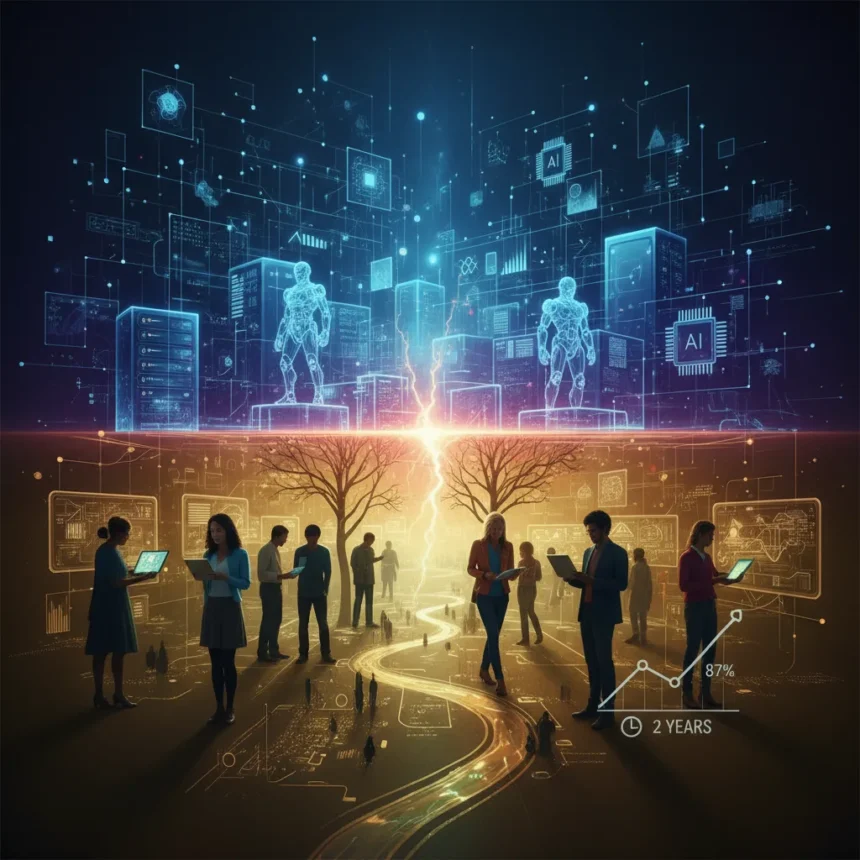
Internet bifurcation is no longer a theoretical risk—it is becoming infrastructure reality. A February 2026 survey by Bright Data of 500 AI practitioners found that 87% agree a two-tier internet is already emerging, with 50% expecting this split to solidify within two years. The survey reveals that as AI agents proliferate, the web is transforming from a human-browsing platform into a dual-layer ecosystem where machines and humans access fundamentally different versions of the internet.
Key Takeaways
- 87% of AI organizations surveyed believe a two-tier internet is forming, splitting human and machine access layers
- 71% of organizations now deploy AI agents specifically for web search and data collection
- 88% report that public web data is becoming more restricted through gatekeeping mechanisms
- 50% expect the bifurcation to solidify within two years, reshaping web infrastructure
- Internet fragmentation driven by AI is creating risks for security, control, and information quality
How Internet Bifurcation is Reshaping Web Access
Internet bifurcation refers to the internet splitting into separate machine and human layers, each optimized for different consumers. The machine layer serves AI agents and bots harvesting data at scale; the human layer serves traditional web browsers and users. This is not a future scenario—it is happening now. According to Or Lenchner, CEO of Bright Data, “We are watching the web evolve from a place humans browse into an environment agents must navigate on their own. That changes the infrastructure requirements completely. In the agentic era, the advantage goes to companies that can access real-time public web data reliably, validate it rigorously, and do it compliantly at scale”. The shift is driven by the sheer volume of AI traffic. The survey found that organizations deploying AI agents increased their data consumption by 132% over the past 12 months, straining both access infrastructure and data quality validation systems.
The practical consequences are already visible. Ignas Anfalovas, Senior Engineering Manager at IPXO, describes the structural reality: “If more of the web is shaped around AI collection and AI consumption, we will end up with two different internet layers: one built for people and another built for machines. This kind of split internet would affect how web content is accessed, who gets paid for it, and how much trust users can place in what they find online”. Publishers are responding by fragmenting their content—some restricting bots entirely, others creating exclusive machine-readable feeds available only through paid APIs or licensing agreements. The human web remains open and free; the machine web becomes gated and commercial.
Data Quality and Regulatory Pressure Accelerating the Split
Internet bifurcation is not just a technical problem—it is a validation and compliance crisis. Among surveyed AI practitioners, 57% cite data quality and validation as their top challenge for real-time reasoning systems. When AI agents scrape the open web at scale, they inherit all its noise: duplicates, outdated information, misinformation, and poisoned training data. Cleaning this becomes prohibitively expensive, pushing organizations toward exclusive data partnerships and proprietary feeds where quality is guaranteed. Simultaneously, regulatory pressure is accelerating the split. The survey found that 73% of respondents anticipate more regulatory legislation restricting bot access, and 58% expect website blocking to increase. Combined with the finding that 88% already report public web data becoming more restricted through gatekeeping, the trajectory is clear: the open web is closing. Publishers and platforms are tightening access to protect user privacy, combat misinformation, and prevent AI training without consent. This regulatory squeeze forces AI practitioners to build parallel infrastructure—private data partnerships, licensed APIs, synthetic data generation—rather than relying on the open web.



Internet Bifurcation vs. Geopolitical Fragmentation
Internet bifurcation driven by AI agents is distinct from, but overlapping with, geopolitical internet fragmentation. Former Google CEO Eric Schmidt predicted in 2018 that the internet would bifurcate by 2028 into a Chinese-led internet and a non-Chinese (US-led) internet, driven by China’s technological scale, wealth, and Belt and Road Initiative influence over 60+ countries. That fragmentation is driven by nation-states enforcing data sovereignty, censorship, and localized infrastructure. The AI-driven bifurcation is different: it is market-driven and architectural. Companies building AI agents are voluntarily creating separate data channels because the machine layer and human layer have incompatible requirements. One is optimized for speed and scale; the other for trust and usability. Yet the two trends reinforce each other. Geopolitical fragmentation creates regional data silos, which then force AI practitioners to build region-specific agent infrastructure. The result is not one bifurcated internet—it is multiple bifurcations happening simultaneously across different axes: machine vs. human, regulated vs. open, Western vs. Chinese.
What Internet Bifurcation Means for Publishers and Users
For publishers, internet bifurcation creates both risk and opportunity. Risk: if machine traffic separates from human traffic, publishers lose visibility into how AI systems use their content and lose the ability to monetize bot traffic directly. Opportunity: publishers can build exclusive data partnerships with AI companies, licensing content for training or real-time retrieval at premium rates. The survey data suggests this is already happening—71% of organizations deploying AI agents are seeking reliable, compliant data access, and they are willing to pay for it. For users, the implications are more troubling. A bifurcated internet means two different information ecosystems. The human web remains discoverable through search and social, but increasingly filtered and curated. The machine web becomes optimized for AI consumption—faster, more structured, but opaque and accessible only through APIs that users cannot directly query. Information quality risks multiply. If humans and machines access different versions of the internet, they develop diverging information diets. Misinformation, bias, and manipulation can be baked into each layer independently. Trust erodes because users cannot verify what their AI assistants are reading.



Is internet bifurcation inevitable?
Internet bifurcation is not inevitable—it is a choice. The survey shows 50% of AI practitioners expect it to solidify within two years, but that expectation reflects current trajectory, not destiny. Alternatives exist: regulators could mandate open, machine-readable feeds accessible to all AI agents under fair-use frameworks. Publishers could develop standardized licensing agreements that price bot access fairly without fragmenting the web. Infrastructure providers could build interoperable data layers that serve both humans and machines from the same underlying content. But these require coordination across competing interests, and the survey suggests the industry is moving in the opposite direction. With 88% reporting increased gatekeeping and 73% expecting more regulation, the pressure is toward fragmentation, not consolidation.
Can the bifurcated internet be reunified?
Reunification would require either regulatory intervention mandating open access or a technological breakthrough that makes machine and human optimization compatible. Neither is likely in the short term. Regulators are moving toward stricter data protection and bot control, not mandating openness. Technologically, the requirements are fundamentally opposed—machines want raw, unfiltered data at scale; humans want curated, trustworthy information in digestible form. A unified internet would require compromise on both sides, and neither side has incentive to compromise yet.
How should AI practitioners respond to internet bifurcation?
Organizations deploying AI agents should invest in data partnerships and compliance infrastructure now, before the bifurcation fully solidifies. The survey found that data quality validation is the top challenge for real-time reasoning, suggesting that proprietary, validated data sources will command premium pricing. Building relationships with publishers, licensing data ethically, and developing internal validation pipelines are not luxuries—they are competitive necessities in a bifurcated internet.
Internet bifurcation is reshaping the digital commons. The web is no longer a single, unified platform—it is becoming two platforms optimized for two different consumers, governed by different rules, and increasingly isolated from each other. This shift has profound implications for information quality, user trust, and the future of open data. The question is not whether bifurcation will happen, but how quickly it will consolidate and what safeguards will protect users and publishers in a fragmented digital world.


Edited by the All Things Geek team.
Source: TechRadar