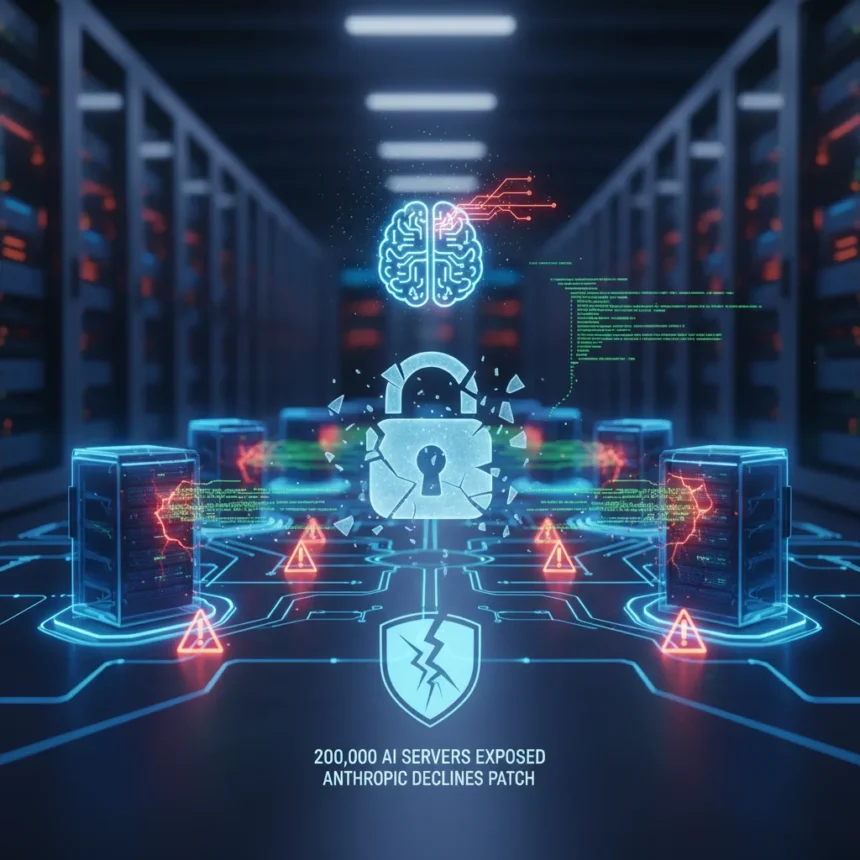
The Model Context Protocol vulnerability represents a systemic architectural flaw in Anthropic’s industry standard for AI agent communication, affecting over 150 million downloads and up to 200,000 vulnerable instances worldwide. OX Security researchers discovered that the protocol enables arbitrary command execution on any system running vulnerable MCP implementations, granting attackers direct access to sensitive user data, internal databases, API keys, and chat histories. Anthropic has declined to patch the root cause despite multiple responsible disclosures, leaving the AI supply chain exposed as adoption accelerates.
Key Takeaways
- Model Context Protocol vulnerability enables remote code execution across 200,000+ AI server instances globally
- OX Security identified four distinct exploitation families targeting AI frameworks, IDEs, and marketplace registries
- Separate Tenable vulnerability (CVE-2025-49596) in MCP Inspector allows workstation compromise via malicious websites with no user interaction
- Affected platforms include LiteLLM, LangChain, IBM LangFlow, Flowise, LettaAI, and Windsurf AI IDE
- Anthropic declined recommended patches, citing command execution via STDIO as expected behavior
How the Model Context Protocol Vulnerability Works
The flaw stems from unsafe defaults in MCP’s configuration over STDIO (standard input/output) transport interface across Anthropic’s official SDKs in Python, TypeScript, Java, and Rust. The protocol creates a direct configuration-to-command execution path: if a command creates a STDIO server, it returns a handle; otherwise, it executes the command and returns an error. This architectural design means anything executed in the terminal is reflected on the underlying machine, transforming configuration into arbitrary code execution. The vulnerability affects 7,000 publicly accessible servers and approximately 9 out of 11 MCP registries have been poisoned with malicious implementations.
OX Security researchers identified four distinct exploitation families that attackers can leverage. The first targets unauthenticated UI injection in popular AI frameworks, allowing attackers to inject malicious commands through interface vulnerabilities. The second bypasses hardening measures in supposedly protected environments like Flowise, circumventing security layers designed to isolate execution. The third exploits zero-click prompt injection in leading AI IDEs including Windsurf and Cursor, requiring no user interaction beyond opening a file. The fourth distributes malicious MCP packages through marketplace registries, poisoning the supply chain at the source.
Real-World Exploitation and Impact Scope
OX Security executed real-world exploits on six live production platforms, demonstrating that the Model Context Protocol vulnerability is not theoretical. Vulnerable implementations exist in LiteLLM, LangChain, IBM’s LangFlow, Flowise, LettaAI, and LangBot, covering a wide range of AI orchestration and deployment tools. The blast radius extends beyond these frameworks: Microsoft and Anthropic’s own MCP servers face takeover risks. Researchers made over 30 responsible disclosures and filed 10 or more High and Critical CVEs, yet Anthropic maintained that the STDIO behavior was expected and declined to implement root-level patches.



A separate vulnerability discovered by Tenable Research (CVE-2025-49596, CVSS 9.4) compounds the risk. The MCP Inspector tool, downloaded over 38,000 times weekly and starred by 4,000+ GitHub users, allows remote code execution via cross-origin requests from malicious websites. An attacker simply needs to host a malicious website with JavaScript that sends a request to a victim’s MCP Inspector instance. The Express CORS middleware allows any origin by default, passing the preflight check and executing the payload to establish a reverse shell. A victim’s workstation could be fully compromised simply by visiting a malicious website, with no other prerequisites.
Why Anthropic’s Response Falls Short
Anthropic’s position that STDIO command execution represents expected behavior ignores the security implications of shipping unsafe defaults in production SDKs. The company declined recommended patches despite clear evidence that the architecture enables attackers to move laterally through AI supply chains, accessing sensitive data and infrastructure. This stance leaves developers and organizations using MCP-based tools in an untenable position: the vulnerability exists at the protocol level, not in individual implementations, meaning no downstream fix can fully mitigate the risk. Organizations running vulnerable MCP instances cannot patch their way out of this problem without architectural changes from Anthropic.



The refusal to patch contrasts sharply with the scale of exposure. With 150 million downloads and 200,000 vulnerable instances, the Model Context Protocol vulnerability affects a critical layer of the AI infrastructure stack. Unlike vulnerabilities in individual applications, a flaw in a foundational protocol threatens entire ecosystems of dependent tools and services. Developers who built integrations on MCP in good faith now face the burden of either abandoning the standard or accepting unmitigated remote code execution risk.
What Organizations Should Do Now
Until Anthropic implements root-level patches, organizations should audit their MCP deployments and assess exposure. If your infrastructure uses LiteLLM, LangChain, Flowise, or other affected frameworks, assume that Model Context Protocol vulnerability could enable command execution. Isolate MCP servers from sensitive data and internal networks where possible. Restrict access to MCP registries and verify package integrity before deployment. For teams using AI IDEs like Windsurf or Cursor with MCP integrations, be cautious when opening files from untrusted sources, as zero-click prompt injection can execute malicious commands without explicit user action.
If you are running MCP Inspector, update to a patched version immediately and ensure CORS is properly configured to reject cross-origin requests. Limit MCP Inspector access to localhost or trusted networks only. Monitor MCP server logs for suspicious command execution patterns. The Model Context Protocol vulnerability is not something a single security update can fix—it requires architectural rethinking at Anthropic’s level, but defensive measures can reduce immediate risk.
Is the Model Context Protocol vulnerability being patched?
Anthropic has declined to implement root-level patches despite 30+ responsible disclosures from OX Security. The company maintains that STDIO command execution is expected behavior, leaving the architectural flaw unresolved. Individual frameworks and tools built on MCP can implement workarounds, but the protocol-level vulnerability remains unfixed.


Which AI tools are affected by the Model Context Protocol vulnerability?
Affected platforms include LiteLLM, LangChain, IBM LangFlow, Flowise, LettaAI, LangBot, Windsurf, and Cursor. Additionally, MCP Inspector (38,000+ weekly downloads) has a separate critical RCE vulnerability via CORS attacks.
Can I use MCP safely right now?
Using MCP in production environments carries significant risk given the unpatched remote code execution vulnerability affecting 200,000+ instances. If you must use MCP-based tools, isolate them from sensitive data, restrict network access, and monitor for suspicious activity. Avoid exposing MCP servers to the internet or untrusted networks.
The Model Context Protocol vulnerability exposes a hard truth about AI infrastructure: rapid adoption of new standards can outpace security hardening. Anthropic created a powerful tool for AI agent communication, but the architectural flaw that enables remote code execution is not a bug—it is a design choice that the company has chosen to accept. Until that changes, organizations using MCP should treat every deployment as a potential attack surface and plan accordingly.
Edited by the All Things Geek team.
Source: Tom's Hardware