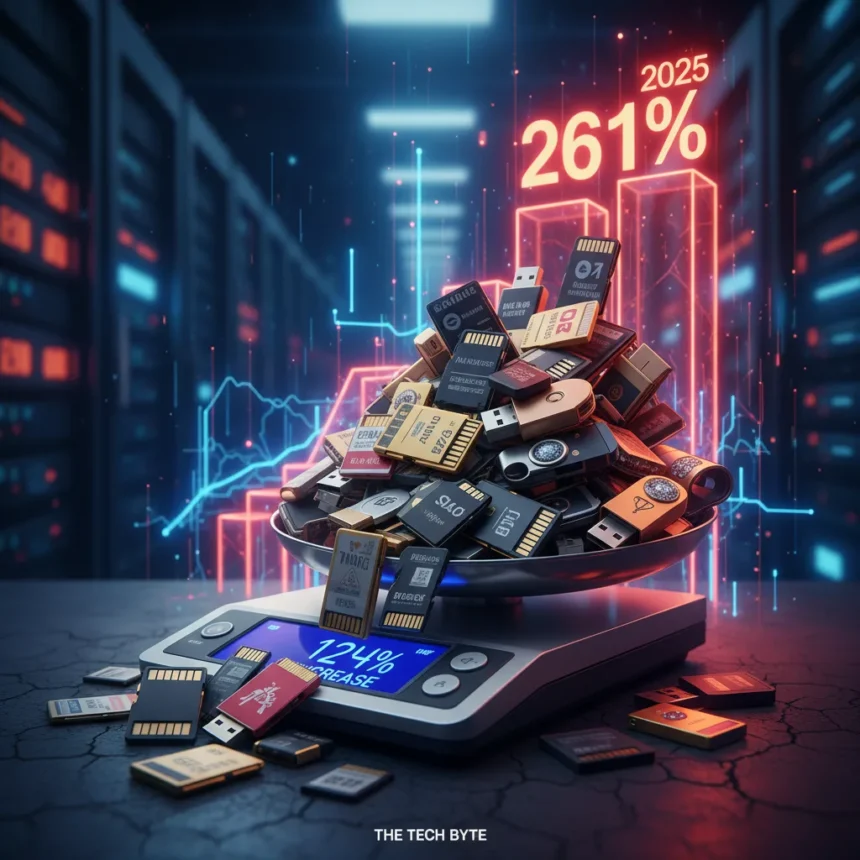
Memory card and flash drive prices have surged dramatically in 2025, with average increases of 124% and peak jumps reaching 261% for some products, driven by a NAND chip shortage tied to booming AI demand. The shortage, which began expanding this year, is reshaping the portable storage market and hitting photographers, videographers, and everyday users who rely on SD cards, microSD cards, and USB flash drives.
Key Takeaways
- Memory card and flash drive prices jumped 124% on average, with peak increases reaching 261%.
- NAND chip shortage driven by AI demand is the primary cause of 2025 price increases.
- Multiple storage formats affected: USB flash drives, SD cards, microSD cards across all capacities.
- Shortage began in 2025 and continues to expand across consumer storage categories.
- Retail example: SABRENT 128GB Rocket SD cards available at $19.79 with discount.
Why Memory Card and Flash Drive Prices Are Exploding
The sudden spike in memory card and flash drive prices stems from a fundamental supply crunch. NAND flash memory, the core component in all portable storage devices, has become scarce as manufacturers prioritize production for artificial intelligence processors and high-capacity data center storage. This competition for limited NAND supply has cascaded down to consumer-grade products, pushing retail prices to levels unseen in years.
The shortage did not emerge overnight. Starting in 2025, NAND availability tightened across the entire storage ecosystem. Unlike previous shortages that targeted specific product categories, this one spans USB flash drives, SD cards, and microSD cards in virtually every capacity from 32GB to 1TB. Retailers are passing these supply constraints directly to consumers through higher prices.
Which Storage Formats Face the Biggest Price Hits
No storage format has escaped the price surge. USB flash drives, once commodity items selling for pocket change, now cost substantially more. SD cards used by photographers and videographers in cameras and drones are experiencing similar pressure. MicroSD cards, essential for smartphones, tablets, and action cameras, round out the affected categories. The breadth of impact suggests this is not a temporary blip but a structural market shift driven by AI-driven demand for NAND production capacity.


The variation in price increases across different capacities and brands reveals how supply constraints ripple unevenly through the market. Some products experience the full 261% peak jump, while others see more moderate increases. This inconsistency makes it difficult for consumers to predict which purchases will deliver value and which will feel like price gouging.
What This Means for Photographers, Videographers, and Everyday Users
For professionals who burn through storage cards regularly, these price hikes represent a real cost increase to their business. A photographer shooting 4K video or a content creator managing large file transfers now faces significantly higher expenses for the same storage capacity. Casual users buying a USB drive for file backup or a microSD card for a smartphone find themselves paying multiples of what they expected.



The shortage creates a dilemma: buy now at inflated prices or wait for supply to stabilize. Neither option is attractive. Purchasing at peak prices means overpaying; waiting risks further increases if the NAND shortage persists. Unlike processor shortages that primarily affect enthusiasts and professionals, this storage crunch touches everyone who uses a camera, phone, or computer.
When Will Memory Card and Flash Drive Prices Stabilize
The timeline for relief remains unclear. NAND manufacturers are caught between competing demands: fulfilling massive orders for AI infrastructure and meeting consumer storage needs. Until AI-driven demand moderates or NAND production capacity expands significantly, consumer storage prices are unlikely to fall back to 2024 levels. Industry watchers expect the shortage to persist through at least the first half of 2025, with potential relief arriving later in the year only if production ramps accelerate.
Historically, storage prices have fallen consistently over time as manufacturing scales. This shortage temporarily inverts that trend, making 2025 potentially the worst year to buy portable storage in a decade. Strategic purchasing—buying only what you need immediately rather than stocking up—may be the wisest approach until supply normalizes.
Are there alternatives to buying expensive memory cards right now?
Cloud storage services offer one alternative for backing up files, though they require ongoing subscription fees and reliable internet access. External SSDs, while not immune to NAND shortages, sometimes offer better price-per-gigabyte ratios than memory cards for large-capacity needs. However, these alternatives do not solve the problem for photographers and videographers who need in-camera storage during shoots.



Will memory card and flash drive prices ever return to 2024 levels?
Prices typically fall once NAND production catches up to demand. If the AI-driven shortage eases in the second half of 2025, memory card and flash drive prices should begin declining back toward previous levels. However, manufacturing capacity additions take months to come online, so even optimistic scenarios suggest elevated prices through mid-2025 at minimum.
Which brands are hit hardest by memory card and flash drive price increases?
The shortage affects all major manufacturers equally since they all rely on the same NAND supply chain. SanDisk, Kingston, Samsung, Lexar, and others have all raised prices in response to supply constraints. No brand has managed to avoid the impact, making price shopping across brands less effective than in normal market conditions.
The 2025 NAND shortage has exposed how dependent consumer storage is on a fragile supply chain. As AI demand continues reshaping semiconductor manufacturing priorities, ordinary users are paying the price—literally. If you need storage, buying now despite inflated costs may be smarter than gambling on future price drops that could take months to materialize. The memory card and flash drive prices landscape has fundamentally shifted, and waiting for normalcy might cost you more in the long run.
Where to Buy
SanDisk Ultra Fit USB 3.2 Gen 1 USB-A Flash Drive | SanDisk Ultra Dual Drive Go USB Type-C | Lexar D40E Dual USB 3.2 Gen 1 Jump Drive | SanDisk Extreme Pro SDXC UHS-I | Lexar Professional SDXC UHS-II
Edited by the All Things Geek team.
Source: Tom's Hardware