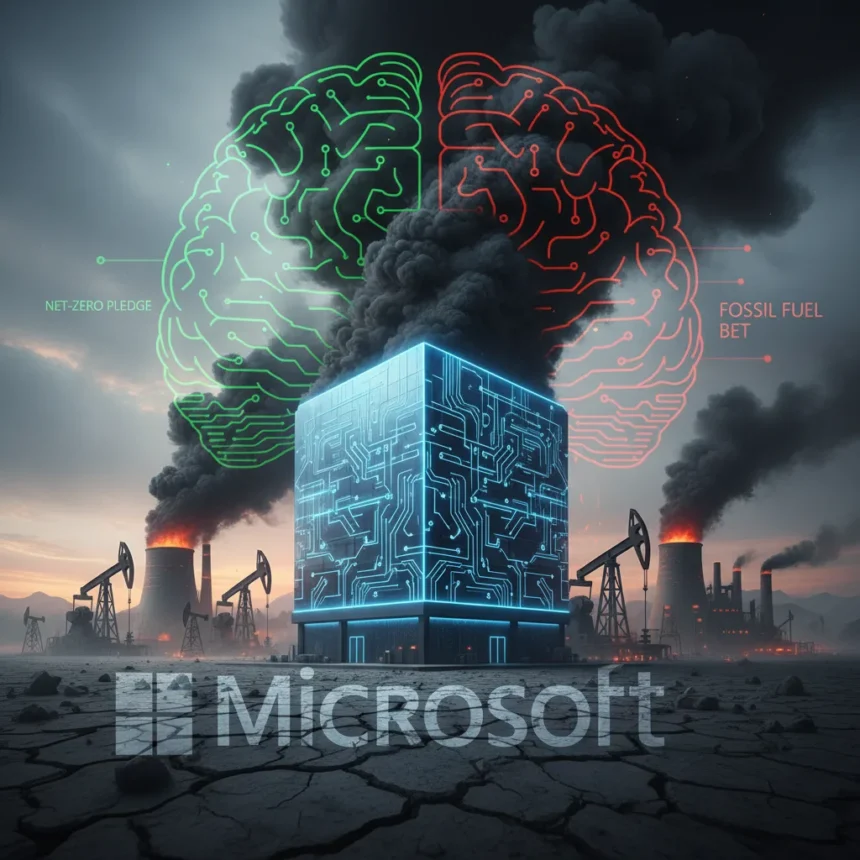
AI data center energy demand is the defining infrastructure crisis of this decade, and Microsoft’s latest move makes that clearer than ever. Microsoft is reportedly backing a $7 billion deal tied to methane gas infrastructure to power its AI expansion, a direct contradiction of its stated net-zero by 2030 commitment. This is not a minor footnote in a sustainability report — it is a signal that the AI arms race is overriding climate strategy at the highest levels of Big Tech.
Key Takeaways
- Microsoft is backing a $7 billion deal involving methane gas projects to power AI data centers.
- A single generative AI query uses roughly 10 times the electricity of a standard Google search.
- Goldman Sachs projected in May 2024 that AI will drive a 160% increase in data center power demand.
- Big Tech collectively plans $11 billion in natural gas generation, enough to power the state of South Dakota.
- Microsoft simultaneously holds a $10 billion-plus renewables deal with Brookfield for 10.5 GW of green energy delivery between 2026 and 2030.
Why AI Data Center Energy Demand Is Breaking Climate Commitments
AI data center energy consumption is growing at a pace that no existing renewable pipeline can match in real time. Goldman Sachs projected in May 2024 that AI would drive a 160% increase in data center power demand, and AI power demand overall is expected to triple by 2030. When a single generative AI query consumes roughly 10 times the electricity of a standard Google search, the arithmetic becomes brutal at scale — and utilities simply cannot build wind and solar fast enough to keep up.
That gap is exactly why Microsoft is reaching for gas. Azure’s growth requires 24/7 dispatchable power, the kind that renewables alone cannot guarantee without massive battery storage infrastructure that does not yet exist at the required scale. The problem is that Microsoft made a very public bet in the other direction, signing a Global Renewable Energy Framework Agreement with Brookfield for 10.5 GW of wind and solar capacity to be delivered between 2026 and 2030. Backing methane gas at the same time does not just complicate that story — it undermines it entirely.
The $7 Billion Deal and What It Actually Means
Microsoft’s fossil fuel commitment sits inside a broader Big Tech pattern that is accelerating fast. The company is reportedly in talks with Chevron for up to 5 GW of gas-fired capacity in the Texas Permian Basin. Across the industry, Microsoft, Google, Amazon, and Meta are collectively planning $11 billion in natural gas generation — 7.5 GW of capacity, enough to power South Dakota. This is not a bridge strategy. At this scale, it is a structural dependency.



What makes Microsoft’s position particularly difficult to defend is the dual role it is playing in the fossil fuel economy. The company is not just buying gas power to run its data centers — it is also actively marketing AI tools to oil and gas firms including ExxonMobil and Chevron to help them extract more fossil fuels. That creates a feedback loop: AI accelerates fossil fuel production, fossil fuel revenue funds more AI infrastructure, and the cycle continues while net-zero targets recede further into the distance.
How Microsoft’s Rivals Are Handling the Same Problem
Microsoft is not alone in this bind, but its competitors are making different bets on how to solve it. Google has partnered with Crusoe Energy on a 1 GW data center project, while Amazon and Meta have backed what is described as a Ratepayer Protection Pledge involving gas and nuclear through public-private arrangements. Microsoft itself is pursuing nuclear alongside gas, with power expected from Constellation’s restart of Three Mile Island Unit 1 in 2028, while AWS has committed $650 million to a Talen nuclear campus. Nuclear at least offers a path to low-carbon baseload power — gas does not.



The Brookfield deal is worth examining in this context. Microsoft’s $10 billion-plus renewables commitment is genuinely significant — it outpaced Amazon and Meta in securing shovel-ready green projects and has raised costs for competitors trying to access the same pipeline. That is real. But a 10.5 GW renewables pipeline delivering from 2026 onward does not solve a power crunch happening right now, which is precisely why gas is filling the gap. The question is whether Microsoft treats gas as a genuine bridge or a permanent crutch.
Is Microsoft’s net-zero by 2030 target still credible?
That target is under serious pressure. Microsoft’s own emissions have risen as Azure scales, and the shift from carbon offsets toward physical energy delivery — while more honest — exposes just how far the company is from its stated goals. Backing methane gas infrastructure while selling AI tools to fossil fuel companies makes the 2030 target look aspirational at best.
Why does AI use so much more power than regular internet services?
Generative AI models require enormous computational resources for both training and inference — the process of generating a response. A single AI query uses roughly 10 times the electricity of a standard Google search, and data centers running these models operate continuously at high load, unlike traditional web servers that handle more variable traffic patterns.
What are the alternatives to gas for powering AI data centers?
Nuclear is the most discussed alternative for 24/7 baseload power, with both Microsoft and AWS pursuing nuclear deals. Renewables paired with long-duration storage are a longer-term option, but storage technology at grid scale remains expensive and limited. Big Tech CAPEX is projected at $700 billion annually by 2026, and a meaningful portion of that needs to flow toward non-gas solutions if net-zero claims are to survive contact with reality.


Microsoft’s fossil fuel pivot is not a surprise — it is the logical outcome of betting everything on AI growth without first solving the energy equation. The $7 billion gas deal does not cancel out the Brookfield renewables commitment, but it does reveal which priority wins when the two come into conflict. Until the company can demonstrate that gas is genuinely temporary and that its renewables pipeline will replace rather than merely supplement fossil capacity, its climate credentials deserve exactly the skepticism they are now receiving.
Edited by the All Things Geek team.
Source: TechRadar