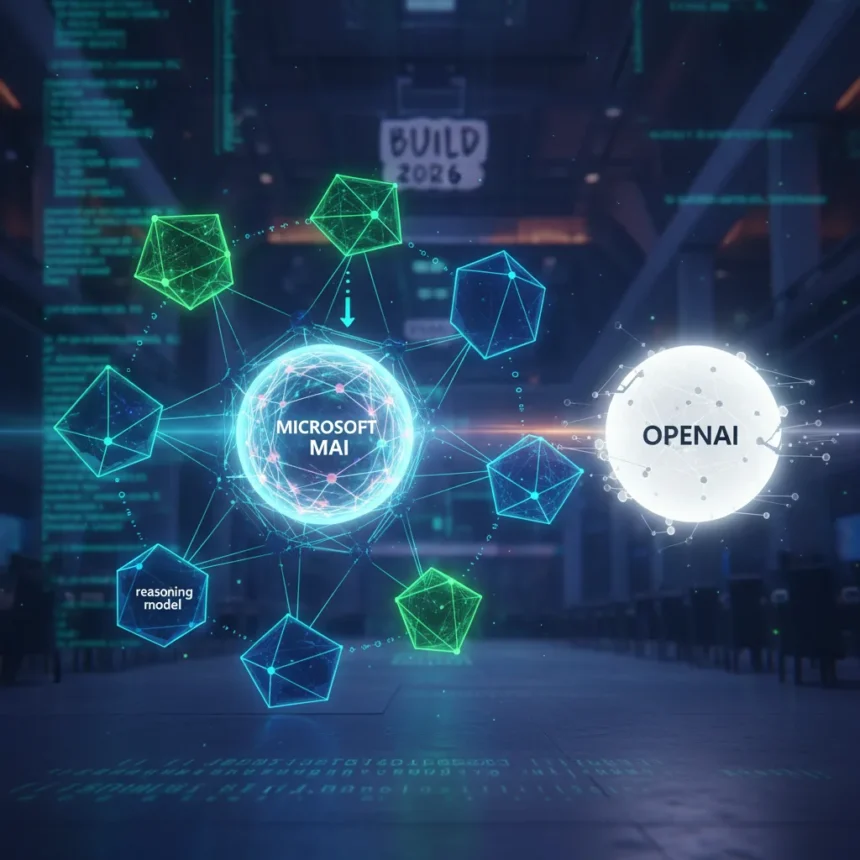
Microsoft’s AI Superintelligence Team unveiled seven new Microsoft MAI models at Build 2026 in San Francisco on June 2, signaling a strategic shift toward controlling its own AI destiny rather than remaining dependent on OpenAI. The family includes MAI-Thinking-1, Microsoft’s first reasoning model, alongside systems for image generation, transcription, voice, and coding. This is not a break from OpenAI—Microsoft’s flagship GPT models remain central to Copilot and Azure—but rather an expansion of optionality that lets developers choose the right tool for their workload and budget.
Key Takeaways
- Microsoft MAI models include MAI-Thinking-1, a 35 billion parameter reasoning model with 256K context window
- MAI-Thinking-1 trained from scratch on clean, commercially licensed data with zero distillation
- Independent raters prefer MAI-Thinking-1 to Anthropic’s Sonnet 4.6 in blind testing
- MAI-Image-2.5 ranks #3 for text-to-image and #2 for image-to-image on Arena AI leaderboard
- Models rolling out on PowerPoint, OneDrive, GitHub Copilot, VS Code, and third-party platforms
What Microsoft MAI Models Actually Solve
The core problem is cost. Running large language models at scale eats into developer margins, especially for teams building high-volume applications. Microsoft MAI models address this through a combination of efficiency and transparency. MAI-Thinking-1 is a mid-sized, 35 billion active parameter model with a 256K context window built for high efficiency and performance, but importantly, at a low-token cost. By training from scratch on enterprise-grade, clean, and commercially licensed data with zero distillation, Microsoft claims developers can build with confidence that the model’s behavior and outputs remain predictable and legally defensible.
This matters because distilled models—those created by compressing larger systems—can inherit unpredictable quirks from their parent models. Microsoft’s approach removes that risk. The company also frames this as a governance play. Foundry, Microsoft’s control plane, now lets developers mix and match models from Microsoft, OpenAI, Anthropic, and other providers within a single platform with enterprise governance and Azure data residency. This is not about abandoning OpenAI; it is about making OpenAI optional.
How Microsoft MAI Models Compare to Competitors
On reasoning tasks, Microsoft claims MAI-Thinking-1 outperforms Anthropic’s Claude Sonnet 4.6 in blind testing by independent raters. On coding benchmarks, it matches Claude Opus 4.6 on SWE Bench Pro. These are Microsoft’s claims, not independent third-party verdicts, so treat them as such. What matters more is the ecosystem. MAI-Image-2.5 ranks #3 on the Arena AI leaderboard for text-to-image workloads and #2 for image-to-image, surpassing Nano Banana 2. The model is already live in PowerPoint, rolling out on OneDrive, and landing on Foundry. MAI-Transcribe-1.5 delivers state-of-the-art accuracy across 43 languages, with streaming support coming soon. MAI-Voice-2 now supports more than 15 additional languages with new voice options. MAI-Code-1 is tuned specifically for GitHub and is available in Copilot and VS Code.



Anthropic’s Claude family remains the stronger pure reasoning engine for complex multi-step problems. OpenAI’s GPT-4 models still lead on general-purpose performance. But Microsoft is not trying to dethrone either. Instead, it is building a portfolio where developers pick the model that solves their specific problem at the lowest cost. That is a fundamentally different competitive strategy—one based on optionality rather than dominance.
The Broader Strategic Play
Microsoft’s announcement reveals a company hedging its bets. OpenAI remains a critical partner and investor, but the relationship is no longer exclusive. By launching MAI models and positioning Foundry as a neutral control plane, Microsoft is signaling to enterprise customers that they will not be locked into any single vendor. This reduces customer risk and, paradoxically, makes Microsoft more attractive as a platform provider.



The models will also roll out on third-party platforms including Fireworks AI, Baseten, and OpenRouter. This distribution strategy is intentional—it makes Microsoft MAI models accessible to developers who do not use Azure, further expanding the competitive moat. Developers get choice. Microsoft gets scale. OpenAI gets continued revenue from Azure consumption but no longer has exclusive access to Microsoft’s most demanding enterprise customers.
Should Developers Switch to Microsoft MAI Models?
Not universally. If you are building a chatbot or general-purpose assistant, GPT-4 or Claude Opus may still be the better choice. If you need to transcribe audio across dozens of languages with minimal setup, MAI-Transcribe-1.5 is worth testing. If you are generating images at high volume and cost matters, MAI-Image-2.5’s position on the leaderboard suggests competitive quality. If you are writing code and live in GitHub, MAI-Code-1 is already in your workflow. The real win is that you no longer have to choose one path. Foundry lets you use different models for different tasks within the same application, with consistent governance and billing.
When will Microsoft MAI models be widely available?
MAI-Thinking-1 is currently in private preview on Foundry. MAI-Image-2.5 is live in PowerPoint and rolling out on OneDrive. MAI-Code-1 is available now in Copilot and VS Code. Full public availability timelines have not been specified, but Microsoft says the models will expand to Fireworks AI, Baseten, and OpenRouter.
Is this Microsoft declaring independence from OpenAI?
No. Microsoft remains deeply invested in OpenAI and continues to deploy GPT models across its products. This launch makes OpenAI optional rather than mandatory, which is a different thing entirely. The strategy is optionality, not replacement.



Which Microsoft MAI model should I use for my project?
Use MAI-Thinking-1 for reasoning and coding tasks if cost is a priority and you need a reasoning model. Use MAI-Image-2.5 for image generation if you are already in Microsoft’s ecosystem (PowerPoint, OneDrive). Use MAI-Transcribe-1.5 for multilingual audio transcription. Use MAI-Code-1 if you develop in GitHub. If you are unsure, start with Foundry and run side-by-side tests with competing models to see which delivers the best results for your specific workload.
Microsoft’s launch of seven new MAI models is not a declaration of independence from OpenAI. It is a declaration of independence from any single vendor. That shift matters far more than the individual models themselves. For developers tired of being locked into one provider’s pricing, governance model, or performance characteristics, that choice is the real win.
Edited by the All Things Geek team.
Source: Windows Central