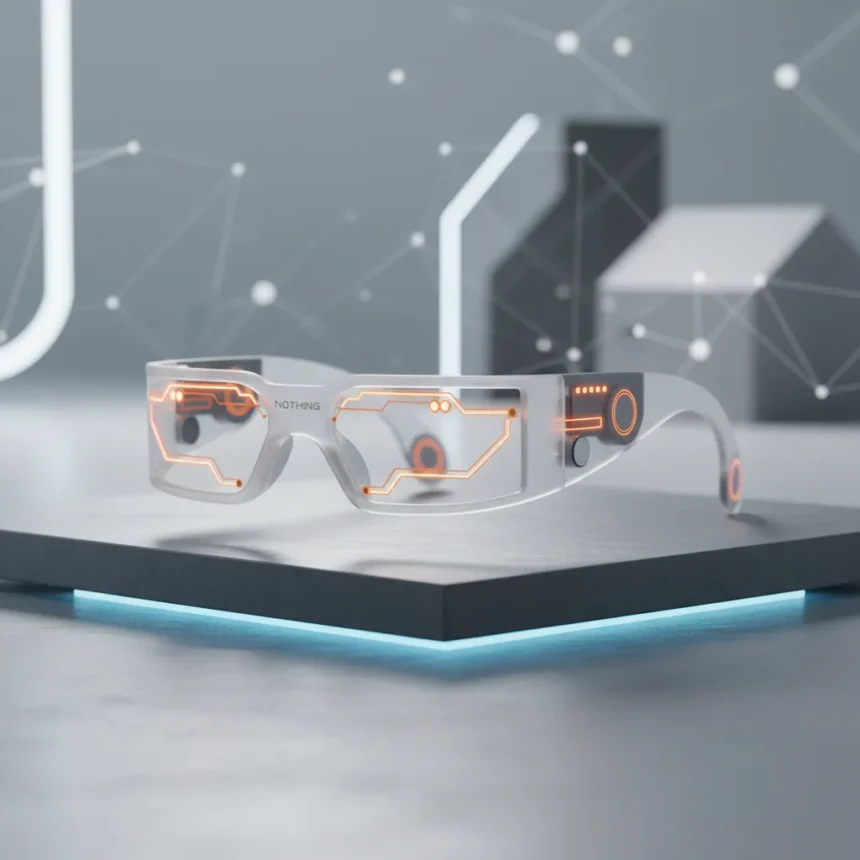
Nothing AI smart glasses are coming in the first half of 2027, marking the London-based company’s entry into a crowded wearables market dominated by Meta, Apple, Google, and Samsung. The device will feature built-in cameras, microphones, and speakers but exclude a display—a deliberate design choice that sets Nothing apart from bulkier mixed-reality competitors and aligns with the company’s focus on lightweight, everyday wearables.
Key Takeaways
- Nothing AI smart glasses launch H1 2027 with cameras, mics, speakers, but no display
- AI processing offloaded to paired smartphones and cloud servers for lightweight design
- Follows Nothing’s signature aesthetic with transparent elements and LED arrays
- Competes with Meta Ray-Ban Meta AI glasses on affordability and everyday utility
- CEO Carl Pei shifted strategy to multi-device ecosystem beyond phones and earbuds
Nothing’s Shift Into AI Wearables
Carl Pei, Nothing’s founder, initially resisted entering the smart glasses market but has now pivoted to a multi-device strategy that extends beyond the company’s core phone and earbud lineup. This strategic expansion signals Nothing’s ambition to compete across the broader AI wearables ecosystem. The company plans to launch AI-enhanced earbuds later in 2026, setting the stage for the glasses debut in 2027. Nothing’s approach prioritizes mainstream, affordable lifestyle wearables rather than enterprise-focused or expensive mixed-reality headsets that dominate current market conversations.
According to Bloomberg sources familiar with the plans, Nothing aims to keep the glasses lightweight by offloading all AI processing to paired smartphones and cloud servers rather than embedding computational hardware in the device itself. This architecture mirrors Meta’s strategy with its Ray-Ban Meta AI glasses, which also rely on phone and cloud processing to handle camera feeds and voice queries without requiring a bulky on-device processor. The design philosophy reflects a fundamental shift in how wearables approach AI: not as standalone computers, but as input devices tethered to more powerful external systems.
Design Language and Hardware Specifications
Nothing AI smart glasses will maintain the company’s signature aesthetic, incorporating transparent elements and LED arrays that have become visual hallmarks of Nothing’s product line. The device will include cameras, microphones, and speakers—the essential hardware for capturing visual data, recording audio, and delivering AI-generated responses. By omitting a display, Nothing avoids the technical complexity and power drain that screens introduce, allowing the glasses to function as a pure input-output device.



This hardware configuration directly compares to Meta’s Ray-Ban Meta AI glasses, which similarly use cameras and microphones to enable visual and audio interactions while relying on the paired smartphone to process requests and return results through the device’s speakers. The absence of a display on Nothing’s version suggests the company is betting that voice and audio feedback will suffice for most user interactions—a bet that Meta has already validated in the consumer market.
Competitive Landscape and Market Timing
Nothing enters a smart glasses market where Meta, Apple, Google, and Samsung are already establishing footholds. Meta’s Ray-Ban partnership has proven that affordable, display-free smart glasses can appeal to mainstream consumers seeking practical AI features rather than immersive virtual experiences. Apple’s Vision Pro commands the premium segment, while Google and Samsung are developing Android XR glasses for the mid-to-high range. Nothing’s 2027 launch positions the company as a late entrant but one that emphasizes affordability and integration with its existing device ecosystem.



The timing aligns with Nothing’s broader product roadmap. The company plans new AI-focused earbuds for late 2026, which could serve as a testing ground for AI interaction patterns before the glasses launch. If Nothing can establish credibility with AI earbuds first, the glasses become a natural extension of the ecosystem—a device that deepens engagement with the same cloud-based AI services.
What Remains Unknown
All details about Nothing AI smart glasses stem from anonymous Bloomberg sources and remain unconfirmed until the company makes an official announcement. Pricing, exact feature set, software capabilities, battery life, and regional availability have not been disclosed. Nothing has not revealed which AI models will power the glasses, whether they will integrate with Nothing’s existing app ecosystem, or how tightly they will bind to Nothing phones versus working with any Android device.
Will Nothing AI smart glasses compete with Meta Ray-Ban Meta AI glasses?
Yes. Both devices omit displays, offload AI processing to phones and cloud, and target everyday users seeking practical AI features rather than immersive experiences. Meta’s Ray-Ban glasses are already in the market, giving Meta an advantage in user adoption and developer support. Nothing’s entry will hinge on pricing, ecosystem integration, and whether the company can differentiate on design or AI performance.
When will Nothing AI smart glasses launch?
Nothing plans to release AI smart glasses in the first half of 2027, according to Bloomberg sources. The company will also launch new AI earbuds later in 2026, potentially establishing momentum before the glasses arrive.


What makes Nothing AI smart glasses different from Apple Vision Pro?
Nothing AI smart glasses have no display and are designed as lightweight, voice-first devices for everyday use. Apple Vision Pro is a premium spatial computing headset with a display, advanced optics, and on-device processing. Nothing targets affordability and simplicity; Apple targets immersive experiences. The two serve different use cases and price segments.
Nothing AI smart glasses represent a calculated bet that AI wearables don’t need screens to be useful. If the company executes on affordability and seamless integration with its smartphone ecosystem, the glasses could establish Nothing as a credible player in the AI wearables market. But Bloomberg sources and unconfirmed details mean the actual product may differ significantly from current expectations. The real test comes in 2027 when Nothing finally reveals what it has built.
Where to Buy
Edited by the All Things Geek team.
Source: T3