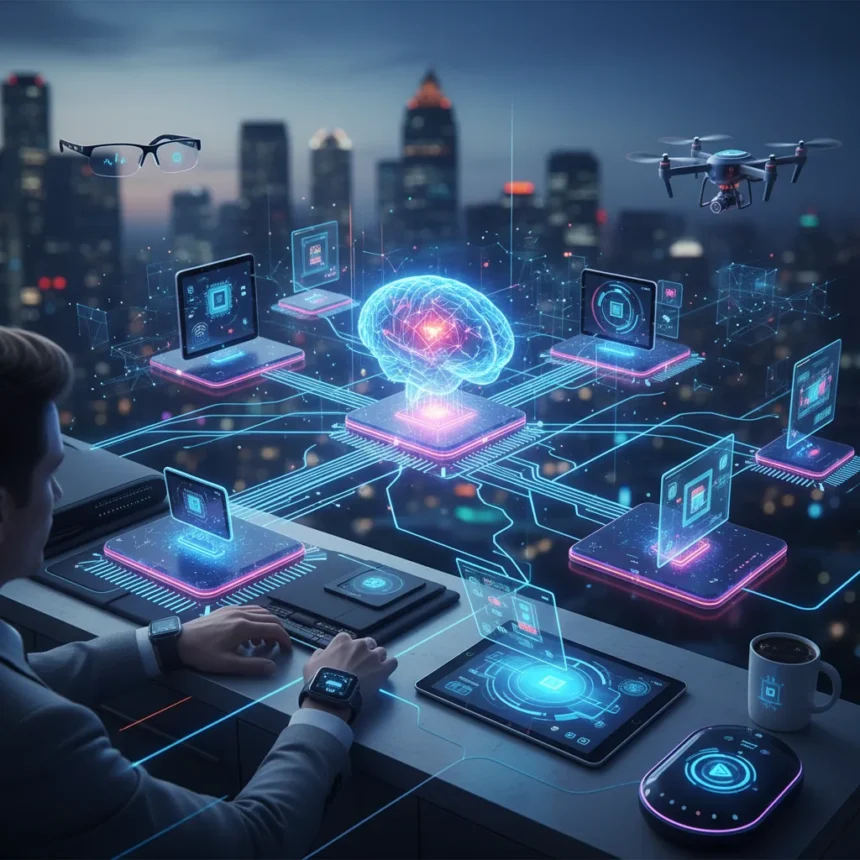
The NPU-everywhere strategy represents a fundamental shift in how artificial intelligence will be distributed across consumer devices. Rather than relying on centralized cloud processing or powerful standalone chips, this approach embeds neural processing units directly into phones, laptops, tablets, and wearables. By 2030, proponents argue that this ubiquitous deployment could transform every user into a walking supercomputer capable of running complex AI tasks locally.
Key Takeaways
- NPUs will be embedded across phones, laptops, wearables, and IoT devices by 2030
- Local AI processing reduces latency and improves privacy compared to cloud-dependent models
- The 1000 TOPS performance target represents a benchmark for next-generation consumer devices
- Distributed NPU architecture challenges traditional centralized AI infrastructure
- Device manufacturers are racing to integrate NPUs into mainstream consumer products
What the NPU-everywhere Strategy Actually Means
The NPU-everywhere strategy refers to the systematic deployment of neural processing units across all consumer computing devices rather than concentrating AI processing in data centers or high-end workstations. This architectural shift prioritizes local computation over cloud dependency, allowing devices to handle machine learning tasks independently. The strategy targets a performance ceiling of 1000 TOPS (trillion operations per second) as the standard for consumer-grade devices, a metric that would enable sophisticated AI workloads to run entirely on personal hardware.
This approach fundamentally differs from earlier AI deployment models. Where cloud-based systems required constant internet connectivity and introduced processing delays, distributed NPU architecture keeps computation on-device. Users benefit from faster response times, reduced bandwidth consumption, and greater control over their data. The strategy also addresses privacy concerns inherent in sending personal information to remote servers for processing.
Why Device Manufacturers Are Betting on This Shift
The NPU-everywhere strategy appeals to manufacturers for several compelling reasons. First, embedding NPUs reduces dependence on cloud infrastructure, lowering operational costs and latency. Devices become more self-sufficient, capable of delivering AI features without requiring constant server communication. This independence strengthens competitive positioning—a phone that can run advanced AI tasks locally requires less reliance on a company’s cloud ecosystem.



Second, the strategy addresses consumer demand for privacy. As regulatory scrutiny of data collection intensifies globally, local processing becomes a marketing advantage. Devices that promise on-device AI execution without data transmission to remote servers align with privacy-conscious consumer expectations. Third, the commoditization of NPU technology makes integration economically viable. As manufacturing costs decline and performance improves, embedding these units into mid-range and budget devices becomes feasible, not just premium flagships.
The 1000 TOPS Consumer and Performance Targets
The concept of the 1000 TOPS consumer refers to a user equipped with devices capable of collectively delivering one trillion operations per second of neural processing power. This performance level would enable running state-of-the-art AI models locally—language models, image generation systems, real-time translation, and complex data analysis. A smartphone, laptop, and smartwatch combined could theoretically handle tasks that previously required cloud servers or specialized hardware.



Reaching this target requires coordinated progress across multiple device categories. Smartphones need NPUs capable of 200-400 TOPS. Laptops and tablets require 300-600 TOPS. Wearables, though constrained by battery and thermal limits, still need meaningful neural processing capacity. The cumulative effect creates a distributed computing environment where users carry supercomputing power in their pockets and bags. This performance standard, while ambitious, reflects the trajectory of semiconductor development and industry investment in AI acceleration.
How This Strategy Challenges Traditional Cloud Infrastructure
The NPU-everywhere approach directly threatens the business model of cloud AI providers. Companies that have invested heavily in data center infrastructure and cloud AI services face disruption if computation shifts to edge devices. However, the strategy does not eliminate cloud entirely—instead, it redefines the cloud’s role. Rather than handling routine inference tasks, cloud systems would focus on training, complex analytics, and scenarios requiring massive datasets or computational resources beyond consumer devices.
This architectural change also affects software development. Developers must design applications that work efficiently on distributed, heterogeneous hardware rather than assuming uniform cloud environments. Optimization becomes critical—an AI feature that works on a flagship phone may struggle on a mid-range device with a smaller NPU. The transition requires new frameworks, programming models, and testing methodologies.
Timeline and Market Implications by 2030
The projection that NPU-everywhere will mature by 2030 reflects current semiconductor roadmaps and industry timelines. Device manufacturers are already integrating NPUs into flagship products, establishing the foundation for mainstream adoption. Over the next five years, the technology will cascade down to mid-range and budget segments, becoming a standard feature rather than a premium differentiator. By 2030, a consumer device without neural processing capability may seem as unusual as a smartphone without a camera today.


Market implications are substantial. Companies leading NPU design and manufacturing—semiconductor firms, chipset makers, and device manufacturers—will capture significant value. Software developers who build applications optimized for local AI will find new opportunities. Cloud providers will need to reposition themselves, emphasizing services that complement rather than replace edge processing. Consumers benefit from faster, more private, and more responsive AI features, though the transition period will create compatibility challenges.
What Happens to Privacy and Data Security
Local AI processing fundamentally improves privacy by default. When an AI model runs on a user’s device, personal data never leaves the hardware. A phone that recognizes faces locally does not need to transmit facial data to a server. A laptop that transcribes audio locally keeps voice recordings private. This architectural advantage aligns with regulatory trends—GDPR, data protection laws, and privacy frameworks increasingly pressure companies to minimize data collection and transmission.
However, privacy is not automatic. The strategy creates new security challenges. Devices with powerful NPUs become more attractive targets for attackers seeking to extract AI models or manipulate local processing. Manufacturers must implement robust security measures—secure enclaves, encrypted processing, and tamper protection. The shift also changes the threat model. Rather than attacking a centralized cloud system, adversaries might target distributed edge devices, requiring security updates across millions of consumer devices.
Comparing NPU-everywhere to Traditional Cloud AI Models
The NPU-everywhere strategy and cloud-dependent AI represent fundamentally different architectural philosophies. Cloud models centralize processing, enabling massive scale and uniform updates but introducing latency, bandwidth consumption, and privacy exposure. Edge NPU models distribute processing, improving response time and privacy but requiring more complex coordination across heterogeneous devices. Neither approach will completely replace the other—instead, they will coexist, with different use cases favoring different models.
Real-time applications like gaming, voice assistants, and augmented reality strongly favor local processing. These tasks require sub-100-millisecond latency that cloud systems cannot reliably deliver. Conversely, tasks requiring massive datasets or computational resources—training new models, processing petabytes of data, or running simulations—will remain cloud-based. The optimal architecture combines both: devices handle routine inference and real-time tasks locally, while cloud systems provide training, complex analytics, and backup processing.
Challenges That Could Slow Adoption
Despite the strategic appeal, the NPU-everywhere approach faces significant hurdles. Thermal and power constraints limit NPU performance in thin, battery-powered devices. A smartphone NPU cannot match the capabilities of a data center GPU without draining the battery in hours. Software fragmentation poses another challenge—developers must optimize for dozens of different NPU architectures across manufacturers, a burden that slows application development. Standardization efforts help but cannot eliminate all variations.
Consumer awareness remains low. Most users do not understand what an NPU is or why they should care. Marketing the benefits of local AI without creating unrealistic expectations requires clear communication. Additionally, the transition period will create compatibility issues. Legacy applications designed for cloud processing will not automatically work with edge NPUs. This gap could frustrate users and slow adoption during the critical years when the technology reaches mainstream markets.
How This Affects AI Model Development
The NPU-everywhere strategy necessitates a fundamental rethinking of AI model architecture. Models designed for cloud execution often prioritize accuracy over efficiency, assuming access to unlimited computational resources. Edge models must be compact, fast, and power-efficient—requirements that often conflict with maximum accuracy. Techniques like model quantization, pruning, and knowledge distillation become essential, allowing developers to compress large models into forms that fit and run efficiently on consumer devices.
This shift creates new opportunities for AI researchers focused on efficient models. Rather than chasing the largest, most capable models, the field will increasingly value models that deliver strong performance within tight constraints. Open-source frameworks and tools that simplify model optimization for edge devices will become valuable assets. Companies investing in efficient AI research now will gain competitive advantages as the market shifts toward distributed processing.
Will every device need an NPU by 2030?
Not every device will require an NPU by 2030, but most mainstream consumer devices—smartphones, laptops, and tablets—will include them as standard features. Highly specialized devices, industrial equipment, and budget products may lack NPUs. However, the technology will become so common that consumers will expect it as a baseline feature, similar to how multi-core processors are now standard rather than premium.
How does local NPU processing affect battery life?
Local NPU processing can improve battery life compared to cloud-dependent models because devices do not need to maintain constant wireless connectivity or transmit data over power-hungry cellular radios. However, running intensive AI tasks locally still consumes significant power. The net battery impact depends on the specific use case—a quick local inference task uses less power than transmitting data to a cloud server and waiting for a response, but sustained heavy processing will drain batteries faster than simple tasks.
What happens to AI companies that rely on cloud processing?
Cloud-dependent AI companies will need to adapt their business models. Rather than providing inference services through cloud APIs, they will shift toward providing optimized models for edge devices, developer tools for efficient AI, and specialized services for tasks that still require cloud processing. Companies that embrace this transition early will thrive; those that resist may find their services increasingly irrelevant as processing moves to the edge.
The NPU-everywhere strategy represents one of the most significant shifts in computing architecture in the coming decade. By distributing neural processing power across every device, the industry is moving toward a future where artificial intelligence is ubiquitous, responsive, and respectful of privacy. The transition will be messy, with compatibility challenges and winners and losers, but the direction is clear. By 2030, the question will not be whether your device has an NPU—it will be how well that NPU is optimized for the tasks you care about most.
Edited by the All Things Geek team.
Source: TechRadar