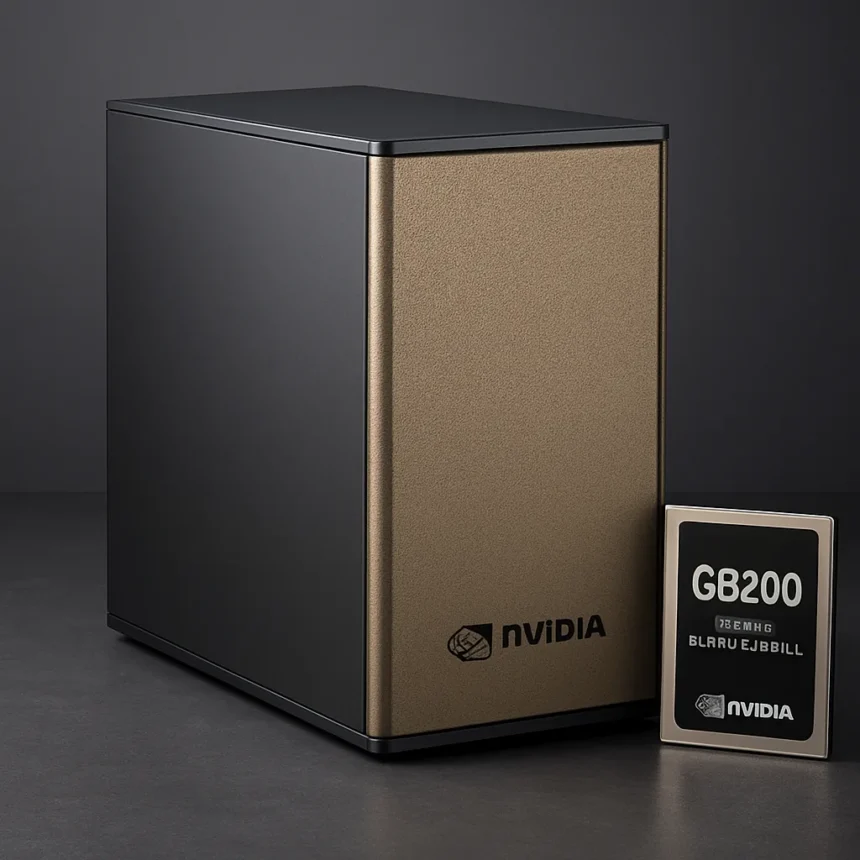
The Nvidia DGX Station is a desktop AI workstation made by Nvidia, powered by the GB300 Grace Blackwell Ultra Desktop Superchip, now available to order with shipping expected in the coming months. It delivers up to 20 petaFLOPS of AI compute and up to 784GB of combined LPDDR5X and HBM3e memory — specs that, until now, required a full rack of hardware to approach. This is not a workstation for rendering video or compiling code. It is a machine built for enterprises that want hyperscaler-grade AI inference and training on a single desk.
Key Takeaways
- The Nvidia DGX Station uses the GB300 Grace Blackwell Ultra Desktop Superchip with up to 784GB of combined memory.
- It delivers up to 20 petaFLOPS of AI compute from a desktop form factor.
- The superchip pairs one Grace CPU (72 Arm cores) with two B300 GPUs connected via NVLink-C2C at 900GB/s.
- GB300 delivers 50% more GPU memory and 50% more FP4 performance than the GB200 it replaces.
- Pricing is enterprise contact-only; Nvidia includes a 3-year hardware and software support package.
What Makes the Nvidia DGX Station Different From Any Desktop Before It
The Nvidia DGX Station is not an incremental upgrade to a GPU workstation. It is a fundamentally different category of machine. The GB300 Grace Blackwell Ultra Desktop Superchip integrates one Grace CPU with 72 Arm cores and two B300 GPUs, connected via NVLink-C2C at 900GB/s bidirectional bandwidth. The result is a coherent memory pool that software can treat as a single unified resource — something no discrete GPU setup can replicate.
The memory configuration alone sets it apart. The two B300 GPUs contribute 576GB of HBM3e (288GB each), while the Grace CPU adds up to 480GB of LPDDR5X. Combined, that reaches up to 784GB of addressable memory, with total memory bandwidth of approximately 24TB/s. To put that in context, the previous GB200-based configuration offered around 384GB of HBM3e and 16TB/s bandwidth — the GB300 is a meaningful step up, not a rebadge.
On raw compute, the GB300 superchip in desktop configuration delivers up to 30 PFLOPS at FP4 precision, 15 PFLOPS at FP8, and 7.5 PFLOPS at FP16. Nvidia rates the full desktop unit at up to 20 petaFLOPS for AI workloads. The power draw is rated at 1,600 watts for the DGX Station configuration — significant for a desktop, but manageable compared to the rack-scale alternatives that demand dedicated data centre infrastructure.



How Does the GB300 Superchip Compare to GB200?
The GB300 Grace Blackwell Ultra outpaces the GB200 across every major metric that matters for AI workloads. GPU memory increases by 50% — from 384GB to 576GB of HBM3e. Memory bandwidth jumps from roughly 16TB/s to approximately 24TB/s. FP4 Tensor performance moves from around 20 PFLOPS to around 30 PFLOPS, with FP8 and FP16 scaling proportionally.
The Blackwell Ultra GPU itself carries 288GB of HBM3e per chip — the highest available in any GPU at this point — compared to 180GB in the B200. Bandwidth per GPU reaches 8TB/s versus 7.7TB/s for the B200, and the maximum GPU TDP rises to 1.4kW, a 40% increase. That power jump is the price of the performance gain, and enterprises considering the DGX Station need to plan their power delivery accordingly.



Against Hopper-generation platforms, the picture is even more dramatic. Nvidia claims the rack-scale GB300 NVL72 delivers 50 times higher AI factory output compared to Hopper systems — a combination of 10x better latency and throughput per user alongside 5x higher throughput per megawatt. The desktop DGX Station won’t match those rack numbers, but it shares the same architectural DNA and the same generational leap in efficiency.
Who Actually Needs the Nvidia DGX Station?
The honest answer is: not many people, but exactly the right people. The DGX Station targets enterprise AI teams that need to run large language model inference or fine-tuning locally — without shipping data to a cloud provider and without the capital expenditure of a full rack deployment. Regulated industries like finance, healthcare, and defence are the obvious candidates. So are AI research labs that want dedicated compute without the operational overhead of a data centre.
For comparison, the rack-scale DGX GB300 NVL72 packs 72 Blackwell Ultra GPUs and 36 Grace CPUs into a single rack, with up to 20-37TB of fast memory and a rack TDP of roughly 100.8kW. That system is for hyperscalers and large enterprises building AI factories. The DGX Station is for teams that need serious AI compute but don’t need — or can’t afford — an entire rack. It’s a different problem being solved, not a downgrade.
Pricing is enterprise contact-only, with no figures published. Nvidia bundles a 3-year hardware and software support package with the system. Expect the cost to reflect the hardware inside — this is not a machine with a consumer price tag.



Is the Nvidia DGX Station available to buy now?
The Nvidia DGX Station is available to order now, with shipping expected to begin in the coming months. Pricing is not publicly listed and requires direct contact with Nvidia’s enterprise sales team. A 3-year hardware and software support package is included.
How does the DGX Station differ from the DGX GB300 NVL72 rack system?
The DGX Station is a single desktop unit with one GB300 Grace Blackwell Ultra Desktop Superchip, two B300 GPUs, and up to 784GB of memory. The DGX GB300 NVL72 is a full rack system with 72 Blackwell Ultra GPUs and 36 Grace CPUs, requiring liquid cooling and a rack TDP of approximately 100.8kW. They share the same chip architecture but serve very different deployment scales.
What AI workloads is the DGX Station designed for?
The DGX Station is built for enterprise AI inference and training workloads, including large language model fine-tuning and deployment. Its large unified memory pool — up to 784GB — makes it well-suited for running models that exceed the memory capacity of conventional GPU workstations. It’s particularly relevant for organisations in regulated industries that need on-premises AI compute without cloud dependency.
The Nvidia DGX Station is a genuine milestone: the most capable AI compute you can put on a desk, built on the same GB300 Grace Blackwell architecture that powers Nvidia’s largest rack systems. It won’t suit every budget or every team, but for enterprises serious about on-premises AI at scale, there is currently nothing else at this level in a desktop form factor. The coming months will show whether the real-world performance matches the spec sheet — but the spec sheet alone is enough to make competitors take notice.
Edited by the All Things Geek team.
Source: Tom's Hardware