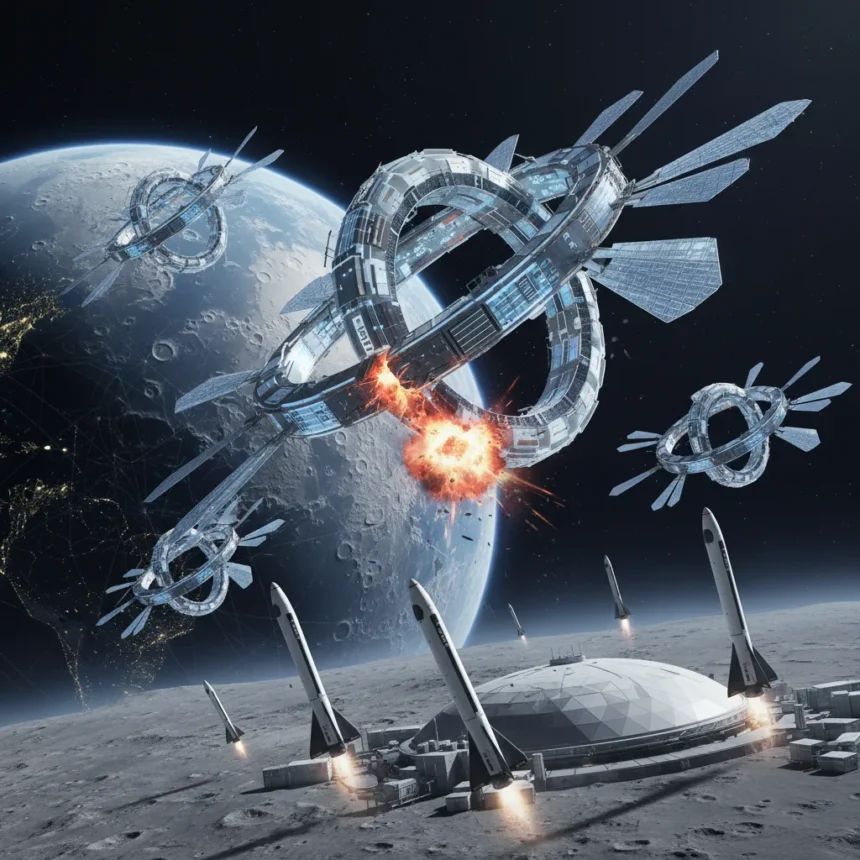
Orbital AI data centers represent a bold bet that space can solve artificial intelligence’s earthbound power crisis—but SpaceX’s own pre-IPO filing reveals the concept is far riskier than Elon Musk’s public cheerleading suggests.
Key Takeaways
- SpaceX plans up to 1 million satellites for orbital AI data centers, each potentially larger than the International Space Station.
- Musk claims orbital AI will be the “lowest-cost place to put AI” within two to three years, but SpaceX admits the technology is unproven.
- Space avoids Earth’s power grid constraints and water cooling shortages but introduces radiation, vacuum exposure, and launch dependency risks.
- Starcloud has already launched a demonstrator satellite with an Nvidia H1 GPU and plans a Bitcoin mining test for October 2026.
- Terafab, a Tesla-SpaceX joint venture, will manufacture silicon for both Optimus robots and orbital data centers starting at 100,000 wafers monthly.
Why Musk Thinks Space Is the Answer
Elon Musk made his case bluntly at the World Economic Forum in Davos in early 2026: unconstrained solar power in orbit makes space the “lowest-cost place to put AI,” a claim he expects to prove true “within two years, three at the latest.” The logic is seductive. Earth-based AI data centers face a collision of constraints—power grids already strained, water sources depleted for cooling, and land costs escalating. Space offers something Earth cannot: continuous solar exposure without night cycles, zero-gravity environments that simplify heat dissipation, and potential latency advantages through laser communication links. These advantages are real. But SpaceX’s own filing, obtained by Reuters, tells a different story about readiness.
The pre-IPO filing states plainly that orbital AI compute, in-orbit industrialization, and lunar operations are “in early stages, involve significant technical complexity and unproven technologies, and may not achieve commercial viability.” This is not a minor caveat. It is a public admission from SpaceX itself that Musk’s two-to-three-year timeline may be wildly optimistic. The company also warns that orbital data centers will operate “in the harsh and unpredictable environment of space, exposing them to a wide and unique range of space-related risks that could cause them to malfunction or fail,” including accelerated wear on sensitive AI chips.
The Engineering Reality of Orbital AI Data Centers
SpaceX’s growth strategy depends almost entirely on Starship, the company’s fully reusable super-heavy-lift rocket. The filing explicitly states that “any failure or delay in the development of Starship at scale or in achieving the required launch cadence, reusability and capabilities thereof would delay or limit our ability to execute our growth strategy.” This is not abstract risk. Starship’s previous test flights resulted in “massive mid-flight explosions.” Building and launching up to 1 million satellites—each potentially larger than the International Space Station—requires a launch cadence and reliability that Starship has not yet demonstrated at scale.



The physical challenges compound quickly. Radiation in space degrades semiconductors faster than on Earth. Thermal management in vacuum is counterintuitive and unforgiving. A single micrometeorite strike or solar flare can cascade into failures across networked systems. SpaceX’s own engineering admits these are not solved problems. Yet the company is moving forward anyway, unveiling renders of “AI Sat Mini” satellites with unfolding solar arrays and radiator panels—designs that have never operated at this scale in orbit.
Competitors Are Already Testing, Not Just Talking
While SpaceX remains in the concept phase, Starcloud has moved beyond theory. The company filed an FCC permit for 88,000 demisable satellites in sun-synchronous orbit and successfully launched Starcloud 1, a refrigerator-sized demonstrator carrying an Nvidia H1 GPU, aboard a SpaceX Bandwagon 4 mission. Starcloud plans modular 2×2 kilometer space data centers constructed from Starship launches, with a Bitcoin mining demonstrator scheduled for October 2026. This is not vaporware—it is incremental, testable progress. Starcloud’s approach differs fundamentally from SpaceX’s megastructure vision. Smaller, modular satellites are easier to launch, test, and replace if failures occur. They also generate revenue sooner, reducing financial risk.



Terafab, a joint venture between Tesla and SpaceX, is manufacturing silicon wafers for both Optimus robots and orbital data center processors, starting at 100,000 wafers per month with plans to scale to 1 million. This vertical integration suggests SpaceX is serious about the supply chain, but it also locks the company into a single architecture. If orbital AI data centers prove economically unviable, the silicon capacity becomes stranded infrastructure.
The Skeptics Have a Point
Critics argue that orbital AI data centers solve a problem that terrestrial solutions are already addressing more cheaply. Earth-based data centers can relocate to regions with abundant hydroelectric or geothermal power. They can improve cooling through advanced liquid systems. They do not require launching tons of hardware into orbit and managing it in an environment that destroys sensitive electronics. The environmental cost of launching 1 million satellites—including ozone-depleting chemicals released during atmospheric reentry—is also substantial and poorly quantified.
Musk’s timeline remains the most vulnerable element of his thesis. Two to three years is barely enough time to complete a single Starship-scale orbital demonstration, let alone prove commercial viability. SpaceX’s own filing suggests the company knows this, which raises the question: why make the public claim at all? The answer is likely strategic. Announcing orbital AI as a core growth pillar attracts venture capital, signals confidence to investors ahead of IPO, and keeps SpaceX in the center of AI-industry conversations. Whether it delivers on the promise is a different matter entirely.
Can Orbital AI Data Centers Compete on Cost?
The fundamental economic question remains unanswered: will orbital AI compute ever be cheaper than Earth-based alternatives? Launch costs, satellite manufacturing, orbital maintenance, and end-of-life deorbit operations all add layers of expense that terrestrial data centers do not face. SpaceX’s reusable Starship is designed to lower launch costs, but even with dramatic improvements, putting a ton of compute in orbit will never be as cheap as building it on land with existing power infrastructure. The space advantage only materializes if Earth-based options become so constrained that they are no longer viable. That scenario is possible—AI’s projected power consumption could reach 8-10% of global electricity by 2030—but it is not inevitable.



Is Elon Musk right about orbital AI data centers?
Musk is right that space offers unique advantages: unlimited solar power, zero gravity, and freedom from terrestrial infrastructure limits. He is also right that Earth-based data centers face real constraints. But his timeline is almost certainly wrong. SpaceX’s own filing admits the technology is unproven and may not achieve commercial viability. Two to three years is not enough time to build, launch, and validate 1 million satellites. Five to ten years is more realistic, assuming Starship performs flawlessly and no unforeseen technical barriers emerge.
When will orbital AI data centers actually launch commercially?
SpaceX has not announced a commercial launch date. The company is in the concept and demonstration phase. Starcloud’s October 2026 Bitcoin mining test will provide real-world data, but that is a small payload on a single satellite, not a full-scale orbital data center. Realistic commercial deployment for SpaceX is likely five to ten years away, contingent on Starship achieving reliable, high-cadence launches and orbital systems proving their reliability in space.
Orbital AI data centers are not as crazy as critics claim, but they are also not the imminent solution Musk suggests. They represent a genuine long-term bet on space infrastructure, backed by real engineering and real competitors testing real prototypes. The question is not whether space can host data centers—it can. The question is whether it will ever be economically rational to do so at scale. SpaceX’s own filing suggests the company is not yet confident in the answer.
Edited by the All Things Geek team.
Source: Tom's Guide