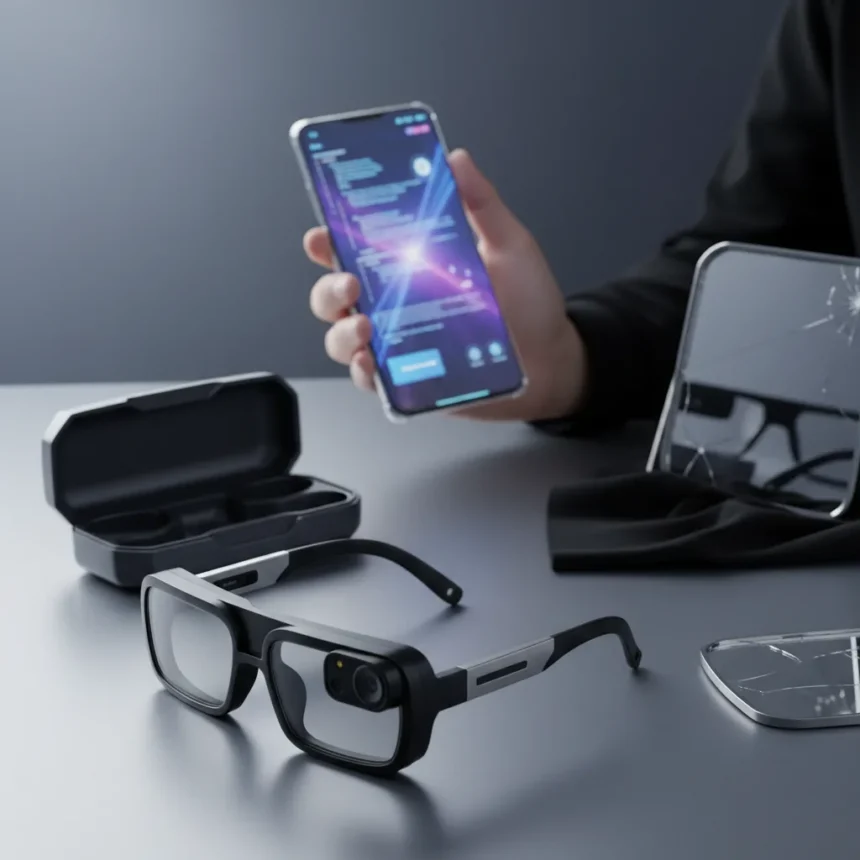
The Rokid AI Glasses Style are smart glasses that ditch the display entirely, betting instead on voice-first AI, lightweight comfort, and all-day battery life to compete with bulkier alternatives like Meta’s offering. After a month of daily use, the verdict is split: the underlying technology genuinely impresses, but the design and price tag feel at odds with what you actually get.
Key Takeaways
- Rokid AI Glasses Style weigh just 38.5 grams, making them the lightest smart glasses available.
- Built-in ChatGPT-5 AI assistant handles questions, reminders, real-time translation across 89 languages online, and contextual information.
- Dual-chip architecture (NXP RT600 + Qualcomm AR1) enables all-day battery life without recharging.
- Design looks like normal sunglasses, not bulky sci-fi goggles, with six photochromic lens options at launch.
- Price of $299 USD feels steep for what amounts to AI-powered audio glasses without a visual display.
What Makes the Rokid AI Glasses Style Different
The Rokid AI Glasses Style take a radically different approach from competitors. Instead of cramming a tiny display into the lenses or building bulky frames, Rokid stripped the concept down to what actually matters for daily use: lightweight design, powerful AI, and seamless audio. The result is a pair of glasses that genuinely look like regular eyewear, not a prototype from a sci-fi movie. You can wear these all day without the self-consciousness that comes with most wearables.
The architecture supports this philosophy through a clever dual-chip setup. An NXP RT600 handles always-on, low-power tasks, while a Qualcomm AR1 manages the heavy lifting for AI and imaging. This division of labor is why the device achieves all-day battery life without the bulk that plagues display-based competitors. Voice-first interaction replaces the need for a screen—you ask questions, get answers through crisp audio speakers, and capture POV photos and video hands-free.
Compared to Meta’s smart glasses, which lean heavily toward the connected-camera aesthetic, the Rokid AI Glasses Style feel more like eyewear than wearable tech. One reviewer noted that by ditching the display and focusing on comfort, AI, and prescription support, Rokid created something you’d actually want to wear all day rather than something you tolerate.



AI Features That Actually Work
The ChatGPT-5 integration is the heart of the experience. You can ask the glasses questions, set reminders, get contextual information about your surroundings, and access real-time translation across 89 languages when online. Head gesture control adds a hands-free layer, letting you navigate without touching anything. The interaction feels natural—not forced or gimmicky.
Real-time translation is genuinely useful for travelers. The glasses handle 89 languages online, though offline support is more limited. For someone constantly on the move, this alone justifies keeping the device charged and paired with your phone. The camera captures what you see without you needing to pull out a phone, which sounds minor until you realize how often you’d use it.



Audio quality through the built-in speakers is crisp and directed to your ears, so others nearby don’t hear your AI assistant’s responses. Calls come through clearly, and the device handles music playback, though one reviewer noted this isn’t a primary use case. Battery life holds up throughout a full day without requiring a midday charge, which is where the dual-chip design earns its keep.
Design and Pricing: Where Enthusiasm Stalls
Here’s the tension: the Rokid AI Glasses Style look good. They’re stylish enough to pass as normal sunglasses, with a clean, premium feel and six photochromic lens options that auto-adjust to lighting and are user-swappable. Yet the original review headline calls them ugly, and it’s hard to shake that opinion once it lands. The design is inoffensive, but inoffensive isn’t compelling enough to justify $299 for glasses without a display.
The price becomes harder to defend when you consider what you’re not getting. There’s no visual output—no notifications on the lens, no augmented reality overlay, no heads-up display. You’re paying for AI, audio, a camera, and the promise of all-day comfort. For many users, that’s enough. For others, it feels like paying flagship prices for a device that’s really a high-end accessory.
A discount code (CC20) knocks $20 off the $299 price tag, bringing it to $279, but that’s a modest saving on an already premium product. Prescription lens support and additional photochromic options add cost on top, which could push the total investment higher depending on your needs.



Setup and Daily Use
Getting started is straightforward. The Hi Rokid app handles pairing via Bluetooth 5.3 and Wi-Fi 5. Once connected, the glasses become an extension of your phone—pulling AI responses, handling calls, and capturing content. The lightweight form factor (38.5 grams) means you forget you’re wearing them, which is the whole point.
Prescription lens support is a genuine advantage over competitors. If you need vision correction, you can get it built into the frames without adding bulk or switching between glasses and smart glasses. The swappable photochromic lenses mean you can adapt to different lighting conditions without carrying multiple pairs.
Rokid AI Glasses Style vs. Meta Smart Glasses: Which Should You Choose?
Meta’s smart glasses are bulkier and more obviously tech-forward, leaning into the connected-camera and social-sharing angle. The Rokid AI Glasses Style prioritize comfort and discretion, trading visual display for all-day wearability and ChatGPT-5 integration. If you want augmented reality overlays and a visible HUD, Meta is the choice. If you want AI assistance without looking like you’re wearing a prototype, Rokid wins.
Are the Rokid AI Glasses Style worth $299?
For daily AI access, real-time translation, and hands-free photo capture in a lightweight, stylish form factor, the Rokid AI Glasses Style deliver genuine value. The technology works reliably, and all-day battery life removes the friction of constant recharging. The question is whether you value those features enough to justify the price. If you’re already sold on wearable AI and want something you’ll actually wear, they’re worth considering. If you’re skeptical that glasses without a display justify premium pricing, you’re not wrong.
How do the Rokid AI Glasses Style compare to regular glasses with prescription lenses?
Regular prescription glasses are cheaper and do one job well: vision correction. The Rokid AI Glasses Style add ChatGPT-5, translation, hands-free camera, and audio features on top of prescription support, making them a multi-function device. The trade-off is cost and the need to keep them charged.
Can you use the Rokid AI Glasses Style offline?
Yes, but with limitations. Offline translation supports fewer languages than the full 89-language online suite. Core AI features and audio work without an internet connection, but real-time translation and contextual lookups require Wi-Fi or Bluetooth tethering to your phone.
The Rokid AI Glasses Style represent a genuine rethink of what smart glasses should be. By abandoning the display arms race, Rokid created something genuinely wearable that integrates AI naturally into daily life. The design is inoffensive but uninspiring, and the price asks a lot for what is ultimately a premium audio and AI accessory. If you value all-day comfort, hands-free AI, and real-time translation, they’re worth the investment. If you’re waiting for smart glasses to look cooler and cost less, keep waiting.
Edited by the All Things Geek team.
Source: TechRadar