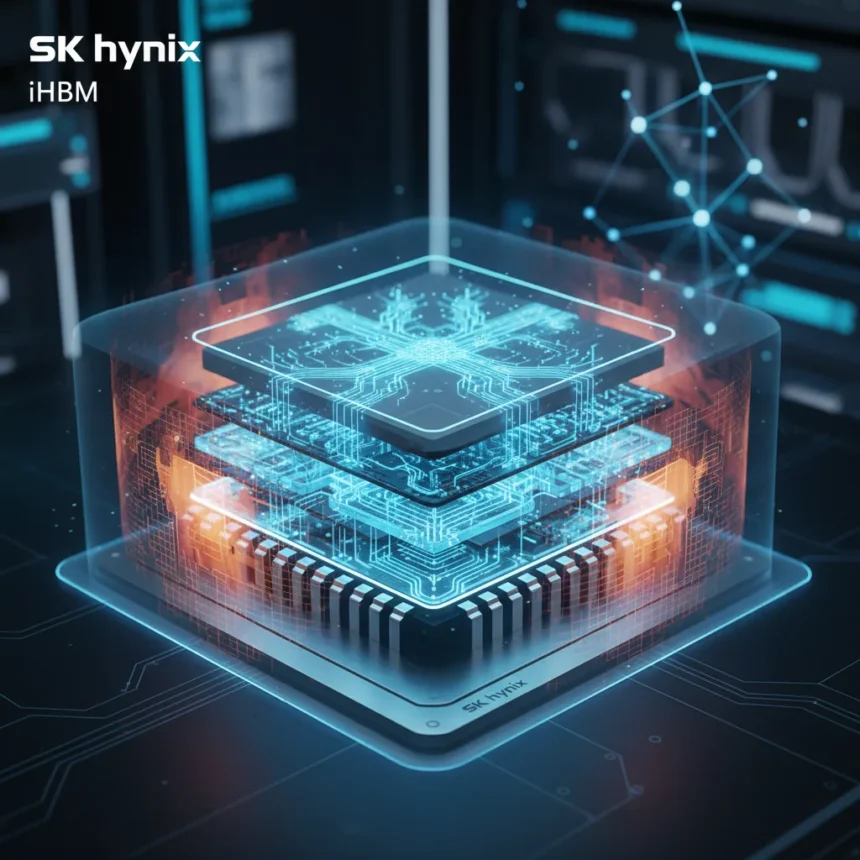
SK hynix iHBM thermal architecture represents a fundamental shift in how memory chips handle heat in AI systems. The company has embedded silicon-based cooling elements directly into the HBM interface package, creating a dedicated heat escape path that cuts thermal resistance by more than 30% compared to conventional designs. This move addresses a critical bottleneck: as AI accelerators demand faster, taller memory stacks, heat dissipation has become a limiting factor in system scaling.
Key Takeaways
- SK hynix iHBM reduces thermal resistance by more than 30% versus conventional HBM architecture
- Cooling elements are embedded directly into the package near the memory-to-processor hotspot
- The technology uses SK hynix’s Advanced MR-MUF production process, already proven in mass manufacturing
- iHBM is designed to integrate into existing customer layouts without major redesigns
- HBM5 adoption is planned around 2029 to 2030, according to Counterpoint Research
How SK hynix iHBM Thermal Architecture Solves the Heat Problem
Memory chips in AI accelerators generate intense heat at the high-speed interface where data flows between the processor and memory stack. SK hynix iHBM places cooling directly at this hotspot, eliminating the indirect heat paths that conventional HBM relies on. Lee Kang-wook, head of package development at SK hynix, stated: “iHBM is an optimal solution for minimizing heat, developed by combining our memory design capabilities with advanced packaging technology”.
The architecture embeds silicon-based thermal management elements into the package itself, creating what amounts to a dedicated highway for heat to escape without interfering with the memory’s internal circuitry. This approach matters because dense AI data centers stack multiple accelerators in tight physical spaces, where cumulative heat becomes a thermal runaway risk. By moving cooling closer to the source of the problem, SK hynix reduces the thermal resistance that conventional designs cannot overcome.
SK hynix iHBM vs. Conventional HBM Memory Design
Traditional HBM stacks rely on heat dissipation through the package substrate and external cooling solutions—a more indirect path that leaves thermal resistance higher. SK hynix iHBM flips this by integrating cooling into the interface itself, eliminating multiple layers of thermal resistance between the hotspot and the cooling medium.



The comparison matters because AI memory scaling is hitting a wall. As stacks grow taller to deliver more bandwidth, heat density increases exponentially. Conventional approaches cannot keep pace with this demand, leading to thermal throttling that degrades performance in the most demanding workloads. SK hynix iHBM addresses this by redesigning the package from the ground up, rather than bolting external cooling onto an unchanged architecture.
Manufacturing and Adoption Path for SK hynix iHBM
SK hynix is using its Advanced MR-MUF process to manufacture iHBM, a production method the company has already proven at scale. This is a significant advantage: the technology does not require entirely new manufacturing lines or untested processes, which lowers the barrier to adoption for customers.



The company has designed iHBM to fit into existing customer system layouts without requiring major redesigns, further reducing friction in the transition. The planned rollout begins with HBM5, which industry analysts expect around 2029 to 2030. This timeline aligns with the broader industry shift toward hybrid bonding for stacked-chip connections, suggesting SK hynix is positioning iHBM as a complementary innovation rather than a standalone solution.
Why AI Data Centers Need SK hynix iHBM Right Now
The AI memory market is under severe strain. Demand for HBM is reportedly running ahead of what SK hynix and competitors can currently manufacture. Thermal constraints make this worse: as customers push existing accelerators harder to extract more performance, heat management becomes a limiting factor that no amount of manufacturing volume can solve.
iHBM removes this constraint by allowing denser, more powerful AI memory configurations without triggering thermal throttling. For data center operators, this means more usable performance per physical footprint—a critical metric when building large-scale AI training and inference clusters. The 30% reduction in thermal resistance translates to either lower operating temperatures at the same performance level, or higher sustained performance at the same temperature budget.
What’s Next for SK hynix iHBM and HBM5
SK hynix has announced the iHBM architecture but has not disclosed a specific commercial availability date independent of HBM5 adoption. The company is working with customers to integrate the technology into next-generation accelerator designs, with full deployment expected as HBM5 ramps. No pricing information has been released, and the company has not detailed whether iHBM will carry a cost premium over conventional HBM.


The broader context matters: SK hynix is one of three major HBM suppliers competing against Samsung and Micron. All three are racing to deliver higher-capacity, lower-thermal memory for the next wave of AI accelerators. iHBM gives SK hynix a thermal advantage heading into the HBM5 era, potentially shifting customer preferences if the technology delivers the promised 30% improvement in real-world systems.
Will SK hynix iHBM require new accelerator designs?
SK hynix has designed iHBM to integrate into existing customer layouts without major redesigns. However, accelerator makers will still need to validate the new package and update their thermal models. Full optimization of iHBM’s benefits likely requires some accelerator-level changes, though not a complete redesign from scratch.
When will SK hynix iHBM be available in consumer GPUs?
iHBM is targeted at data center and AI accelerators, not consumer graphics cards. The technology is planned for HBM5, which Counterpoint Research expects around 2029 to 2030. Consumer GPUs typically lag behind data center adoption by 12-18 months, so widespread consumer availability would follow that timeline.
How much will SK hynix iHBM cost compared to standard HBM?
SK hynix has not disclosed pricing for iHBM. The company has stated that the technology uses proven manufacturing processes and fits into existing layouts, which should minimize cost premiums, but no specific price comparison has been released.
SK hynix iHBM represents a meaningful step forward in solving one of AI hardware’s most stubborn problems: memory heat. By embedding cooling directly into the package interface and cutting thermal resistance by more than 30%, the company is removing a scaling bottleneck that conventional HBM cannot overcome. For data center operators and accelerator makers, this is not just an incremental improvement—it is a prerequisite for the next generation of AI systems. The question now is whether competitors will match the innovation before HBM5 arrives around 2029 to 2030, or whether SK hynix’s thermal advantage becomes a lasting competitive edge in the race for AI memory dominance.
Edited by the All Things Geek team.
Source: Tom's Hardware