





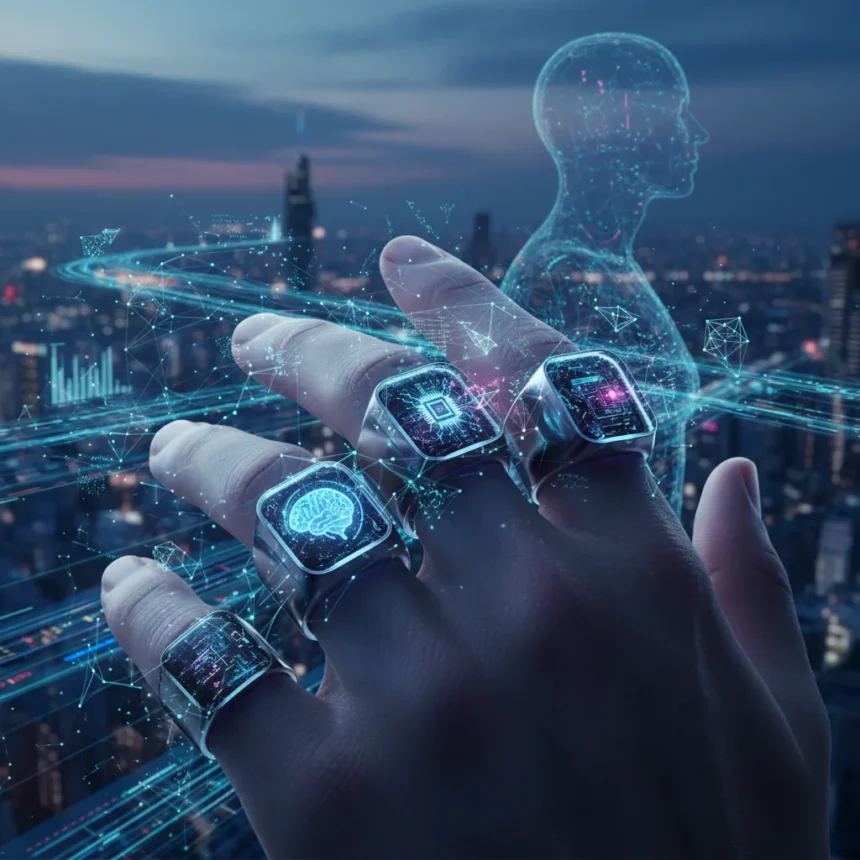
Smart rings will become computers on the body with the ability to at least micro-think, according to Ultrahuman CEO Mohit Kumar in an exclusive interview. This vision represents a fundamental shift in how the wearable industry thinks about finger-worn devices—moving beyond passive health tracking toward active computational partners worn directly on the user’s hand.
Key Takeaways
- Ultrahuman CEO believes smart rings will evolve into wearable computers capable of micro-thinking
- Current smart rings focus on health metrics; future versions will handle computational tasks
- The shift signals a move from passive tracking to active, intelligent wearables
- Ultrahuman is positioning itself at the forefront of this technological evolution
- Micro-thinking capability represents a new category of on-body AI integration
The Vision: Smart Rings as Wearable Computers
Kumar’s statement that smart rings will become computers on the body marks a departure from the current market reality. Today’s smart rings, including Ultrahuman’s own offerings, prioritize biometric monitoring—heart rate variability, sleep tracking, body temperature, and activity detection. These devices excel at gathering data about the wearer’s body, but they remain fundamentally reactive tools that sync information to smartphones for processing and interpretation.
The CEO’s vision suggests a future where smart rings don’t just collect data; they interpret it, make decisions, and execute commands independently. A ring capable of micro-thinking could adjust notifications based on your current stress level, predict health issues before they manifest, or manage your calendar autonomously based on your physical state. This represents a meaningful evolution from wearable to wearable computer.
Micro-Thinking: What It Means for Wearables
Micro-thinking, as Kumar frames it, appears to describe localized intelligence—the ability for a device to perform reasoning tasks at the point of wear rather than relying entirely on cloud processing or smartphone relay. This matters because it enables faster response times, improved privacy (data stays on the device), and true independence from a connected smartphone.



Current smart rings depend on companion apps and cloud services to deliver meaningful insights. A ring with micro-thinking capability would process its sensor data locally, identify patterns, and respond without needing to phone home. This architectural shift has profound implications: a device that thinks is fundamentally different from a device that merely collects and transmits.
Where Smart Rings Stand Today vs. Tomorrow
The gap between current smart rings and Kumar’s vision is substantial but not insurmountable. Today’s devices are constrained by battery life, processing power, and thermal management—three factors that limit how much computation can happen on a finger-worn device. Improving any one of these would unlock new capabilities; improving all three simultaneously would enable the kind of independent intelligence the CEO describes.



Ultrahuman’s current Ring Air and Ring Pro models represent the current state of the art in consumer smart rings, focusing on metabolic health, sleep quality, and activity tracking. These devices serve a clear purpose for biohackers and health-conscious users, but they operate within the existing paradigm: sense, transmit, analyze elsewhere. Kumar’s comments suggest the company views this as a starting point, not an endpoint.
The Competitive Landscape and AI Integration
Other wearable makers—including Oura (which dominates the premium smart ring market) and newer entrants—are also exploring how to add intelligence to finger-worn devices. The race to embed AI in wearables reflects a broader industry trend: moving computation closer to the source of data. Smart rings, by virtue of their position on the hand and constant contact with the body, are uniquely positioned to benefit from on-device intelligence.
Kumar’s framing of smart rings as future computers positions Ultrahuman as thinking bigger than its competitors. Rather than incremental improvements to health tracking, the CEO is articulating a vision of fundamental category expansion. Whether Ultrahuman can deliver on this vision will depend on solving the engineering challenges that have constrained wearables for years.
What Micro-Thinking Requires
For smart rings to achieve genuine micro-thinking, several technical hurdles must be cleared. Battery technology needs to advance significantly—adding processing power without proportional battery drain remains unsolved at scale. Chipmakers must develop processors optimized for ring-form factors, balancing power consumption against computational capability. And the software stack needs to mature; AI models designed for phones or desktops don’t automatically shrink to wrist-worn or finger-worn dimensions.


These are not insurmountable problems, but they are real ones. The companies that solve them first will own the emerging smart ring computer category. Kumar’s public statements suggest Ultrahuman is investing in these solutions, though concrete product timelines remain unclear.
Why This Matters Now
The wearable market is maturing. Basic health tracking is becoming commoditized—every smartphone now includes robust fitness tracking. To justify premium prices and sustained user engagement, wearable makers must offer something beyond data collection. Intelligence on the device itself is the natural next frontier. A ring that understands your body and acts on that understanding is more valuable than a ring that simply reports numbers to your phone.
Kumar’s vision aligns with where the broader tech industry is headed: embedding AI everywhere. The question is not whether smart rings will eventually gain computational capability, but which company will deliver it first and in what form.
Could smart rings actually think independently?
Yes, but not in the human sense. Micro-thinking likely refers to local machine learning inference—running pre-trained AI models on the ring itself to classify patterns, make predictions, and trigger actions. This is already possible on some wearables; scaling it to the power constraints of a smart ring is the remaining challenge.
What would a thinking smart ring do that current ones don’t?
A smart ring with micro-thinking could proactively alert you to stress before you feel it, adjust medication reminders based on your real-time physiology, or predict illness onset days in advance. Current rings report these metrics passively; a thinking ring would act on them autonomously.
Is Ultrahuman working on this technology?
Kumar’s comments suggest the company is exploring this direction, but no product with genuine micro-thinking has been announced. Ultrahuman’s current devices remain health-tracking focused, though the CEO’s vision indicates where the company’s R&D efforts may be headed.
The future of smart rings hinges on this transition from passive sensors to active computers. Ultrahuman CEO Kumar has articulated the destination clearly; whether the company and its competitors can engineer the journey is the real test ahead. The smart ring market today is about tracking your body. Tomorrow’s market will be about understanding it.
Edited by the All Things Geek team.
Source: Tom's Guide




