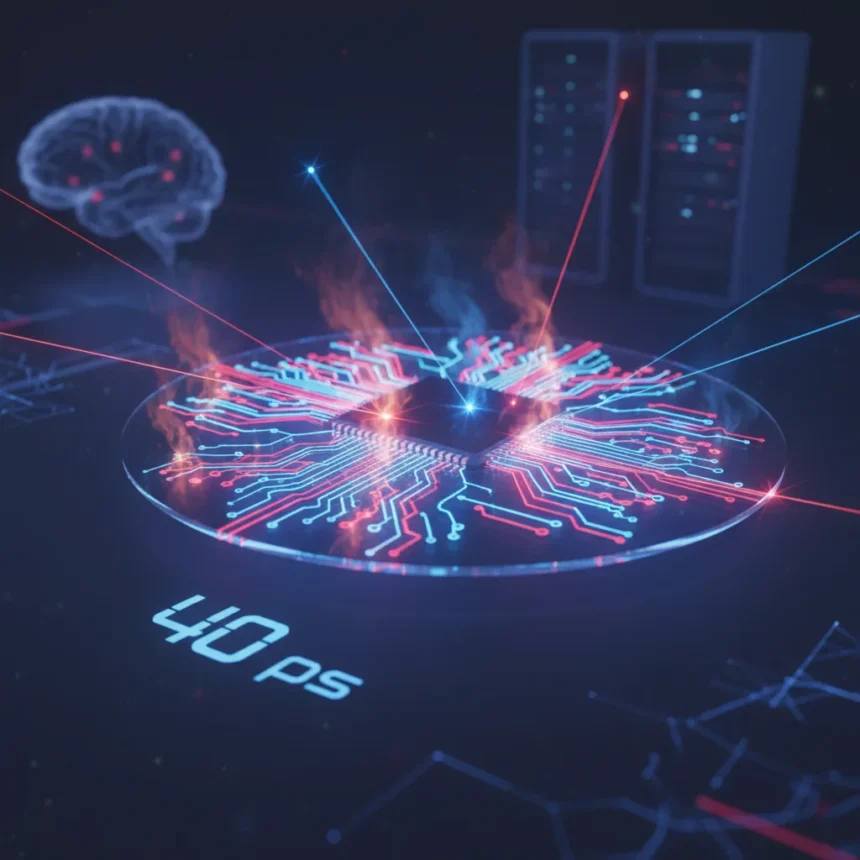
Spintronic memory switching speed has reached a new frontier. University of Tokyo researchers have demonstrated a laser-driven spintronic memory device based on Mn₃Sn that flips non-volatile bits in approximately 40 picoseconds while generating almost no heat—a capability that could fundamentally reshape how we design memory systems for power-hungry AI workloads.
Key Takeaways
- Spintronic memory switching speed reaches 40 picoseconds, roughly 1,000 times faster than DRAM switching
- The device uses manganese tin (Mn₃Sn) and laser pulses to control magnetic state changes
- Non-volatile architecture means data persists without continuous power supply
- Minimal heat generation could enable denser, more energy-efficient memory systems
- Technology remains in research phase, not yet commercially available
What Makes This Spintronic Memory Switching Speed Breakthrough Different
The core innovation lies in speed combined with efficiency. Conventional DRAM achieves nanosecond-scale switching but requires constant power to retain data and generates significant heat at scale. This spintronic memory switching speed demonstration achieves picosecond-scale operation—that’s a thousand-fold acceleration—while retaining data indefinitely without power. The laser-driven approach using Mn₃Sn material allows the device to flip magnetic bits in 40 picoseconds, a timescale previously associated only with theoretical physics rather than practical memory devices.
The non-volatile nature of spintronic memory switching speed is crucial for the energy equation. Traditional volatile memory must refresh continuously, consuming power even during idle periods. A device that holds its state without power consumption could dramatically reduce the energy footprint of data centers and AI accelerators, where memory bandwidth and power consumption are increasingly the limiting factors for performance scaling.
Spintronic Memory Switching Speed Versus Traditional Memory Architectures
Spintronic memory switching speed fundamentally differs from DRAM in both mechanism and consequence. DRAM relies on capacitive charge storage, which leaks over time and requires refresh cycles every few milliseconds. Each refresh consumes power and generates heat. Spintronic memory switching speed, by contrast, uses magnetic orientation—a binary state that persists without decay or refresh. The laser-driven mechanism adds another dimension: ultrafast optical control of magnetic switching, enabling speeds that electronic circuits alone cannot achieve.



The heat generation profile separates this approach from competitors. DRAM cells generate heat proportional to switching frequency and capacitive discharge. Spintronic memory switching speed generates almost no heat because the magnetic state change requires minimal energy once the laser pulse delivers the switching stimulus. For AI systems running billions of memory operations per second, the cumulative thermal savings could enable higher clock speeds or denser chip designs without exceeding thermal budgets.
Flash memory and other non-volatile technologies offer persistence but operate at nanosecond timescales and require complex erase cycles. Spintronic memory switching speed delivers non-volatility with picosecond responsiveness—a combination that existing technologies cannot match. This positions the technology as a potential bridge between the speed of volatile memory and the persistence of storage.



Why Spintronic Memory Switching Speed Matters for AI Hardware
Modern AI accelerators are bottlenecked by memory bandwidth and power consumption, not compute. Large language models and transformer networks require constant movement of massive datasets between memory and processors. Spintronic memory switching speed could address this bottleneck in two ways: first, by enabling faster data access at lower energy cost; second, by reducing the thermal overhead that currently limits how densely memory can be packed on chips.
The research suggests applications in low-power AI systems where energy efficiency determines battery life or operational cost. A memory technology that switches a thousand times faster than DRAM while generating minimal heat could enable edge AI devices with dramatically longer runtime or data centers with substantially lower power bills. The non-volatile aspect adds another advantage—persistent memory means no data loss during power transitions or system shutdowns, improving reliability in resource-constrained environments.
However, the technology remains in the research demonstration phase. Moving from laboratory prototype to commercial product requires solving manufacturing challenges, integration with existing chip architectures, and validation at scale. The University of Tokyo results represent a proof of concept, not a shipping component.
What Still Needs to Happen Before Spintronic Memory Switching Speed Reaches Production
Spintronic memory switching speed has achieved remarkable performance in controlled conditions, but several engineering hurdles remain. First, the laser-driven mechanism must be miniaturized and integrated onto silicon wafers alongside processing logic. Current demonstrations likely use external laser sources; practical chips would need on-chip optical systems or alternative switching mechanisms. Second, read and write reliability must be validated across billions of cycles under manufacturing variations and environmental stress. Third, the device must interface with standard memory controllers and protocols—a spintronic cell is useless if it cannot communicate with the rest of the system.


Manufacturing yield is another critical factor. Research labs can produce individual high-performance devices; fabs must produce millions of identical cells with consistent switching characteristics. Even small variations in Mn₃Sn composition or laser coupling efficiency could degrade performance or cause failures. Cost is equally important—if spintronic memory switching speed requires exotic materials or expensive fabrication steps, adoption will be limited to niche applications.
Could This Technology Actually Replace DRAM?
Spintronic memory switching speed offers compelling advantages, but complete DRAM replacement is unlikely in the near term. DRAM benefits from decades of manufacturing optimization, massive economies of scale, and deep integration into every computing system. A new technology must not only match DRAM’s performance but exceed it significantly enough to justify the cost of retooling fabs and redesigning memory controllers. The speed advantage is clear, and the power advantage is substantial, but the integration complexity and manufacturing maturity gap are real.
More likely, spintronic memory switching speed will find initial homes in specialized applications: AI accelerators where power efficiency justifies higher costs, aerospace or military systems where reliability and radiation hardness matter more than price, or edge devices where battery life is the primary constraint. As manufacturing matures and costs decline, broader adoption could follow. This is the typical trajectory for transformative memory technologies—niche applications first, mainstream adoption years later if the economics work out.
Is spintronic memory switching speed ready for consumer devices?
Not yet. The University of Tokyo demonstration is a research breakthrough, not a consumer product. Manufacturing at scale, integration with existing chip designs, and cost reduction are years away. Expect initial applications in specialized computing rather than laptops or phones.
How does 40-picosecond switching compare to other memory technologies?
DRAM switches in tens of nanoseconds; 40 picoseconds is roughly 1,000 times faster. Flash memory operates at microsecond timescales. The spintronic device occupies a unique performance tier, combining near-DRAM speed with flash-like persistence.
What is Mn₃Sn and why use it for spintronic memory switching speed?
Mn₃Sn is a manganese-tin compound with strong magnetic properties and efficient laser coupling. Its magnetic state can be switched rapidly by laser pulses, making it ideal for ultrafast spintronic applications. The material’s non-volatility ensures data persists without power.
The University of Tokyo’s spintronic memory switching speed achievement represents a genuine inflection point for memory research. Whether it becomes the foundation of future computing systems depends not on physics but on engineering—can the speed and efficiency gains be preserved during the messy transition from laboratory to manufacturing floor? History suggests that’s the harder problem. For now, this research opens a new possibility for memory design and offers a concrete target for the industry to chase.
Edited by the All Things Geek team.
Source: Tom's Hardware