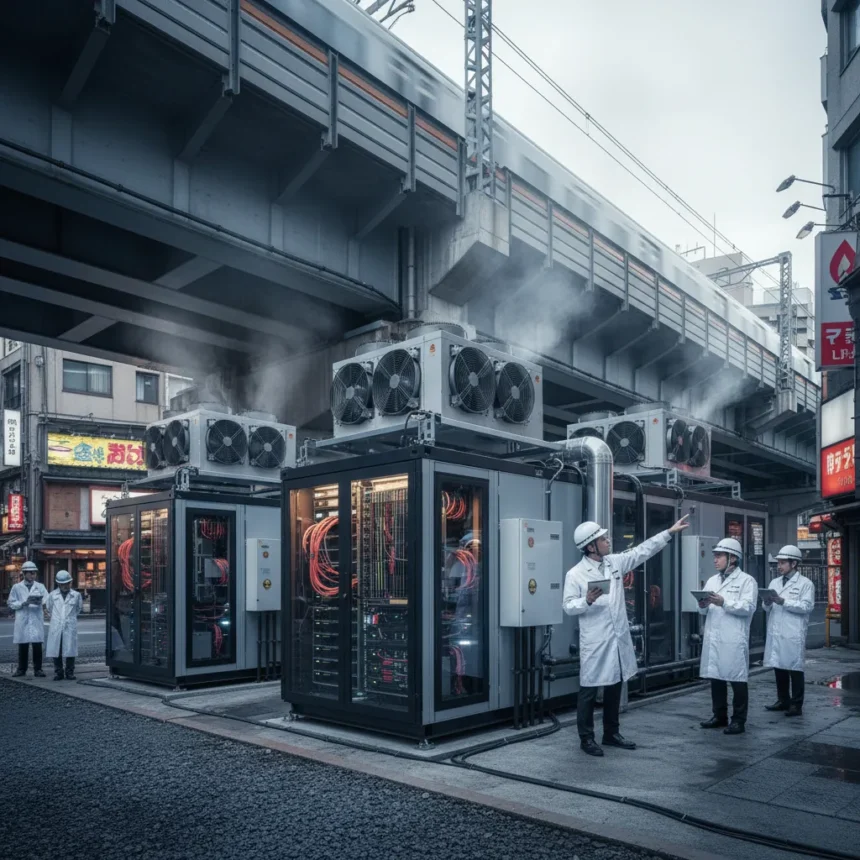
Modular data centers are container-sized enclosures containing servers, cooling systems, and power supply equipment designed for rapid deployment without full building construction. Tokyo’s Tokyu Group consortium is now testing this approach in one of the world’s most space-constrained cities—placing these units directly beneath railway overpasses to unlock underutilized urban real estate.
Key Takeaways
- Tokyu Group consortium is testing modular data centers under Tokyo railway overpasses to utilize unused urban space.
- Modular units package servers, cooling, and power equipment in container-sized enclosures for rapid deployment.
- Passing trains create severe thermal fluctuations and vibration challenges that threaten equipment reliability.
- Project addresses Tokyo’s acute data center land shortage amid surging AI infrastructure demand.
- IIJ operates competing modular data center services across Japan, Iceland, and Africa.
Why Tokyo Needs Data Centers in Unusual Places
Tokyo faces a critical infrastructure bottleneck. The city’s explosive demand for AI computing power, combined with some of the world’s highest real estate costs, has made traditional data center expansion nearly impossible. Rather than build new facilities on scarce land, the Tokyu Group consortium is pursuing an unconventional answer: repurpose the dead space beneath Tokyo’s vast network of railway overpasses. These overpasses crisscross the city, creating pockets of unused airspace that could theoretically host compact modular data centers without consuming valuable ground-level property.
This approach mirrors strategies emerging elsewhere in Asia. IIJ has already deployed modular container and micro data center solutions across multiple regions, operating facilities in Japan, Iceland, and exploring expansion into Kenya. However, Tokyo’s railway-overpass experiment introduces a unique constraint: the thermal and vibration stress imposed by constant train traffic overhead. That challenge sets this test apart from conventional modular deployments in quieter, less-trafficked locations.
The Train Problem: Thermal Swings and Constant Vibration
The modular data centers under Tokyo’s railway overpasses must contend with two severe environmental stressors that traditional facilities never face. Passing trains generate intense vibration that can destabilize server racks, damage delicate components, and degrade electrical connections over time. Simultaneously, the trains themselves radiate enormous heat, creating thermal fluctuations that challenge the modular units’ cooling systems. A server optimized for a stable, climate-controlled data center environment may struggle when ambient temperatures spike and plummet throughout the day as trains pass overhead.


These are not theoretical problems. The consortium’s testing will determine whether commercial-grade cooling equipment can compensate for the thermal chaos, and whether vibration isolation mounts can protect server hardware from the constant mechanical stress. If the tests fail, the entire concept collapses—modular units become too unreliable for production workloads. If they succeed, Tokyo has unlocked a new frontier in urban data center deployment.
Modular Data Centers in the Broader Japanese Market
The Tokyu Group’s railway-overpass experiment sits within a larger wave of Japanese data center expansion. IIJ, Japan’s largest internet infrastructure provider, is expanding its Shiroi campus east of Tokyo, with Phase 3 adding 1,000 racks at 10MW capacity, expandable to 25MW, with on-site solar power and air-cooled systems beginning operations in fiscal 2026. That project represents the traditional approach: build larger, more efficient facilities in less-constrained suburban locations. The modular overpass strategy, by contrast, targets dense urban cores where traditional expansion is economically unfeasible.



Tokyo Century, the consortium partner handling real estate and infrastructure, has also been active globally. The company sold its NOVA Business Park data center project in Loudoun County, Virginia—a 165MW facility completed in September 2025—signaling that Japanese developers are building institutional expertise in large-scale data center operations across continents. The overpass project, then, represents both a local innovation addressing Tokyo’s unique constraints and a test case that could inform modular deployments in other space-starved global cities.
What Success Would Mean for Urban Data Centers Worldwide
If the Tokyu Group consortium successfully mitigates the thermal and vibration challenges, the implications extend far beyond Tokyo. Cities like Singapore, Hong Kong, and densely packed European capitals face identical pressures: soaring AI compute demand, limited available land, and skyrocketing real estate costs. A proven modular data center solution deployable beneath existing infrastructure could unlock gigawatts of new compute capacity in urban cores without requiring new construction permits, environmental reviews, or massive land acquisition.
The current phase remains a proof-of-concept. The consortium has not announced specific test timelines, performance metrics, or scalability targets. Success is not guaranteed—the thermal and vibration challenges may prove insurmountable, or the modular units may require expensive hardening that erodes their cost advantage. But the willingness to test an unconventional approach in one of the world’s most demanding urban environments signals that data center operators are rethinking infrastructure strategy. Stacking new racks in suburban campuses works until it doesn’t. Tokyo’s railway overpasses offer an alternative for cities where traditional expansion has run out of room.
Is modular data center deployment economically viable under railway overpasses?
The Tokyu Group consortium is actively testing this question. Success depends on whether cooling and vibration isolation costs remain low enough to justify deployment, and whether the modular units can maintain reliability under constant thermal and mechanical stress. The test results, when available, will determine whether this model scales beyond proof-of-concept.



How do modular data centers compare to traditional facilities?
Modular data centers offer rapid deployment without new construction, making them ideal for space-constrained urban areas. Traditional facilities offer greater scalability and efficiency at larger capacities. The overpass project essentially asks whether modular units can overcome their environmental disadvantages through engineering—a question only testing can answer.
What other Japanese companies are expanding data center capacity?
IIJ is expanding its Shiroi campus with 1,000 additional racks and 10MW capacity, while Tokyo Century has demonstrated global data center development expertise through its NOVA Business Park project in Virginia. These expansions reflect Japan’s commitment to building AI infrastructure both domestically and internationally.
Tokyo’s railway-overpass data center experiment is bold, unusual, and fundamentally pragmatic. The city cannot expand outward indefinitely, so it is expanding upward—or rather, downward, into the overlooked spaces beneath its own infrastructure. Whether the trains’ thermal chaos and vibrations can be engineered away will determine if this model becomes a template for dense urban computing or remains a curiosity. For now, the Tokyu Group consortium is answering a question that matters far beyond Tokyo: can modular data centers thrive in places where traditional facilities simply cannot fit?
Edited by the All Things Geek team.
Source: Tom's Hardware