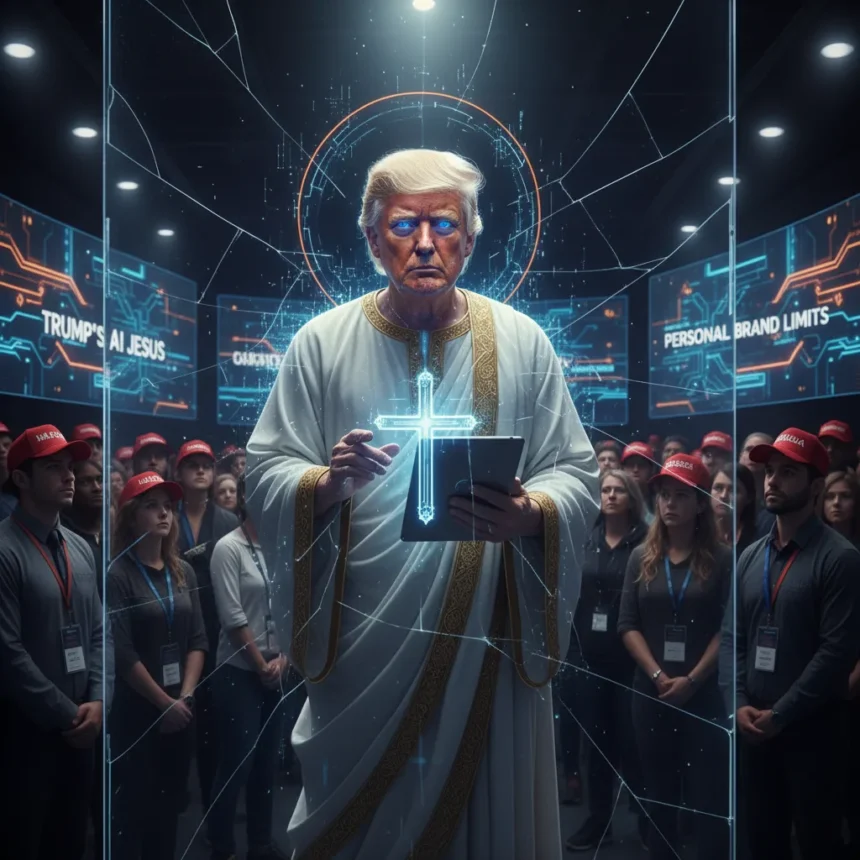
AI-generated religious imagery has become Trump’s latest controversial experiment in personal branding, raising uncomfortable questions about where the line between political theater and genuine offense actually sits. After Trump shared AI images portraying himself as Jesus Christ and the Pope on Truth Social, the move triggered backlash that suggests even his most loyal audience has limits.
Key Takeaways
- Trump posted AI images depicting himself as Jesus and the Pope on Truth Social
- The posts followed Trump’s criticism of Pope Leo over crime and foreign policy positions
- Religious communities responded with criticism for mocking sacred imagery
- AI-generated religious imagery tests the boundaries of acceptable political expression
- The incident raises questions about brand resilience among polarized audiences
Why AI-Generated Religious Imagery Breaks Different Rules
AI-generated religious imagery operates in a category all its own—it bypasses traditional political discourse and enters terrain where even Trump’s most forgiving supporters may balk. When a political figure uses AI to depict himself as Jesus or the Pope, he is not making a policy argument or attacking an opponent’s record. He is making a theological claim, however flippant the intent. That distinction matters because it alienates audiences who might tolerate aggressive rhetoric but draw the line at mockery of their faith.
The Pope Leo criticism that preceded these images was straightforward political disagreement—Trump called the pontiff weak on crime and foreign policy. But responding with AI religious imagery transforms a policy dispute into something that reads as sacrilege to millions of viewers. That escalation is the real liability. A brand can survive attacks on opponents. It struggles when it appears to attack the beliefs of its own base.
The Brand Damage Question: Can Trump’s Image Recover?
Trump’s personal brand has survived scandals that would have ended most political careers. But those scandals typically involved behavior—statements, business dealings, personal conduct. AI-generated religious imagery is different because it is not a mistake or a leaked recording. It is a deliberate creative choice. Someone had to commission or create these images and then decide they were worth posting to millions of followers. That intentionality makes the offense harder to dismiss as out-of-context or misunderstood.



The real test is whether this alienates the evangelical and Catholic voters who have been crucial to Trump’s political coalition. Religious communities do not typically respond well to mockery of sacred figures, even when the mockery comes from someone they otherwise support. If AI-generated religious imagery becomes a pattern rather than an isolated incident, the damage compounds. One controversial post can be explained away. A series of them suggests a deliberate strategy to provoke religious sensibilities, which is a much harder position to defend.
AI-Generated Religious Imagery and the Credibility Gap
What makes AI-generated religious imagery particularly damaging is that it creates a credibility gap between Trump’s public positioning and his actual behavior. If he is positioning himself as a defender of religious values—a claim central to his appeal among evangelical voters—then posting AI images of himself as Jesus undermines that message. The contradiction is too stark to ignore. You cannot simultaneously claim to represent religious interests and mock religious iconography.



The incident also raises questions about judgment. Using AI to create these images suggests either a failure to anticipate how they would be received or a deliberate decision to provoke. Neither option is reassuring to audiences trying to determine whether Trump can be trusted with power. Judgment failures suggest incompetence. Deliberate provocation suggests contempt for the very voters he needs to win.
How This Compares to Previous Controversies
Trump’s brand has weathered countless scandals by maintaining a core narrative: he fights for his supporters against enemies who seek to destroy him. That narrative works when the enemy is clearly external—the media, political opponents, institutions perceived as hostile. But AI-generated religious imagery inverts that dynamic. The offense is not coming from outside enemies. It is coming from Trump himself, directed at audiences who consider themselves his allies.
Previous controversies have typically involved statements Trump made about opponents or groups he views as adversaries. Religious imagery, by contrast, involves mockery of beliefs held by his supporters. That shift from attacking enemies to appearing to mock allies is where the brand vulnerability emerges.
What Happens If This Becomes a Pattern?
The real danger is not a single post but the signal it sends about Trump’s judgment and priorities. If AI-generated religious imagery becomes a recurring feature of his social media strategy, it suggests he values provocation over coalition-building. For a political figure, that is a losing trade. You need your base energized and unified. Mocking the religious beliefs of a significant portion of that base is the opposite of unifying.



The incident also matters because it demonstrates how AI tools can be weaponized in ways that traditional media cannot easily control. A controversial statement can be fact-checked, contextualized, or explained. An AI image is harder to walk back. It exists as a visual artifact that carries its own weight and spreads rapidly across social platforms. Once posted, the damage is immediate and difficult to contain.
Can a Political Brand Survive Mocking Its Own Base?
Historically, political brands survive by maintaining loyalty among core supporters. That loyalty is tested when a leader appears to disrespect the values those supporters hold most dear. AI-generated religious imagery does exactly that—it treats sacred beliefs as material for mockery. Whether Trump’s brand can survive this depends on whether his supporters view the images as a one-time lapse in judgment or as evidence of deeper contempt for their faith. If it is the former, the damage is limited. If it is the latter, the fracture could be lasting.
FAQ
Why does AI-generated religious imagery matter more than other controversial posts?
Religious imagery carries symbolic weight that other content does not. Mocking sacred figures alienates audiences based on deeply held beliefs rather than political disagreement. For a political brand dependent on religious voter support, that is a uniquely dangerous vulnerability.
Could this incident shift evangelical voting patterns?
Single incidents rarely shift voting patterns alone, but patterns do. If AI-generated religious imagery becomes a recurring strategy, it could erode support among religious voters who have otherwise remained loyal. The cumulative effect of repeated mockery is more damaging than one controversial post.
What should Trump do to repair brand damage from this incident?
A direct apology acknowledging that the images crossed a line with religious communities would be the most straightforward path to repair. Anything less—deflection, claiming the images were misunderstood, or doubling down—signals that he does not respect the concerns of religious voters and deepens the credibility gap.
Trump’s AI Jesus images represent a rare moment where his brand’s resilience is genuinely tested. His audience has forgiven him for many things, but mockery of their faith is different territory. The question is not whether one post breaks the brand—it almost certainly will not. The question is whether it signals a shift in strategy that treats religious supporters as targets rather than allies. If it does, the damage compounds far beyond a single viral image.
Edited by the All Things Geek team.
Source: Creativebloq