





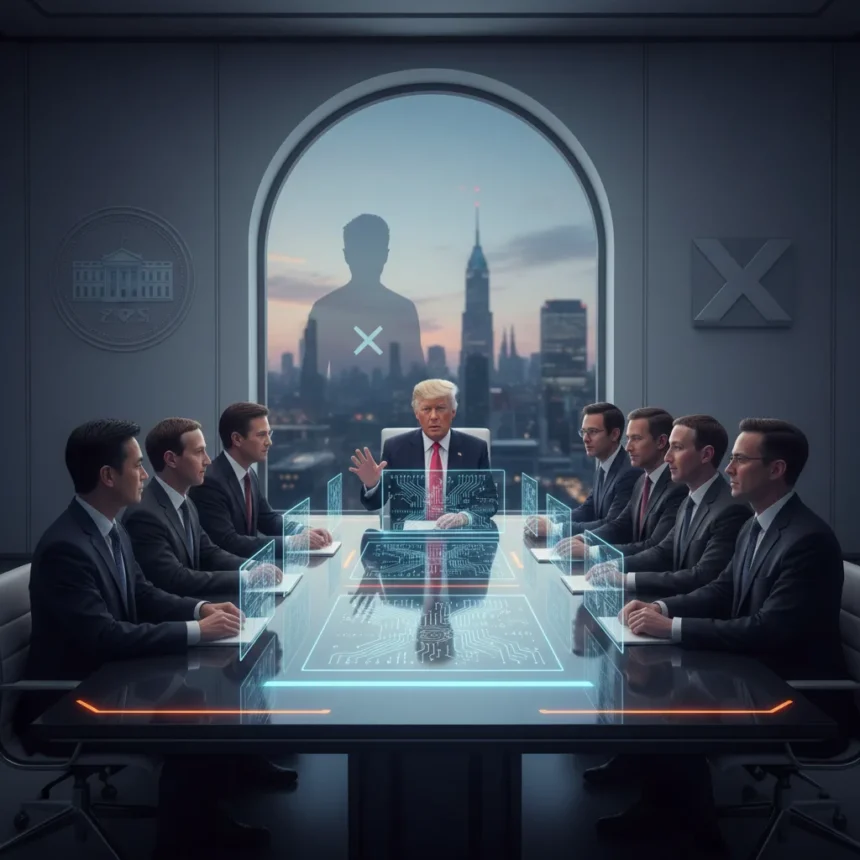
The White House tech council just became the most powerful advisory body in American technology policy. On March 25, 2026, President Trump announced the first 13 members of the President’s Council of Advisors on Science and Technology (PCAST), a group that will shape federal strategy on artificial intelligence, semiconductors, cryptocurrency, and fusion energy. This is not symbolic. These are the people who will write the playbook for American technological dominance in the next four years.
Key Takeaways
- Trump appointed 13 PCAST members on March 25, 2026, with room for 11 more in the full 24-member council
- Co-chairs David Sacks and Michael Kratsios lead the council focused on U.S. tech leadership in the “Golden Age of Innovation”
- Members include NVIDIA’s Jensen Huang, Meta’s Mark Zuckerberg, Oracle’s Larry Ellison, and AMD’s Lisa Su
- Council will advise on emerging technology opportunities and workforce challenges across AI, semiconductors, and fusion
- absent: Elon Musk, despite his prominent 2024 campaign role and DOGE involvement
Who’s on Trump’s White House tech council and why it matters
The roster reads like a greatest-hits compilation of Silicon Valley power brokers. Jensen Huang, CEO of NVIDIA, the company that essentially owns the artificial intelligence chip market. Mark Zuckerberg, whose Meta empire controls social media and is now betting billions on AI infrastructure. Larry Ellison and Safra Catz from Oracle, Lisa Su from AMD—these are the executives who control the semiconductor pipeline that powers every AI model on Earth. Michael Dell, David Sacks, Marc Andreessen, Sergey Brin, Fred Ehrsam from Coinbase—the list represents concentrated control over computing infrastructure, venture capital deployment, and tech policy influence.
The council also includes fusion energy leaders: Jacob DeWitte from Oklo and Bob Mumgaard from Commonwealth Fusion Systems, signaling that nuclear energy is now part of the White House’s technology strategy. And there is John Martinis, a UC physics professor and 2025 Nobel Laureate in physics, lending academic credibility to what is otherwise a venture capital and corporate executive lineup.
Co-chaired by David Sacks (Trump’s AI and Crypto Czar) and Michael Kratsios (White House Office of Science and Technology Policy Director), the council will focus on “opportunities and challenges that emerging technologies present to the American workforce” while ensuring “the U.S. continues to lead in the Golden Age of Innovation”. That is corporate-speak for: these executives will help write the rules that govern their own industries.

The elephant in the room: Elon Musk is not here
Musk’s absence is the story nobody is discussing loudly enough. He spent the 2024 campaign at Trump’s side, led the Department of Government Efficiency (DOGE), and positioned himself as Trump’s closest tech advisor. Yet he is not on PCAST. This signals either a deliberate exclusion or a strategic choice by Musk to operate outside formal advisory structures. Either way, it matters. Musk controls Tesla, Starlink, and xAI—three companies with profound implications for energy, communications, and artificial intelligence. His exclusion from this council means the White House tech strategy will be shaped by his competitors and potential regulators, not by Musk himself.
What this council will actually do
PCAST will advise the President on policy spanning artificial intelligence, semiconductors, cryptocurrency, cloud computing, and fusion energy. The council may form subcommittees to handle classified national security advice. This is not a rubber-stamp advisory body. PCAST has historical precedent dating back to FDR’s 1933 Science Advisory Board, and each presidential administration recharters it with its own priorities.


The focus on workforce prosperity and national security signals that this council will not just talk about innovation—it will shape labor policy, immigration policy (visa quotas for tech talent), export controls on semiconductors, and cryptocurrency regulation. When Mark Zuckerberg sits in a room with Michael Kratsios to discuss AI policy, the outcome will ripple through every tech company in America.
Why Big Tech’s Washington influence just reached a new peak
This appointment signals a fundamental shift in how technology policy gets made. Rather than having tech executives lobby the government from the outside, they are now sitting at the policy table itself. The council brings together the Nation’s “foremost luminaries in science and technology to advise the President and provide recommendations on strengthening American leadership in science and technology”.
The composition skews heavily toward Big Tech and venture capital. Andreessen Horowitz, Google, Oracle, Meta, NVIDIA, AMD, Coinbase—these are the gatekeepers of capital, computing power, and market access. A startup founder seeking favorable regulation or a venture firm betting on a particular technology direction now has direct channels to the White House through this council. That is not corruption, exactly. It is just how power consolidation works in practice.
Is this good or bad for innovation?
The optimistic read: These executives understand where technology is heading and can advise the government accordingly. They can identify regulatory barriers that slow innovation and recommend policies that keep America competitive against China and Europe. The council might accelerate fusion energy deployment, clarify cryptocurrency rules, or streamline semiconductor manufacturing incentives.



The skeptical read: This is industry capturing the regulator. When the people who profit from AI, semiconductors, and crypto are the same people writing the policy, conflicts of interest are inevitable. What looks like “innovation policy” might be “policy that benefits these specific companies.”
What happens next
The council may expand to 24 members total, with additional appointments and a first meeting forthcoming. The White House has not yet announced specific policy recommendations or a timeline for action. But the signal is clear: Trump’s administration believes that technology leadership requires direct input from technology leaders. Whether that produces better policy or just better outcomes for Big Tech remains to be seen.
Why does Elon Musk’s absence matter for AI policy?
Musk founded xAI and has been vocal about AI safety concerns. His exclusion from PCAST means the council’s AI recommendations will come from executives at companies like Meta and Google, which have different AI philosophies than Musk’s. This shapes which AI approaches the White House prioritizes.
Will PCAST actually influence White House policy?
PCAST has historical precedent dating back to FDR’s era and each administration uses it differently. This council’s influence depends entirely on whether Trump acts on its recommendations. The appointments signal seriousness, but advisory bodies only matter if the President listens.
How does PCAST compare to previous tech advisory efforts?
PCAST is a formal, chartered advisory council with historical roots, whereas previous administrations relied more heavily on informal tech summits or individual consultant relationships. This structure gives these 13 executives more institutional power to shape policy recommendations than past advisory arrangements.
The White House tech council represents a bet that Silicon Valley executives should help write the rules that govern their industries. Whether that produces innovation or just protects incumbent power will become clear in the policy recommendations that follow. For now, the message is unmistakable: Big Tech has never been closer to the center of American government.
Edited by the All Things Geek team.
Source: TechRadar