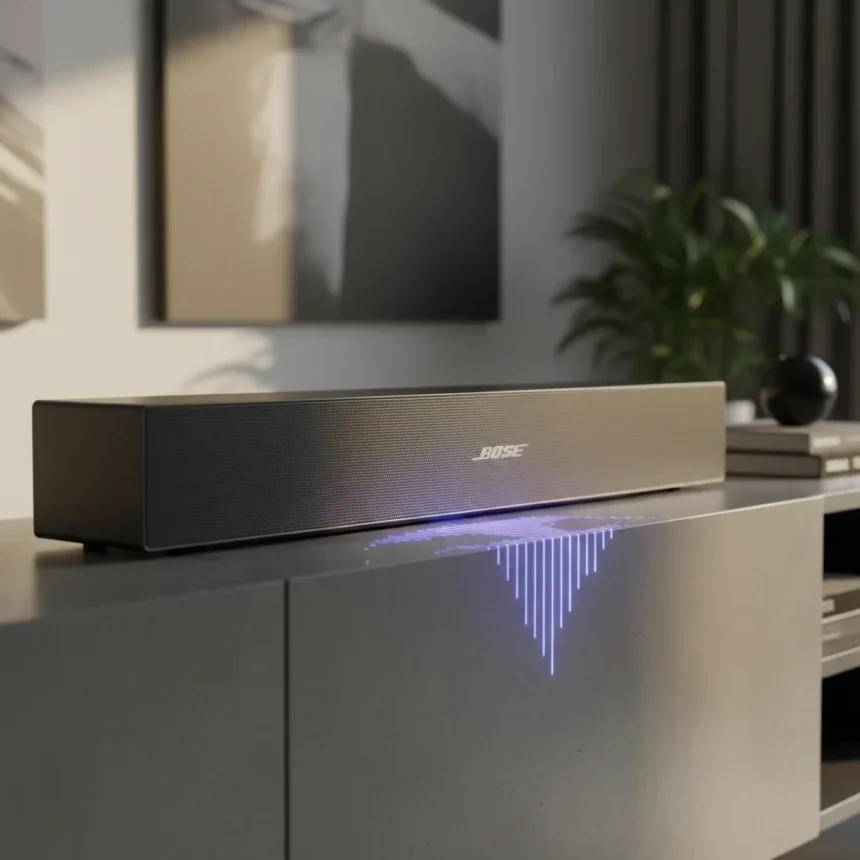
The Bose Lifestyle Ultra Soundbar represents the company’s biggest acoustic overhaul in a decade, and the standout claim is deceptively simple: it sounds full without forcing you to buy a separate subwoofer. After testing it in a Manhattan brownstone with 14-foot ceilings, the soundbar’s nine-driver architecture delivers bass that feels complete on its own.
Key Takeaways
- Nine-driver 5.0.2 configuration ships standard without requiring a subwoofer
- Touch-controlled circular panel design echoes iPod interface from 25 years ago
- Upgradeable to 5.1.2 when paired with the new Lifestyle Ultra Subwoofer
- Available in Black and Smoke White finishes with glass-layer top panel
- Complementary Lifestyle Ultra Speaker enables multi-room and surround configurations
The Bose Lifestyle Ultra Soundbar Architecture Explained
The Bose Lifestyle Ultra Soundbar uses five front-facing speakers to handle the main soundstage with virtual side output processing, while two additional drivers deliver up-firing overhead audio for true Dolby Atmos. This nine-driver setup is the foundation of why the soundbar avoids sounding thin or bass-light in comparison to competitors like the Sonos Arc Ultra, which relies on external subs for depth.
What distinguishes this approach is the distribution strategy. Rather than concentrating bass drivers in a single subwoofer module, Bose spread the low-frequency work across the main cabinet. The result feels more integrated—bass doesn’t boom from one corner of the room but instead anchors the entire soundstage. In a room with cathedral ceilings, that coherence matters.
Design That Nods to Apple’s Past
The circular touch-controlled panel on top is the most divisive design choice. It’s a deliberate callback to iPod scroll wheels from approximately 25 years ago, which feels either charming or gimmicky depending on your tolerance for nostalgia. The glass layer finish elevates the aesthetics beyond typical plastic soundbars, and the choice between Black and Smoke White finishes allows for some flexibility in matching existing décor.



The industrial design is understated compared to flashier competitors. There’s no RGB lighting, no aggressive angular styling. Instead, Bose went for restraint—a soundbar that sits beneath your TV without screaming for attention. That approach appeals to people who view audio equipment as furniture, not statement pieces.
Scaling Up With the Lifestyle Ultra Speaker
Bose introduced a companion product, the Lifestyle Ultra Speaker, which fundamentally changes how you can configure this ecosystem. Measuring 12.2cm wide by 18.5cm tall by 16.8cm deep, the speaker houses a tri-driver setup with a 3-inch subwoofer and an upfiring height channel. You can use it standalone, pair two for stereo, or integrate it as rear surround output when connected to the Lifestyle Ultra Soundbar.



This modular approach matters because it lets you avoid the all-or-nothing trap of traditional soundbar expansion. You’re not locked into buying Bose’s official subwoofer if you want surround channels—the Lifestyle Ultra Speaker handles both roles. The multi-room capability means you can extend audio throughout your home without rewiring or buying separate systems for each room.
How the Bose Lifestyle Ultra Soundbar Compares to Alternatives
The Sonos Arc Ultra is the obvious competitor in the premium soundbar category, though it takes a different philosophy—Sonos expects you to add a subwoofer eventually, whereas Bose is betting you won’t need one out of the box. For users who want a complete system without layering purchases, that’s a meaningful difference.
If you’re willing to spend significantly more, the Bluesound Pulse Cinema offers 500W of power across 16 drivers with full Dolby Atmos support and Hi-Res Audio at 24-bit/192kHz resolution. But that’s a different price tier entirely, targeting audiophiles rather than mainstream home theater buyers. The Bose Lifestyle Ultra Soundbar sits in the sweet spot between casual listening and serious audio investment.
Should You Buy the Bose Lifestyle Ultra Soundbar?
If you’re upgrading from a TV’s built-in speakers, the difference will be transformative. The Bose Lifestyle Ultra Soundbar’s bass performance without a subwoofer is its strongest selling point—you get a complete soundbar experience without the footprint or cost of additional hardware. The design is elegant, and the ecosystem flexibility with the Lifestyle Ultra Speaker means you can expand later without feeling locked in.



The main caveat is that the circular touch panel, while distinctive, introduces a learning curve compared to traditional remote controls. And if you’re already deep in the Sonos ecosystem, switching to Bose means abandoning your existing integration.
Does the Bose Lifestyle Ultra Soundbar really need a subwoofer?
No. The nine-driver configuration delivers full-range audio out of the box, including bass that feels complete without a separate sub. You can upgrade to the Lifestyle Ultra Subwoofer later if you want additional low-frequency impact, but it’s optional rather than essential.
Can you use the Bose Lifestyle Ultra Speaker as rear surround speakers?
Yes. The Lifestyle Ultra Speaker functions as rear channel output when paired with the Lifestyle Ultra Soundbar, and it also works as a standalone speaker or stereo pair for multi-room audio setup.
What finishes does the Bose Lifestyle Ultra Soundbar come in?
The soundbar is available in Black and Smoke White, both featuring a glass-layer top panel for a premium finish.
The Bose Lifestyle Ultra Soundbar succeeds because it refuses to compromise on bass to save cost or space. For buyers tired of anemic soundbar bass and the endless upsell of subwoofers, it’s a genuinely competitive choice. The design is restrained, the ecosystem is flexible, and the acoustic overhaul actually delivers on Bose’s claims.
Where to Buy
Bose Smart Ultra Soundbar | Samsung HW-Q990F | Samsung HW-Q990D
Edited by the All Things Geek team.
Source: T3