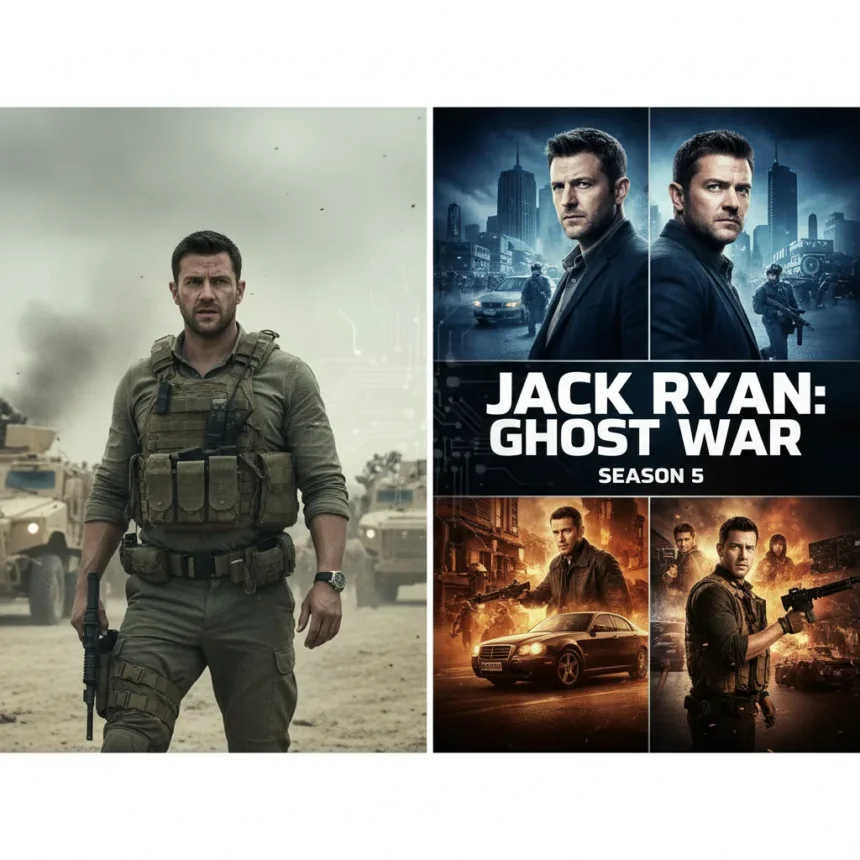
Jack Ryan: Ghost War should have been Jack Ryan season 5. The 105-minute film, which landed on Prime Video on May 20, 2026, feels less like a standalone movie and more like a truncated television season forced into a theatrical runtime. That structural mismatch is the core problem—not the action, not the cast, not even the plot, but the decision to compress what works as episodic storytelling into a single sitting.
Key Takeaways
- Jack Ryan: Ghost War premiered on Prime Video on May 20, 2026, after a theatrical debut on May 15, 2026.
- The film runs 105 minutes and is rated R for action violence and language.
- Critical reception is mixed: 36% on Rotten Tomatoes (11 critics) and 40/100 on Metacritic (6 critics).
- The cast reunites returning characters Mike November, James Greer, and introduces MI6 officer Emma Marlowe.
- Critics describe the film as generic and trading intelligence for spectacle rather than deepening the franchise.
Why Jack Ryan: Ghost War Feels Like a Truncated Season
The premise is solid. Jack Ryan is pulled back into espionage when an international covert mission unravels a deadly conspiracy, forcing him to confront a rogue black-ops unit with lives on the line and the clock ticking. That setup—a conspiracy, a rogue unit, personal stakes—has sustained the Jack Ryan television series for four seasons. But here, it gets 105 minutes to breathe. A proper season would give that conspiracy room to develop across eight episodes, letting tension build and character relationships deepen. Instead, Ghost War rushes through the beats, hitting plot points without earning the emotional weight that made the original series engaging.
The returning cast—Michael Kelly as Mike November, Wendell Pierce as James Greer, and new addition Sienna Miller as MI6 officer Emma Marlowe—are capable actors working with material that feels compressed. Jack reunites with his team to navigate a treacherous web of betrayal, operating in real time with escalating threats. That premise works. The execution, however, suffers from the constraints of a movie runtime. You cannot develop a rogue black-ops conspiracy, a personal mission for the entire team, and meaningful character arcs in 105 minutes when the television series spent 50+ hours establishing these relationships.
The Critical Consensus: Generic Action, Not Intelligent Spy Craft
Critics have noticed the problem, even if they did not frame it as a format issue. Rotten Tomatoes sits at 36% positive from 11 critics, with an average rating of 5.1/10. Metacritic landed at 40/100 from 6 critics, labeled as mixed or average reviews. One critic from FandomWire noted the film falls short of the original entertaining series run, trading intelligence for a generic action spectacle. The Times described it as generic and very streaming—damning words for a franchise built on smart geopolitical plotting. Collider called it a slick spy thriller that is easy and engaging enough for longtime fans, which reads as faint praise. JoBlo noted it is a fast-moving plot with scaled-down global stakes compared with earlier movies.



That pattern matters. Critics are not saying the film is unwatchable. They are saying it feels thin, generic, and undercooked compared to what the Jack Ryan name implies. A television season would solve this. Eight episodes let you develop the conspiracy, let you breathe between action sequences, let you explore the psychological toll on Jack and his team. A movie compresses everything into a sprint, and intelligence-driven spy craft does not sprint well.
Jack Ryan Season 5 Would Have Changed Everything
Imagine Ghost War as a season. Episode one introduces the covert mission and the conspiracy it unearths. Episodes two through four develop the rogue black-ops unit as a genuine threat, giving viewers time to understand who they are and why they matter. Episodes five and six escalate the personal stakes—Emma Marlowe becomes a real partner, not a supporting character introduced halfway through. Episodes seven and eight bring the conspiracy to a head, with time for genuine character consequences. That structure is what Jack Ryan did for four seasons. It worked. Ghost War has all the pieces for that structure but none of the space to execute it.



Prime Video clearly believed in this story enough to greenlight it. The production involved Amazon MGM Studios, Paramount Pictures, Skydance Media, and returning producers including John Krasinski, Carlton Cuse, and Graham Roland. That pedigree suggests confidence. But somewhere in development, the decision was made to compress this into a film. That decision is the mistake. Not because films cannot work—they can—but because this particular story does not. It needs episodes, not a runtime.
What Does This Mean for the Jack Ryan Franchise?
The Jack Ryan television series ran from 2018 to 2023, establishing a formula that worked: intelligent plotting, character development, geopolitical stakes that felt earned rather than manufactured. Ghost War inherits that formula but abandons the structure that made it effective. If Prime Video wants to continue the franchise, the lesson is clear: return to television. The Ryanverse has always been about slow-burn intelligence work, not action-thriller compression. Ghost War proves that point by failing to deliver on it.
Is Jack Ryan: Ghost War worth watching?
If you are a longtime Jack Ryan fan, yes—it reunites the cast and delivers action sequences. But manage expectations. You are watching a compressed story that wanted to be a season, not a complete narrative arc. The film is available on Prime Video and runs 105 minutes, so the time commitment is reasonable. Just know you are getting the highlights, not the full picture.
Could Jack Ryan: Ghost War have worked as a film?
In theory, yes. A tighter, more focused story centered entirely on one mission could work in 105 minutes. But that is not what Ghost War is. It is a season-length story crammed into a movie, which is why critics found it generic and thin. The problem is not the medium—it is the mismatch between the story and the format chosen to tell it.



Will there be more Jack Ryan content after Ghost War?
The research brief does not specify future plans. Ghost War’s mixed reception and structural issues suggest Prime Video may reconsider the format for any continuation. If they do return to the franchise, the smarter choice would be a season, not a film.
Jack Ryan: Ghost War is a case study in format failure. The story, the cast, and the production values are there. What is missing is the space to let the story unfold. Prime Video should have trusted the television format that made Jack Ryan work in the first place. Instead, it created a film that feels like an abridged season—competent but incomplete, with all the right pieces arranged in the wrong shape. For fans of intelligent spy craft, that is a disappointment that a better format could have prevented.
Edited by the All Things Geek team.
Source: Tom's Guide