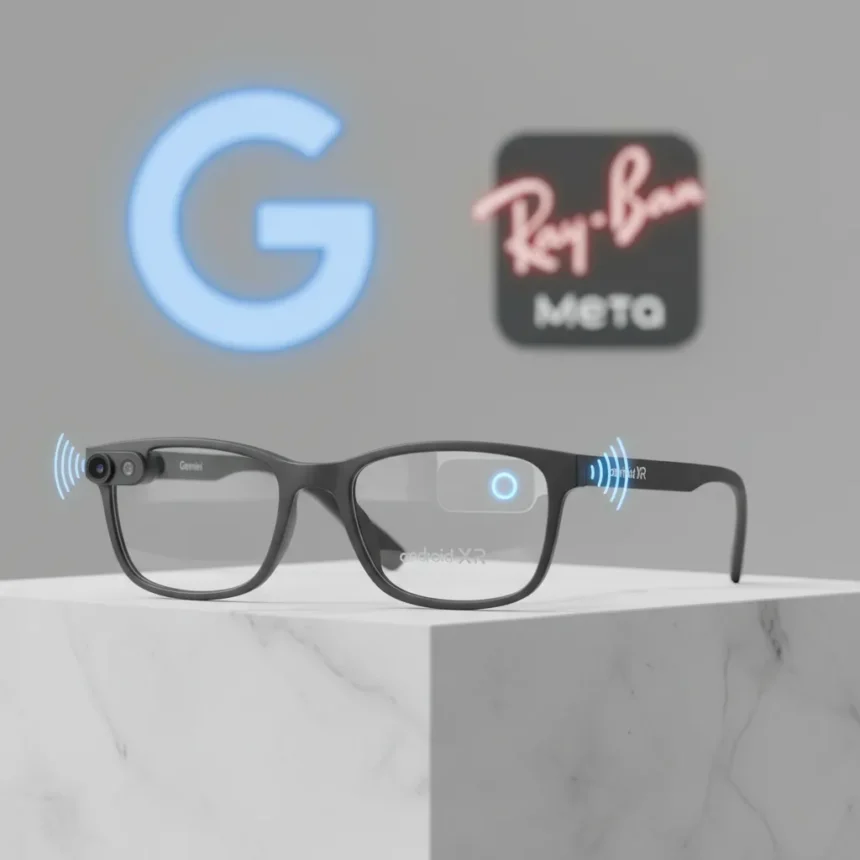
Google’s Intelligent Eyewear Android XR smart glasses represent the company’s most direct challenge yet to Ray-Ban Meta’s smart glasses leadership. Shown at Google I/O, these glasses combine Warby Parker’s fashion credentials with Gemini Live conversation capabilities, signaling that Google is serious about competing in the wearable AI space.
Key Takeaways
- Google’s Intelligent Eyewear runs Android XR, competing directly with Meta’s smart glasses ecosystem.
- Warby Parker styling suggests Google prioritizes fashion appeal alongside functionality.
- Gemini Live conversation is a core feature, embedding conversational AI directly into the glasses.
- The hands-on demo at Google I/O positioned the glasses as a Ray-Ban Meta alternative.
- This marks Google’s entry into a smart glasses category currently dominated by Meta.
What Makes Google’s Intelligent Eyewear Different
Google’s approach to smart glasses differs fundamentally from Meta’s strategy. While Ray-Ban Meta focuses on camera-first recording and social sharing, Google’s Intelligent Eyewear emphasizes conversational AI as the primary interaction mode. Gemini Live conversation built directly into the glasses means users can ask questions, get real-time information, and engage with AI without reaching for a phone. This positions the glasses as a thinking tool rather than just a recording device, a distinction that could resonate with users tired of the surveillance-focused narrative around smart eyewear.
The partnership with Warby Parker addresses a persistent criticism of smart glasses: they often look like gadgets rather than fashion accessories. By embedding technology into frames that people actually want to wear, Google removes a major barrier to adoption. Ray-Ban Meta succeeded partly because Ray-Ban is a trusted eyewear brand, but Google’s approach suggests the company understands that smart glasses must feel like eyewear first and technology second.
Android XR vs Meta’s Ecosystem
Android XR is Google’s answer to Meta’s proprietary smart glasses operating system. Rather than building an entirely closed ecosystem, Google is leveraging Android’s flexibility and developer community. This could allow faster iteration, more third-party app support, and deeper integration with Google’s existing services like Maps, Search, and Workspace. Ray-Ban Meta is tightly integrated with Meta’s social and AI services, but Android XR offers an alternative philosophy: open, modular, and device-agnostic.


The competitive advantage here lies in ecosystem breadth. If developers can build apps for Android XR across multiple manufacturers’ hardware, the platform could scale faster than Meta’s single-device approach. Ray-Ban Meta works well for Meta’s use cases, but Android XR could become the standard platform for any smart glasses maker willing to adopt it.
The Gemini Live Advantage
Gemini Live conversation represents Google’s AI-first positioning for smart glasses. Rather than treating the glasses as a secondary screen, Google has designed them around voice-based AI interaction. This makes sense for wearables: you cannot easily read a small screen while walking, but you can have a conversation. By making Gemini Live the central feature, Google is solving a real usability problem that Ray-Ban Meta has not fully addressed.


Ray-Ban Meta’s AI features exist within the Meta AI ecosystem, focused on image recognition and social content. Gemini Live offers a different value proposition: a conversational assistant integrated into your eyewear. For users who want AI as a thinking partner rather than a social tool, this distinction matters. The hands-on demo at Google I/O highlighted this difference, with the author noting that the conversational experience felt natural and intuitive compared to competing approaches.
Design and Fashion Credentials
Warby Parker’s involvement signals that Google understands smart glasses cannot succeed as pure technology. They must be wearable accessories first. Warby Parker has built a brand around affordable, stylish eyewear that does not scream “tech gadget.” By partnering with them, Google is borrowing credibility in the eyewear space that neither Meta nor other smart glasses makers possess to the same degree.
Ray-Ban Meta has the advantage of Ray-Ban’s century-old brand heritage, but Warby Parker represents a younger, more digital-native aesthetic. For users who care about contemporary design and do not want frames that look like they belong in a sci-fi film, Google’s Intelligent Eyewear could be more appealing. This is not a trivial advantage—fashion matters in wearables, and Google is taking that seriously.
When Will Google’s Intelligent Eyewear Launch?
The glasses were demonstrated at Google I/O, but the research brief does not confirm a specific launch date, pricing, or availability timeline. This is typical for Google’s hardware announcements, where the company often shows products months or even years before they reach consumers. Ray-Ban Meta has had time to establish itself in the market, but once Google’s Intelligent Eyewear launches, the competitive landscape will shift significantly.


Can Google Actually Beat Ray-Ban Meta?
Ray-Ban Meta has first-mover advantage and Meta’s massive resources behind it. The glasses are already available, refined through real-world use, and integrated into Meta’s ecosystem. Google’s Intelligent Eyewear is still in the demo phase. However, Google’s advantages are substantial: Android XR offers platform flexibility, Gemini Live provides a compelling AI-first experience, and Warby Parker’s design credentials matter. The smart glasses market is still nascent, meaning there is room for multiple winners. Google is not trying to dominate a mature category—it is trying to shape one that is still being defined.
FAQ
What is Google Intelligent Eyewear?
Google Intelligent Eyewear is an Android XR smart glasses platform shown at Google I/O, featuring Gemini Live conversation and Warby Parker styling. The glasses are designed to compete with Ray-Ban Meta by emphasizing AI conversation as the primary interaction mode rather than recording or social sharing.
How do Google Intelligent Eyewear compare to Ray-Ban Meta?
Google’s glasses focus on conversational AI through Gemini Live, while Ray-Ban Meta emphasizes camera-first recording and social features. Google’s partnership with Warby Parker also prioritizes fashion appeal, whereas Ray-Ban Meta leverages Ray-Ban’s heritage brand. Both use their respective platforms—Android XR for Google, Meta’s proprietary OS for Ray-Ban Meta.
When can I buy Google Intelligent Eyewear?
A specific launch date and pricing have not been announced. The glasses were demonstrated at Google I/O, but availability details remain unclear. Google typically takes time between hardware announcements and consumer availability, so interested buyers should expect to wait.
Google’s Intelligent Eyewear signals that the smart glasses race is just beginning. While Ray-Ban Meta has established itself as the category leader, Google’s combination of Android XR, Gemini Live, and Warby Parker styling creates a credible alternative. The next few years will determine whether smart glasses become a mainstream category or remain a niche product—and Google is betting it can shape that outcome.
Edited by the All Things Geek team.
Source: Tom's Guide