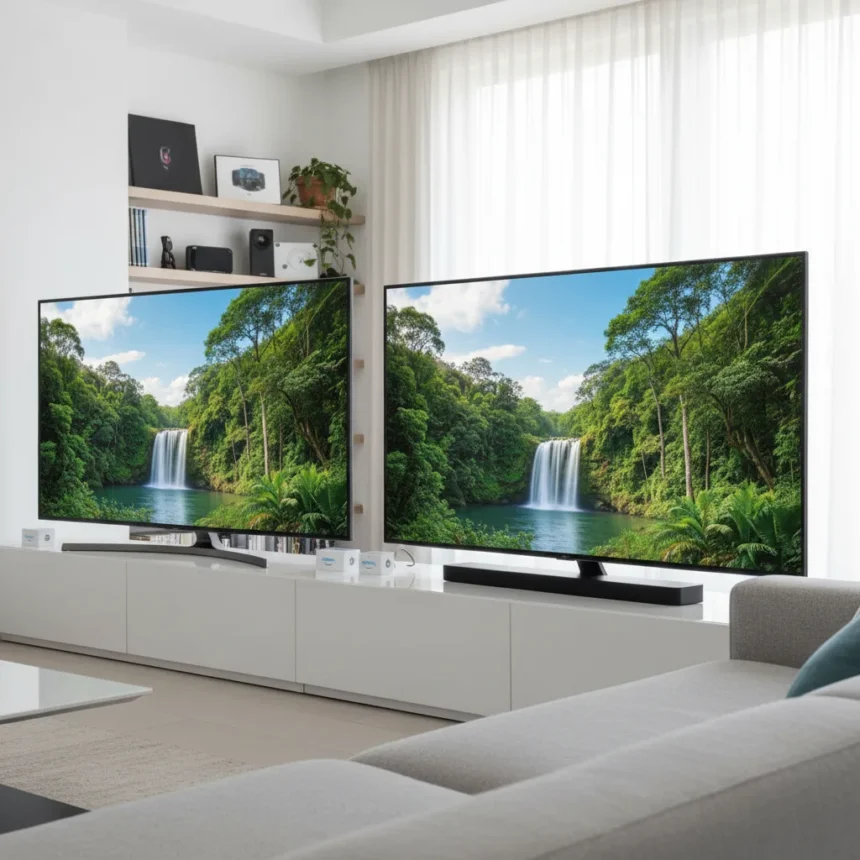
The LG B6 OLED budget TV is LG’s entry-level OLED model from 2016, and two variants—the B65 and B6E—have surfaced on Amazon, finally exposing real pricing for what many consider the best value in premium television. The B6 shares identical picture processing and panel technology with LG’s more expensive E6, C6, and G6 models, meaning you are not sacrificing image quality to save money. What you lose instead are features like 3D support, premium sound, and design refinement—trade-offs that matter far less than they sound.
Key Takeaways
- LG B6 OLED and E6 have identical picture panels and image processing, so core image quality is the same.
- B6 lacks 3D support and uses rear-firing speakers; E6 adds forward-firing Harman Kardon sound and 3D.
- E6 costs roughly $1,000 more than B6, making the budget model exceptional value for picture purists.
- B6 offers infinite contrast ratio, excellent motion handling, and wide viewing angles rivaling costlier models.
- Remote and build materials differ: B6 has a smaller remote and plastic lamination versus E6’s glass.
Picture Quality: Where the B6 Refuses to Compromise
The LG B6 OLED budget TV delivers the same infinite contrast ratio and image processing as the higher-tier E6, C6, and G6 models. This is not marketing speak—LG customer service has confirmed that picture quality differences between these models are nonexistent. The panel itself is identical, which means blacks are truly black, motion handling is excellent with zero blur and no flicker, and viewing angles are wide enough for any room layout. Peak brightness sits around 400 cd/m² for smaller highlights, though the TV dims via automatic brightness limiter when displaying larger bright windows, a limitation shared across LG’s 2016 OLED lineup.
In side-by-side comparisons, the E6 edges ahead slightly in light output and possibly in image cleanliness, but only marginally. For most viewers watching in normal lighting conditions, the difference is imperceptible. This is why forum users and reviewers consistently note that the B6 represents the smarter buy if you prioritize picture quality above all else—and if you do not need 3D or premium audio.
Where the B6 Cuts Corners: Sound, Features, and Design
The LG B6 OLED budget TV loses three things that justify the E6’s higher price. First, sound: the B6 has rear-firing speakers laminated to a plastic sheet, while the E6 features forward-firing Harman Kardon speakers in 55-inch and 65-inch models. For a TV that will sit in a living room without a soundbar, this matters. Second, 3D support is absent on the B6, a feature LG dropped from its budget tier in 2016. Third, the remote is smaller and less premium, and the B6 uses plastic lamination instead of glass. The curved C6 and flagship G6 with its integrated soundbar represent further steps up the design ladder, but the B6 holds its own as a straightforward, no-nonsense display.



LG B6 OLED vs E6: The Real Price Question
In 2016, a 55-inch B6 launched at around $2,500, while the 65-inch G6 flagship sat near $8,500. The E6, positioned between them, commanded a premium of roughly $1,000 over the B6 for its upgraded sound, 3D capability, and glass lamination. For a home theater enthusiast on a budget, the B6 is the best bargain in OLED TVs, as one reviewer noted. You are paying for the panel—the most expensive component—and getting the same quality as models that cost significantly more. The remote, the speakers, and the frame materials are luxuries, not necessities.
The emergence of two B6 variants on Amazon suggests LG is still moving inventory of this 2016 model, which means deals may be available for buyers willing to look past the newer model year. Compared to similarly priced LED TVs from competitors like Samsung, the B6 outperforms in contrast ratio, though LED brightness is often higher. For the money, OLED picture quality at the B6’s price point is unbeatable.



Should You Buy the LG B6 OLED Budget TV?
If you want the best picture quality for the lowest price and already own a soundbar or do not care about 3D, the answer is yes. The B6 is not a compromise—it is a smart choice. If you spend time in a bright room or demand the absolute best sound from your TV itself, the E6 might justify its extra cost. But for most viewers, the B6’s identical picture quality and lower price make it the rational choice. The panel is the TV; everything else is optional.
Does the LG B6 OLED budget TV support 3D?
No, the B6 lacks 3D support, unlike the E6 and G6 models. LG discontinued 3D from its budget tier in 2016, so if 3D is essential, you would need to step up to the E6 or higher.
How does the B6’s sound compare to the E6?
The B6 uses rear-firing speakers mounted on a plastic sheet, while the E6 features forward-firing Harman Kardon speakers in the 55-inch and 65-inch sizes. For TV audio alone, the E6 is noticeably better, but most home theater setups use a separate soundbar anyway.
Is the LG B6 OLED budget TV brighter than the E6?
Not significantly. Both models peak at similar brightness levels for HDR content, though the E6 is marginally brighter in controlled tests. For everyday viewing, the difference is negligible, and both are limited by automatic brightness limiter on fullscreen bright content.



The LG B6 OLED budget TV proves that entry-level does not mean compromised when it comes to OLED picture quality. The real question is not whether the B6 is good enough—it is whether you need the extras the E6 offers. For most buyers, the answer is no.
Where to Buy
Edited by the All Things Geek team.
Source: TechRadar