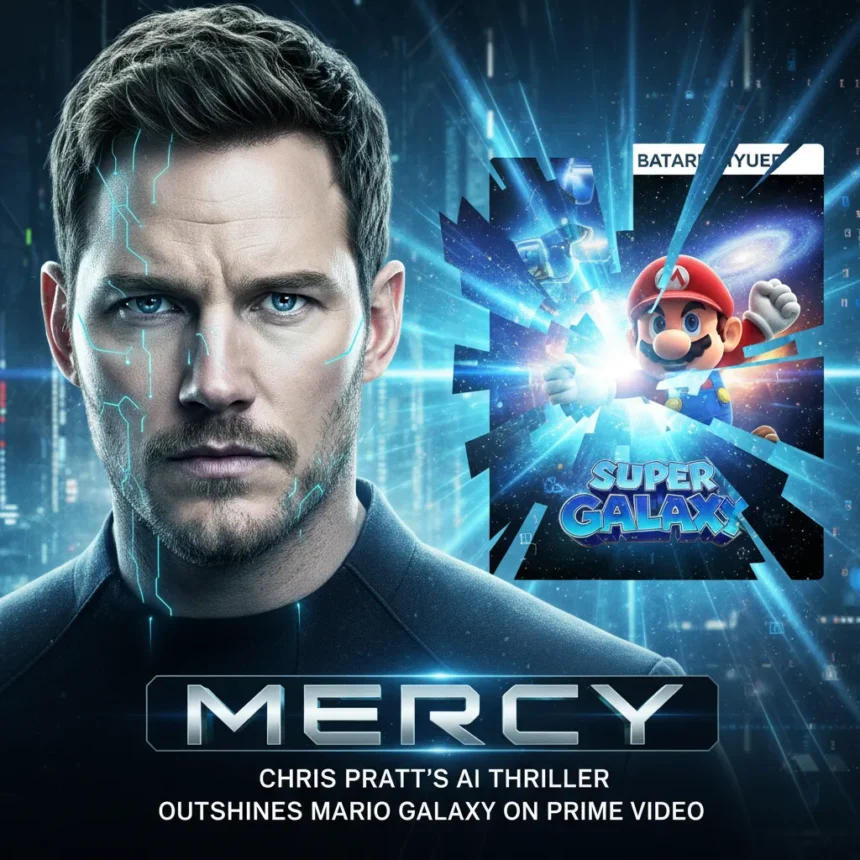
Mercy is a 2026 sci-fi thriller starring Chris Pratt and Rebecca Ferguson, directed by Timur Bekmambetov, that arrived on Prime Video on March 22, 2026, and immediately became the platform’s number-one title in the U.S. and number three globally. Set in 2029 Los Angeles, the film depicts a dystopian justice system where AI judges prosecute citizens accused of violent crimes, making it a far more compelling watch than the noise surrounding the Super Mario Galaxy movie.
Key Takeaways
- Mercy became a streaming hit after arriving on Prime Video on March 22, 2026, reaching number one in the U.S.
- The film stars Chris Pratt as detective Chris Raven and Rebecca Ferguson as an AI judge in a 2029 Los Angeles setting
- Despite earning $54.6 million against a $60 million budget, Mercy found massive success on streaming
- The premise gives Pratt 90 minutes to prove his innocence in his wife’s murder before the AI judge determines his fate
- Critics gave it a 25% score on Rotten Tomatoes, but audiences clearly disagree with the verdict
Why Mercy Chris Pratt Prime Video Matters Right Now
Mercy arrived on Prime Video at precisely the right moment—when audiences are hungry for smart sci-fi that does not talk down to them. The film’s central premise is genuinely unsettling: an AI judge with absolute power over life and death, no jury, no appeals, just algorithmic judgment rendered in real time. Pratt’s detective Chris Raven has ninety minutes to prove his innocence in his wife’s murder before the system executes him or sets him free. That ticking clock creates genuine tension, something the marketing machinery around the Super Mario Galaxy film completely fails to generate.
The box office told one story—Mercy earned $54.6 million against a $60 million budget, making it a theatrical flop. But streaming told a different one. The film reached number one in the U.S. and number three globally on Prime Video, a trajectory that reveals where audiences actually want to spend their attention. The gap between critical consensus (25% on Rotten Tomatoes) and audience behavior suggests critics missed what made this premise work.
Mercy Chris Pratt Prime Video vs. The Mario Noise
The Super Mario Galaxy movie arrives with franchise recognition, animated spectacle, and a marketing budget designed to dominate cultural conversation. Mercy has none of that. What it has instead is a premise that feels urgent in 2026: a world where your guilt or innocence is determined by code rather than evidence, where an AI judge cannot be bribed, cannot be swayed, cannot be reasoned with. That is more relevant to actual anxieties about technology than any plumber jumping through warp pipes.



Rebecca Ferguson as the AI judge is the film’s secret weapon. She brings an unsettling precision to the role—not cold exactly, but absolutely certain, which is somehow worse. Watching her prosecute Pratt’s character creates a dynamic that straightforward action or comedy cannot match. The film leans into the sci-fi premise rather than using it as window dressing, which separates it from countless other streaming offerings that treat futuristic settings as mere aesthetics.
The Streaming Verdict: Why Mercy Deserves Your Attention
Mercy works because it trusts its audience to sit with an uncomfortable idea for two hours. The AI judge system is not presented as obviously evil—it is presented as logical, efficient, and impossible to game. That moral ambiguity, combined with the 90-minute countdown, creates a thriller that respects your intelligence. The theatrical release stumbled, but Prime Video proved that the film’s actual audience was waiting elsewhere. In a week crowded with franchise noise and animated spectacle, Mercy offers something rarer: a sci-fi premise that makes you think rather than just react.



Is Mercy worth watching if I disliked Chris Pratt’s previous films?
Mercy gives Pratt a role that plays against his typical comedic persona. The 90-minute survival scenario leaves little room for quips, and the AI judge system does not care about charm. If you have avoided his films because of tone, this one operates in a completely different register.
Why did Mercy flop at the box office but succeed on streaming?
The theatrical release earned $54.6 million against a $60 million budget, but Mercy became a streaming sensation after arriving on Prime Video on March 22, 2026. Audiences may have skipped it in cinemas due to marketing or scheduling, but the film’s premise resonates more powerfully in the home viewing context where you control the pacing.
How does the AI judge system in Mercy actually work?
The film is set in 2029 Los Angeles, where an AI judge prosecutes citizens accused of violent crimes and determines guilt or innocence. Pratt’s character has 90 minutes to prove his innocence in his wife’s murder before the system renders its verdict. The film explores what happens when justice becomes algorithmic and irreversible.
Skip the Mario hype. Mercy is the film that actually earned its streaming dominance by delivering a premise that feels both futuristic and uncomfortably plausible. It is available now on Prime Video, and the clock is ticking.



Where to Buy
Amazon Prime Video – Free Trial
Edited by the All Things Geek team.
Source: TechRadar