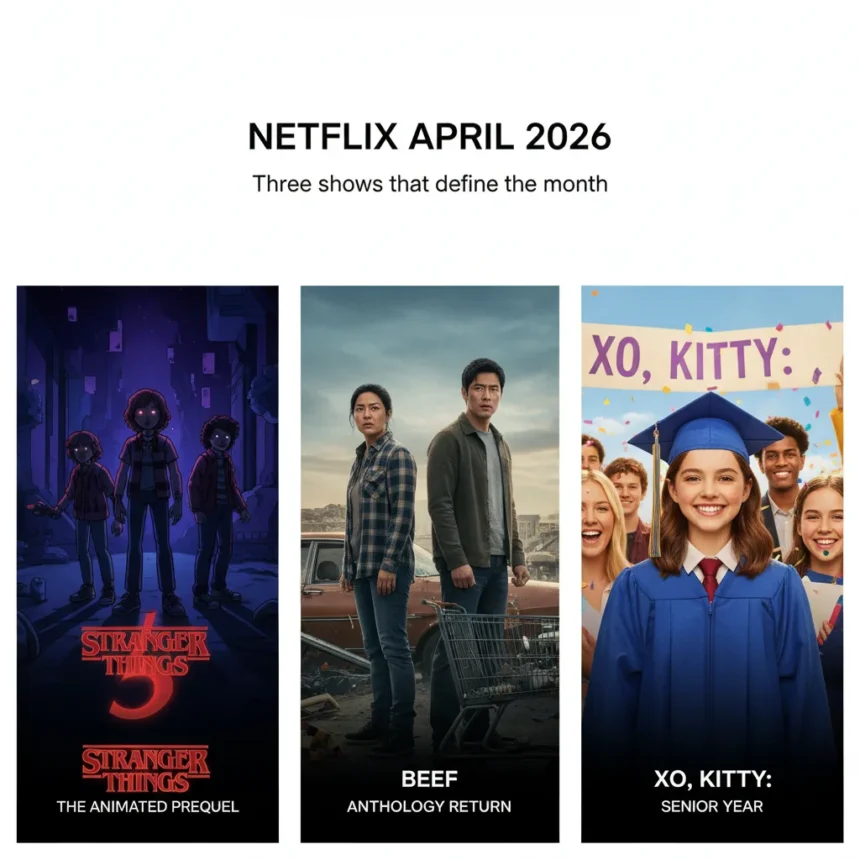
Netflix April 2026 arrives packed with three heavyweight releases that will dominate streaming conversations: an animated Stranger Things prequel, an Emmy-winning anthology’s second season with a completely new cast, and a young-adult romance returning for its final chapter. This month represents a rare convergence of nostalgia, prestige television, and teen drama that few streaming services can match.
Key Takeaways
- Stranger Things: Tales from ’85 animated prequel launches April 23, bridging the gap between Seasons 2 and 3 with Saturday morning cartoon aesthetics.
- Beef Season 2 premieres April 16 with an entirely new anthology cast including Carey Mulligan and Oscar Isaac, following the first season’s eight Emmy wins.
- XO, Kitty Season 3 arrives April 2 for its final senior year at Korean boarding school KISS, featuring returning lead Anna Cathcart and a cameo by original To All the Boys star Lana Condor.
- April 2026 total includes eight major Netflix originals and returning series across multiple genres.
- All three flagship shows expand existing Netflix universes rather than launching new properties, reflecting the streamer’s shift toward franchise extension.
Stranger Things: Tales from ’85 Bridges the Canon Gap
Stranger Things: Tales from ’85 launches April 23 as an animated prequel set between Seasons 2 and 3 of the main series, styled as a Saturday morning cartoon. This release arrives months after the controversial final season of the live-action show ended, making the animated spinoff a strategic move to keep the franchise alive during the gap before any potential film continuation. The show directly addresses fan frustration over unresolved plot threads and character arcs by exploring the Hawkins universe during a quieter period in the timeline.
The animated format represents Netflix’s calculated bet on nostalgia—Saturday morning cartoons evoke a specific era and emotional resonance that live-action cannot replicate. By positioning Tales from ’85 as a prequel rather than a sequel, the show avoids the narrative pressure of following the divisive final season. Instead, it operates as a side story that enriches the existing mythology without forcing resolution on storylines viewers already found frustrating. This approach mirrors how successful franchises (Marvel, Star Wars) use spinoffs to extend engagement without directly confronting fan criticism of the main property.
Beef Season 2 Resets the Anthology with New Cast and Story
Beef Season 2 premieres April 16 with a completely new cast and storyline, following the first season’s sweep of eight Emmy Awards. The anthology format means zero returning characters—instead, the new season features Carey Mulligan, Oscar Isaac, Cailee Spaeny, and Charles Melton in an unrelated narrative. This is a radical departure from traditional television renewal, where audiences expect familiar faces and continuous plot threads. Netflix is betting that the Emmy prestige of Season 1 will draw viewers to Season 2 regardless of cast turnover.



The Emmy-winning first season established Beef as premium television, which creates both opportunity and risk for the anthology expansion. Viewers who loved the original cast may feel alienated by the complete reset, while new audiences attracted by the awards buzz have no entry barrier. The anthology model allows Netflix to chase different actors and directors each season without being locked into a specific ensemble. This flexibility mirrors the success of shows like American Horror Story and Fargo, where the rotating cast becomes a feature rather than a bug.
XO, Kitty Season 3 Concludes the Boarding School Romance
XO, Kitty Season 3 arrives April 2 for its final season, following Kitty Song-Covey (Anna Cathcart) through her senior year at Korean boarding school KISS. The show is a young-adult spin-off from To All the Boys I’ve Loved Before, and the new season brings returning character Min Ho (Sang Heon Lee) alongside Lana Condor’s cameo as original series protagonist Lara Jean. The timing positions XO, Kitty as the bridge between the original To All the Boys trilogy (which concluded in 2021) and whatever comes next in that universe.



This season will focus on Kitty’s senior-year experiences, including the Senior Sunset list, family reconciliation, and her relationship with Min Ho. By anchoring the final season around a specific milestone (graduation), the show creates natural narrative closure while preserving the option for future spin-offs or films. XO, Kitty has carved out space in Netflix’s young-adult library by leaning into the awkward-situations-and-complex-romance formula that defined the original To All the Boys films, though with a Korean boarding school setting that distinguishes it from the Seattle-based parent series.
The Broader April 2026 Slate Beyond the Big Three
Beyond these three headliners, Netflix April 2026 includes Bloodhounds Season 2 (April 3), The Bad Guys: The Series Season 2 (April 2), Running Point Season 2 with Kate Hudson (April 23), and originals like Eat Pray Bark, Agent from Above, and Gangs of Galicia Season 2 (April 3). This density of releases—eight major titles in a single month—reflects Netflix’s strategy of overwhelming the conversation with quantity while three flagship shows monopolize word-of-mouth. The streamer is no longer competing on single breakout hits; it is competing on the sheer volume of content that justifies the subscription price.
What distinguishes April 2026 is the absence of major new intellectual property launches. Every significant release is either a returning series or a spinoff of an existing franchise. This represents a fundamental shift in how Netflix allocates production budgets—rather than taking risks on original concepts, the platform is maximizing the value of proven properties. For viewers, this means comfort and predictability; for creative industries, it signals consolidation around established brands rather than investment in emerging voices.
Why April 2026 Matters for Streaming Dominance
Netflix’s April 2026 lineup demonstrates why the platform maintains its streaming lead despite competition from Disney+, Prime Video, and others. The ability to release three culturally significant shows in a single month—each with distinct audiences (nostalgia-driven adults, prestige television enthusiasts, and young-adult romance fans)—is a competitive advantage smaller platforms cannot match. While individual shows may face mixed reviews, the sheer breadth of the slate ensures Netflix captures attention across demographics.



The month also reveals Netflix’s post-password-crackdown strategy: fewer new concepts, deeper exploitation of existing franchises, and consistent monthly release cadences designed to keep subscribers engaged and prevent churn. For the platform, a reliable returning series is worth more than a risky original—it has a built-in audience and lower marketing costs. This approach prioritizes retention over discovery, a rational choice for a company with 250+ million subscribers.
Is Netflix April 2026 worth the subscription?
If you watch animated science fiction, prestige anthology dramas, or young-adult romance, April 2026 is a strong month for Netflix. The three flagship releases alone justify a subscription for fans of those genres. However, if none of those categories appeal to you, the broader slate includes only mid-tier returning series without standout originals.
Will Beef Season 2 be as good as Season 1?
That depends on your attachment to the original cast. The new anthology story and ensemble are completely separate, so Beef Season 2 succeeds or fails on its own merits rather than as a direct sequel. Emmy prestige suggests quality, but anthology shows often see uneven seasons.
Can you watch XO, Kitty Season 3 without seeing the original To All the Boys films?
Yes. XO, Kitty is designed as a standalone spin-off with its own characters and setting at a Korean boarding school. The Lana Condor cameo is a bonus for fans of the original series, not a prerequisite for understanding the story.
Netflix April 2026 is a masterclass in leveraging existing intellectual property to dominate a single month. Three shows, three distinct audiences, zero new risks—that is the modern streaming formula. Whether it delivers cultural moments or simply fills time between more ambitious projects remains to be seen, but the platform’s ability to execute this strategy at scale is why Netflix remains the default choice for most subscribers.
Edited by the All Things Geek team.
Source: TechRadar