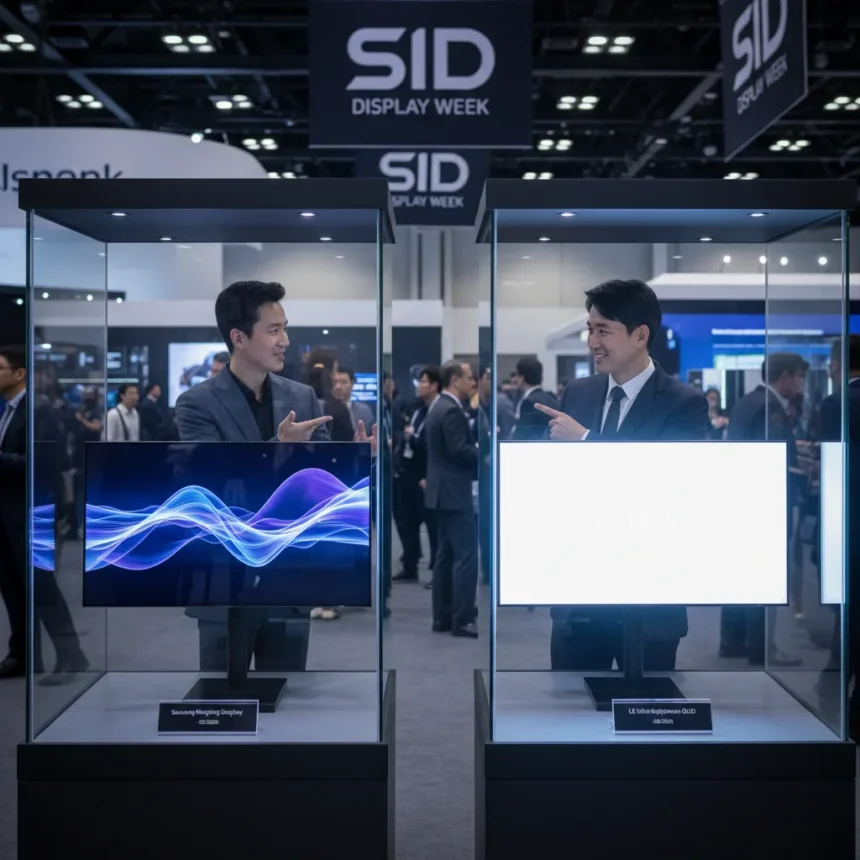
Next-gen OLED display technology is pushing into a new era of performance and application. At SID Display Week 2026, held May 5 to 7 at the Los Angeles Convention Center, Samsung Display and LG Display unveiled competing visions for the future of OLED screens, reigniting one of tech’s most intense rivalries.
Key Takeaways
- LG Display’s 3rd-Gen Tandem OLED achieves 18% better power efficiency and 1,200-nit brightness for automotive use, launching end of 2026.
- LG’s TV panel reaches 4,500-nit peak brightness with 0.3% reflectance, claimed as the lowest among existing displays.
- LG gaming OLEDs hit 720Hz refresh rate (27-inch model won SID Display of the Year) and a world-first 39-inch 5K2K curved panel.
- Samsung showcased morphing automotive OLED screens with foldable and extendable capabilities, positioning against LG’s automotive push.
- Both companies framed their innovations as optimized for AI-era applications and workloads.
LG Display’s Automotive OLED Breakthrough
LG Display’s 3rd-Gen Tandem OLED for automotive represents a significant leap in efficiency and brightness. The technology introduces a deep-blue dopant and optimized electron and hole movement, delivering an 18% improvement in power consumption while boosting brightness to 1,200 nits and extending panel lifetime beyond 15,000 hours. Production begins at the end of 2026, with plans to expand the technology into laptops and tablets afterward. This positioning directly challenges Samsung’s morphing automotive screens, which emphasize form-factor innovation over efficiency gains.
The automotive OLED space has become critical as electric vehicle manufacturers demand displays that balance power draw with visibility in bright sunlight. LG’s efficiency gains address a real pain point: automotive OLED panels consume significant battery power, and an 18% reduction translates to meaningful range improvements for EVs. The 1,200-nit brightness ensures visibility without washing out colors—a balance that morphing screens alone cannot solve.
TV and Gaming OLED Specs Reach New Extremes
LG Display’s TV panel with Primary RGB Tandem 2.0 technology achieves a peak brightness of 4,500 nits with ultra-low reflectance of just 0.3%, claimed as the lowest reflectance among existing displays. This combination addresses two long-standing OLED weaknesses: brightness limitations compared to mini-LED TVs and reflectance issues in bright rooms. Advanced pixel structure and enhanced algorithms enable the extreme brightness without sacrificing color accuracy.



On the gaming side, LG’s 27-inch OLED panel running at 720Hz refresh rate won the SID Display of the Year award, signaling industry recognition of the achievement. The company also unveiled a world-first 39-inch curved OLED panel at 5K2K resolution, a combination that no competitor has publicly demonstrated. A separate 27-inch 5K gaming panel with 220 PPI uses a new RGB stripe structure to increase aperture ratio and reduce color bleeding and fringing—technical refinements that matter to competitive gamers and content creators who scrutinize pixel-level precision.
Samsung’s Morphing Screens Counter LG’s Spec War
While LG focused on brightness, resolution, and efficiency metrics, Samsung Display emphasized form-factor innovation through morphing automotive OLED screens with foldable and extendable capabilities. This represents a different strategic bet: instead of chasing raw brightness numbers, Samsung is betting that flexible, shape-changing displays will differentiate future vehicles. Morphing screens could enable dashboards that expand or collapse based on driver preference, a capability that static panels cannot match regardless of brightness or refresh rate.



The contrast between the two companies’ strategies reflects deeper disagreements about where OLED’s future lies. LG is optimizing for traditional display use cases—automotive, TV, gaming, computing—with incremental but meaningful improvements in power, brightness, and resolution. Samsung is exploring entirely new form factors that may redefine what a vehicle display can do. Neither approach is wrong, but they appeal to different segments of the market.
AI Optimization and the Event’s Broader Significance
Both LG and LG Display framed their innovations under the umbrella of “OLED Evolution for the AI Era,” suggesting that next-gen OLED display technology is being designed with AI workloads and AI-driven applications in mind. While the exact nature of AI optimization for displays remains unclear from the announcements, the messaging signals that manufacturers see AI as a key driver of future display demand—whether through AI-powered image processing, dynamic refresh rate adjustment, or power management.
SID Display Week itself remains the world’s largest display event, where companies present research papers, future technologies, and new products. The 2026 edition’s emphasis on next-gen OLED display technology underscores that OLED has moved beyond a niche premium technology into the mainstream of automotive, gaming, and TV markets. The rivalry between Samsung and LG, which dominated the smartphone OLED space a decade ago, has shifted to larger, more complex applications where power efficiency, brightness, and form-factor flexibility all matter.
What Does This Mean for Consumers?
The technologies unveiled at SID Display Week 2026 will not reach consumer devices immediately. LG’s 3rd-Gen Tandem OLED launches at the end of 2026 in automotive applications, with expansion to laptops and tablets afterward. The gaming panels and TV technologies are closer to commercialization but remain in the showcase phase. What matters now is the direction: both Samsung and LG are investing heavily in OLED for automotive, gaming, and professional displays, signaling confidence that OLED will dominate these categories within the next 2-3 years.



For car buyers, the push toward OLED automotive displays means brighter, more efficient dashboards and infotainment systems are coming. For gamers, 720Hz refresh rates and 5K resolution on OLED panels represent a generational leap in visual fidelity. For TV buyers, the 4,500-nit brightness and near-zero reflectance of LG’s Primary RGB Tandem 2.0 could finally make OLED competitive with mini-LED in bright rooms, removing one of the technology’s last practical disadvantages.
When will LG’s 3rd-Gen Tandem OLED automotive panels launch?
LG Display’s 3rd-Gen Tandem OLED for automotive begins production at the end of 2026. The company plans to expand the technology to laptops and tablets after the initial automotive rollout, though specific launch dates for those applications have not been announced.
How does Samsung’s morphing screen technology compare to LG’s automotive OLED?
Samsung’s morphing automotive OLED screens emphasize flexible, foldable, and extendable form factors that can reshape to suit driver preferences. LG’s 3rd-Gen Tandem OLED prioritizes efficiency gains (18% power reduction) and brightness (1,200 nits) for traditional fixed displays. Both address automotive needs but through different innovations: Samsung on form, LG on performance.
What is the significance of LG’s 0.3% reflectance claim?
LG claims its Primary RGB Tandem 2.0 TV panel achieves 0.3% reflectance, the lowest among existing displays. Reflectance is the amount of light bouncing off the screen surface rather than being absorbed. Ultra-low reflectance allows OLED TVs to perform better in bright rooms, addressing a historical weakness of OLED technology compared to mini-LED alternatives.
The SID Display Week 2026 announcements make clear that next-gen OLED display technology is no longer about proving OLED works—it is about dominating specific high-value markets. Samsung and LG are not competing to sell the most OLED panels overall; they are competing to define what OLED becomes in cars, gaming rigs, and premium TVs. The winner will not be determined by a single breakthrough but by which company’s bet on morphing screens, efficiency, or brightness resonates with manufacturers and consumers over the next three years.
Edited by the All Things Geek team.
Source: Android Central