





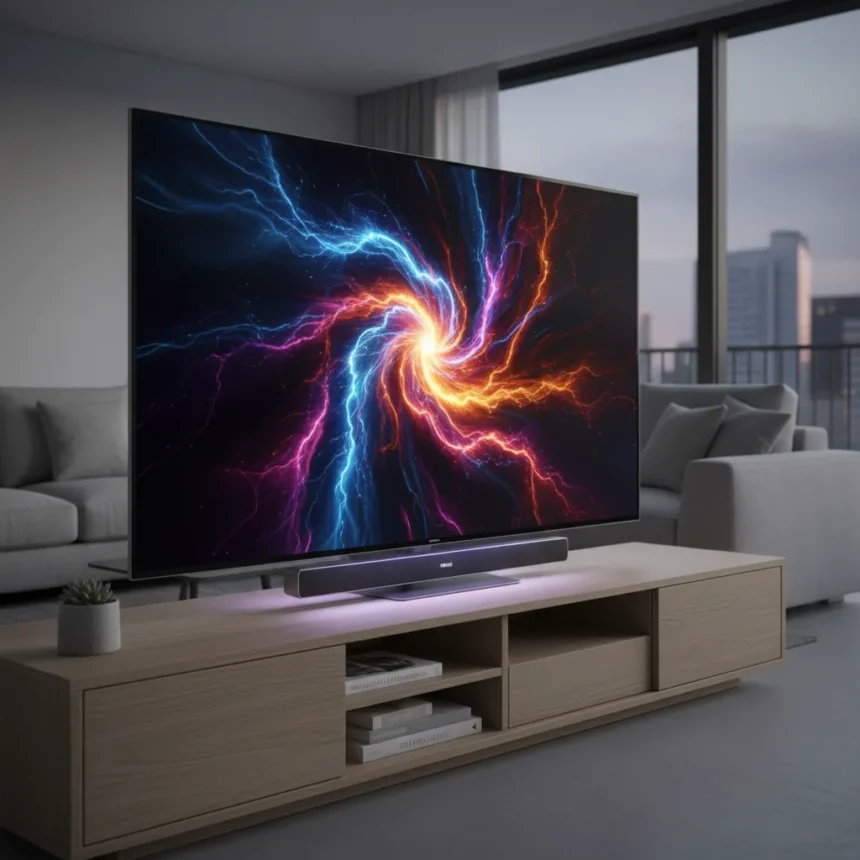
The Philips OLED950 is Philips’ latest flagship OLED TV, positioned as the cheapest flagship OLED television from a mainstream manufacturer available right now. Based on What Hi-Fi?’s first review impressions, the set is off to a strong start, though its ultimate place in the premium OLED market remains to be determined after full testing.
Key Takeaways
- Philips OLED950 promises brighter peak output than the OLED909 predecessor model.
- The TV reportedly fixes a long-standing complaint about Philips OLED color handling that reviewers found too aggressive.
- Priced as the cheapest flagship OLED from a mainstream brand, it undercuts rivals like Panasonic Z95B (£2299).
- Early impressions are positive, but comprehensive testing in dedicated viewing rooms is still pending.
- Competitors include LG G5, Samsung S95F, Panasonic Z95B, and Sony Bravia 8 II.
Philips OLED950 Brightness and Color Improvements
The Philips OLED950 addresses two critical weaknesses that have dogged Philips’ OLED lineup. First, the TV promises higher brightness levels than the OLED909, a direct response to complaints about peak luminance in previous generations. Second, and perhaps more importantly, Philips appears to have moderated what reviewers consistently criticized as the brand’s slightly aggressive color handling. What Hi-Fi? noted that Philips may have tempered some of its more aggressive tendencies, especially around color reproduction, while still maintaining its characteristic bombastic approach to picture processing and tuning.
This balance is crucial. Philips has long pursued a distinct visual signature, but that signature sometimes worked against the TV rather than for it. If the OLED950 truly delivers improved color accuracy without abandoning Philips’ processing strengths, it could differentiate itself in a crowded segment. The question is whether these improvements translate to measurable performance gains once the set enters What Hi-Fi?’s full testing protocol.
Value Positioning Against Premium Rivals
The Philips OLED950 enters a market dominated by established premium players. The Panasonic Z95B, currently priced at £2299, represents the closest direct rival in terms of positioning and feature set. The LG G5, Samsung S95F, and Sony Bravia 8 II round out the high-end OLED competition, each bringing different strengths to the table. What makes the OLED950 notable is that Philips is attacking this segment from a price-conscious angle without positioning itself as a budget alternative.



The Philips OLED910, the OLED950’s cheaper sibling, costs £1999 for the 65-inch model. This pricing context matters: the OLED950 sits above the OLED910 but below the Panasonic Z95B, suggesting Philips has found a strategic gap in the market. Whether that gap is sustainable depends entirely on whether the OLED950 delivers performance that justifies its position relative to more established rivals. Early impressions suggest it could, but early impressions are not final verdicts.
What Hi-Fi?’s First Impressions and Testing Ahead
What Hi-Fi?’s initial assessment is cautiously optimistic. The reviewer noted that the OLED950 has a solid feature set and shows promise based on first-look testing. However, the publication explicitly stated that it wants to see the TV in its dedicated viewing rooms for comprehensive testing before making a final recommendation. This measured approach reflects the reality that OLED TVs reveal their true character only under controlled conditions with calibrated test patterns and extended viewing.



The distinction between first impressions and full testing matters. A TV can look impressive in a showroom or during initial setup, then reveal inconsistencies or processing artifacts during rigorous evaluation. What Hi-Fi? is essentially saying the OLED950 could become a serious contender in the top-end OLED market if it delivers the goods when subjected to full testing. That conditional phrasing is honest journalism, not hedging—it acknowledges that promise and performance are not the same thing.
Philips OLED950 vs. Established OLED Competitors
The OLED950 faces stiff competition from brands with deeper OLED pedigree. LG has dominated OLED TVs for years and continues to refine its approach with the G5. Samsung’s S95F brings QD-OLED technology and the brand’s aggressive processing style. Panasonic’s Z95B, the closest pricing rival, carries the weight of Panasonic’s reputation for calibration accuracy. Sony’s Bravia 8 II offers a more measured, cinema-focused aesthetic.
Philips’ challenge is not just matching these competitors on specs—it is establishing itself as a credible alternative in a segment where brand trust and proven performance matter. The brand’s history with OLED is shorter than LG’s, less proven than Panasonic’s, and less flashy than Samsung’s. What the OLED950 has is aggressive pricing and the promise of improved color handling. Whether that is enough depends on how the full testing shakes out. If Philips has genuinely fixed its color issues while maintaining its processing strengths, it could carve out a meaningful position in the premium OLED market.
Is the Philips OLED950 worth buying right now?
Not yet, based on What Hi-Fi?’s own assessment. The publication made clear it wants to complete full testing before recommending the set. Wait for the comprehensive review before committing to a purchase, especially at flagship pricing.



How does the Philips OLED950 compare to the OLED909?
The OLED950 promises higher brightness and improved color handling compared to its predecessor. Philips has addressed one of reviewers’ biggest complaints about the OLED909—its aggressive color processing—while boosting peak luminance. These are meaningful upgrades if they hold up under full testing.
What is the price of the Philips OLED950?
The exact price was not stated in What Hi-Fi?’s initial review, but the TV is positioned as the cheapest flagship OLED from a mainstream manufacturer. For context, the cheaper OLED910 costs £1999, and the Panasonic Z95B costs £2299, suggesting the OLED950 falls somewhere in that range.
The Philips OLED950 represents an interesting challenge to the premium OLED establishment. If it delivers on its promises of improved brightness and corrected color handling, it could become a serious contender. But early impressions are just that—early. What Hi-Fi?’s full testing will determine whether this value-focused flagship lives up to its potential or becomes another well-intentioned effort that falls short of its rivals.
Where to Buy
Edited by the All Things Geek team.
Source: What Hi-Fi?




